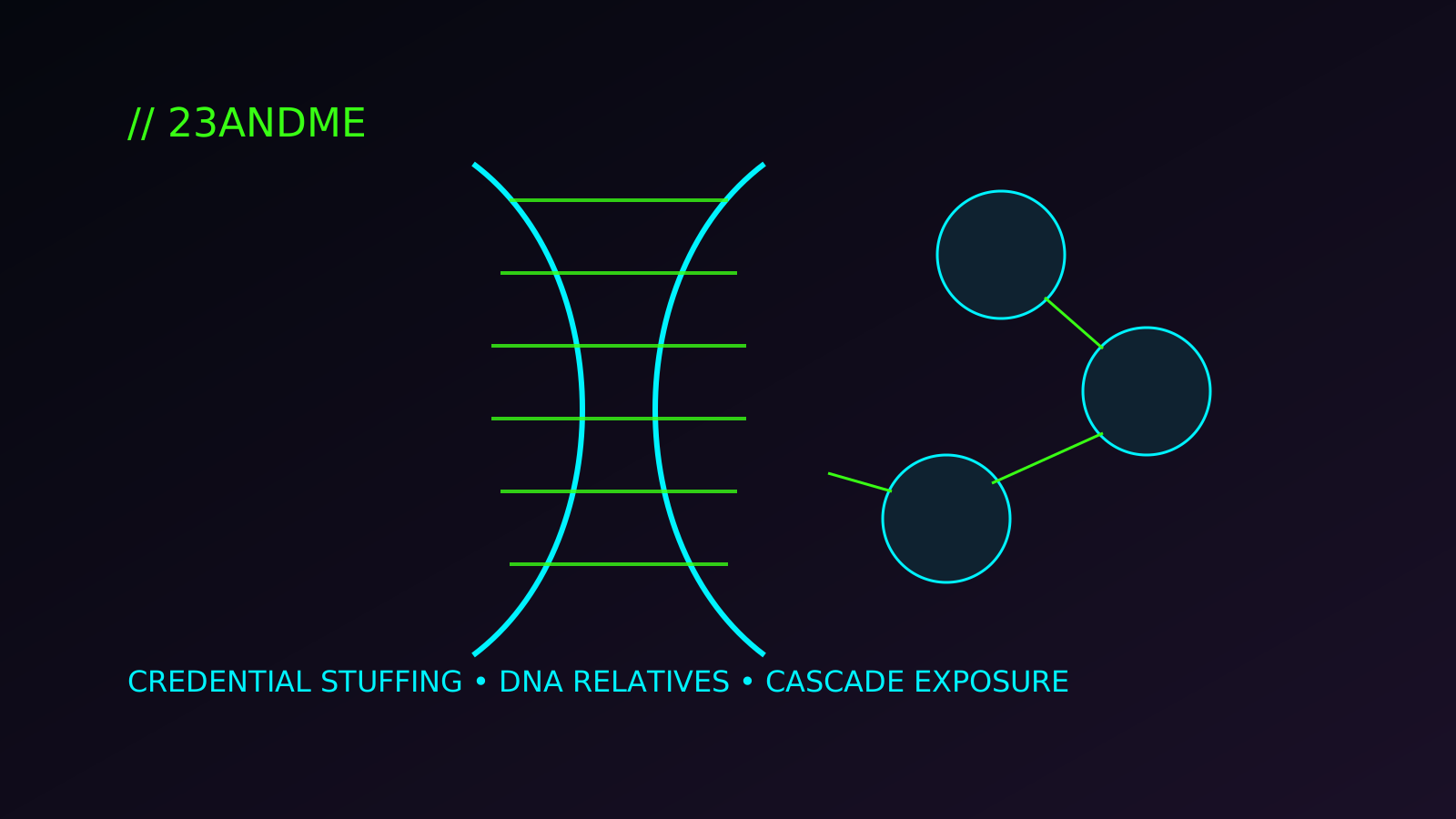
When DNA Became a Target List: The 23andMe Breach
When DNA Became a Target List: The 23andMe Breach
The first intrusion into 23andMe in 2023 was not a zero-day.
It was a familiar failure pattern: stolen usernames and passwords from other breaches, replayed at scale against accounts whose owners had reused credentials.
The breach became historically significant because of what happened next.
From Account Takeover to Networked Exposure
Attackers initially compromised a smaller set of accounts through credential stuffing. But 23andMe’s DNA Relatives feature connected users to genetic matches and profile details across account boundaries.
That relationship graph created a multiplier effect:
- One compromised account could reveal data about many related profiles
- Data exposure propagated through social/genetic linkage, not just direct account compromise
- Blast radius depended on feature design as much as authentication strength
Why Genetic Data Is Different
Unlike a password, DNA is not rotatable.
Even when only profile and ancestry fields are exposed, genetic-platform records carry unique long-term sensitivity:
- Familial linkage
- Ethnicity and ancestry indicators
- Identity attributes that can be used for discrimination, targeting, or extortion narratives
This incident made clear that “account security” and “population privacy” are not separate problems in consumer genomics.
Attack Economics
Credential stuffing remains cheap:
- Breached credential lists are abundant
- Automation lowers per-account attack cost
- Success rates are low per attempt but high in aggregate
When a platform stores high-value data and permits lateral visibility through product features, even a modest takeover rate can produce outsized impact.
Response and Structural Lessons
23andMe moved to stronger authentication requirements after the incident and expanded protections around account access and feature exposure.
The broader lesson extends beyond one company:
Sensitive-data platforms cannot treat strong authentication as optional user preference.
When the underlying data is durable, identity controls must be default-on and resilient to credential reuse behavior seen across the consumer internet.
Attack Chain: 23andMe Credential-Stuffing Breach
graph TD
    A["Credential Harvest\nAttackers use breached\nusername/password sets\nfrom prior leaks"] --> B["Automated Replay\nCredential stuffing against\n23andMe login endpoints\nat scale"]
    B --> C["Account Takeover\nSubset of reused-password\naccounts successfully\ncompromised"]
    C --> D["Feature Amplification\nDNA Relatives and profile\nlinkages expose additional\nconnected-user data"]
    D --> E["Data Packaging\nCompromised and linked\ndataset compiled for sale\nand extortion use"]
    E --> F["Public Disclosure\nIncident acknowledged,\nresponse and notification\nworkflow initiated"]
    F --> G["Control Hardening\nMandatory stronger auth,\naccount protections, and\nfeature-risk reassessment"]

    style A fill:#1a1a2e,color:#e0e0e0
    style B fill:#0d3b66,color:#a9d6ff
    style D fill:#8e44ad,color:#fff
    style E fill:#c0392b,color:#fff
    style G fill:#2c3e50,color:#e0e0e0
// Further Reading & Media
The 23andMe Breach
How credential stuffing against reused passwords exposed genetic-profile data through 23andMe's DNA Relatives feature, turning weak account hygiene into population-scale privacy risk. Use this reference overview as a jumping-off point for deeper reporting, primary-source disclosures, and historical context.
→ View Resource