The Signer Believed a Lie: Bitget and the September Drain
The Signer Believed a Lie: Bitget and the September Drain
The money did not leave because someone walked out with a seed phrase.
On September 25, 2026, between 02:31 and 05:23 UTC+8, transfers moved out of Bitget hot and warm wallets for a little under three hours. SlowMist later put the window at about two hours and fifty-two minutes. The exchange’s own systems treated the orders as withdrawals it was allowed to make. By the time the public number settled, Bitget said roughly $387.5 million had gone to attacker addresses.
The keys, Mandiant and Bitget both said, were not confirmed stolen. The cold wallets were not touched. What failed was the sentence the signer was willing to believe.
That is the part worth sitting with. A cryptocurrency exchange can spend a fortune on key ceremony, hardware isolation, and the theater of a cold wallet, and still lose the hot path if the machine that asks for a signature has already been taught the wrong request. Bitget in September 2026 is that story. The door was not the vault. It was a security product.
What actually moved
The first public figure was smaller, and the revision matters.
Bitget’s early account put the theft at about $351.6 million. On September 25 the company updated the estimate to $387.5 million, after tracing added Zcash and TRON to the first set of chains. Cointelegraph and Bitget both carried that correction. The assets named in the reporting included ETH, XRP, BNB, AVAX, USDT, and USDC. The chains named alongside them were Ethereum, XRP Ledger, Arbitrum, Avalanche, Optimism, BSC, and Base.
All of it, Bitget said, left hot and warm wallets. Not the cold store. That distinction is the whole incident. A hot wallet exists so the exchange can pay customers without a human ceremony every time. A warm wallet is the slightly slower cousin, still online enough to be useful. Both are the working cash drawer. The cold wallet is the safe in the other room. The intruder did not crack the safe. The drawer opened because the clerk had been handed a form that looked filled in.
Withdrawals were stopped. BleepingComputer, describing the first detection, put the halt on Thursday — September 24, the UTC evening that is already September 25 in UTC+8. The security system had seen unauthorized transfers off the hot and warm wallets and the exchange shut the window. The drain had already had its hours.
The guard that opened the door
The uncomfortable sentence arrived with the interim findings, and then again in the first days of October.
Bitget said the intrusion began in third-party security products. Not in the exchange’s own wallet code. Two appliances. BleepingComputer reported the company’s explanation that both had been hit through a zero-day. SlowMist’s account, as carried in the September 30 reporting, is more precise than that headline, and the precision is the story.
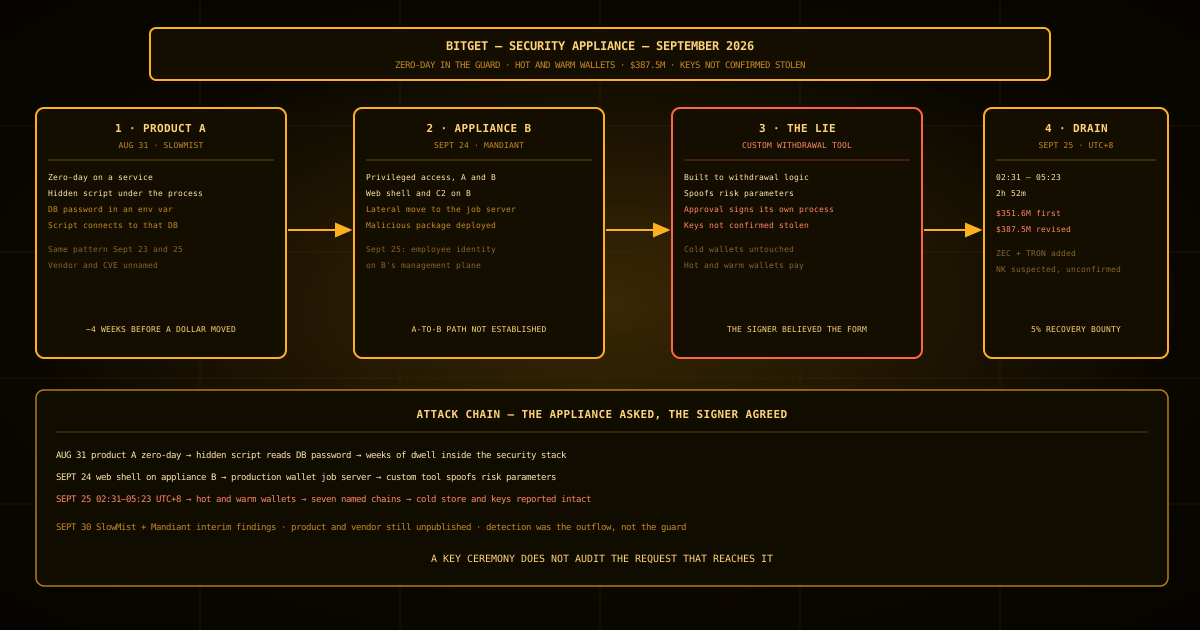
On August 31, the oldest malicious activity in the logs, a service on a node of what investigators called product A was already under a zero-day. A hidden script ran under that service process, read an environment variable that held a database password in clear text, and connected to the database. The same kind of hidden-script activity showed up on another product A node on September 23, and on a third on September 25. The foothold was almost four weeks old before a dollar moved. Bitget’s later write-up of the investigation said the logs had to be walked back about that far. The thing that finally fired was wallet outflow, not the appliance.
September 24 is the day Mandiant places privileged access on both appliances. On appliance B, a web shell, a command-and-control channel, and then a step sideways onto the production wallet job server, where a malicious package was deployed. SlowMist, separately, describes September 25 access to product B’s management platform with an internal employee identity: attempts to inject system commands, change server configuration, and upload a malicious program. The reporting does not establish that product A’s zero-day and product B’s employee-identity access were the same door. Investigators on both teams said the exact path between systems was still open. A diagram that draws a solid arrow from A to B is a guess. The archive should not guess.
What is not a guess is the placement. A security appliance is trusted because it is supposed to watch. It often sits where it can see management networks, hold service credentials, and reach the systems it is paid to protect. Give that box a zero-day, or an employee identity that the management plane will honor, and the defender has built the attacker’s best jump host. Bitget did not publish the product name or the vendor. As of the October 1 confirmation, other customers of whatever that appliance was still could not look themselves up on a CVE list. Bitget said the vulnerability had been fixed. The industry was not told which vulnerability.
That silence is a second incident living inside the first. A named CVE is a bad day and a patch. An unnamed zero-day in a security product is a question every exchange with a similar rack has to answer without the model number.
The signer believed a lie
CEO Gracy Chen described the mechanism in plain language, and the custom tool recovered from the environment matched it.
The intruder, she said, used the vulnerability to obtain high-level internal credentials, reached a critical backend in the wallet infrastructure, spoofed transaction data, and passed it through the exchange’s own approval process. Fake withdrawal orders. The recovered tool was built to the wallet system’s withdrawal logic. It assembled requests with spoofed risk-management parameters and called the withdrawal path.
Read that again without the crypto vocabulary. The attacker did not need to steal the key that signs. The attacker needed the job server that is allowed to ask. Once that server could present a withdrawal the risk engine would accept, Bitget’s authorization did what it was designed to do. It released funds.
This is the cousin of the Bybit theft in February 2025, and it is not the same crime. Bybit was a supply-chain compromise of a signing interface: the transaction the operators approved was not the transaction they thought they were looking at. Bitget is a backend integrity failure: the request arriving at approval had already been dressed as legitimate by a tool sitting on the exchange’s own job server. In both cases the key ceremony was not the control that failed. The control that failed was the belief that whatever reached the signer had earned the right to be there.
SlowMist, via The Crypto Times, also reported attempts to alter withdrawal records and to push additional bitcoin out after the main window. A drain that can edit the ledger of the drain is not finished when the last transfer confirms. It is finished when the record and the chain disagree in public, and someone is still willing to read both.
What the attribution is, and is not
Chen pointed at North Korea. The basis she gave was IP behavior and on-chain analysis, not a government indictment and not a malware family name tied, in the public reporting, to a known bureau. Early headlines said “suspects,” “says,” “accuses.” That is a company’s investigative judgment. It is not a charging document.
The suspicion is not absurd. North Korean operators have spent years treating exchanges as revenue infrastructure — Bangladesh Bank’s SWIFT path, Ronin’s bridge keys, Bybit’s signing interface. A $387.5 million hot-wallet drain sits in that tradition of outcome. It does not, by itself, sit in that tradition of proof. If later reporting assigns a tracked cluster, the archive can move the sentence. In September 2026 the honest line is: the chief executive suspects a state revenue crew; the public record has not yet made that suspicion a finding.
What the public record has made a finding is duller and more useful. A security product held a database password in an environment variable. A service process could read it. A job server that can call withdrawal logic could be reached from an appliance. Approval trusted the shape of the request. Those are design facts. They do not require a flag.
The bounty, and the unnamed box
On September 30, Bitget published the interim SlowMist and Mandiant account and opened a recovery bounty: five percent to partners who froze or recovered funds. The number is an admission that tracing, not a patch, is the rest of the incident. Coins that have already moved are a law-enforcement and a liquidity problem. The appliance they moved through is still, in the open reporting, a blank line where a vendor advisory should be.
That blank line is the hangover. Exchanges that treat hardware custody as the control are defending the asset the attacker did not need. The asset the attacker needed was permission to make the signer agree. For a few hours on September 25, Bitget’s own process agreed.
What a defender can do without the model number
There is no vendor advisory to inventory against. That does not make the incident un-huntable. The behaviors in the SlowMist and Mandiant accounts are ordinary enough to look for on any appliance that can see a money path.
A script running as the child of a service process. A process reading an environment variable that holds a database password. A database session whose source address is the appliance itself. A web shell on a management plane. A new package on a job server that is allowed to call withdrawal logic. An employee identity logging into that management plane at an hour when the employee is not, and then trying to change configuration. None of those require the product name. They require logs that still exist four weeks back, which is the other dull finding in Bitget’s account: the investigation had to walk that far, and a retention policy shorter than the dwell would have made August 31 into a rumor.
The withdrawal path has its own tells, and they are the ones that actually stopped this drain. Outflow that does not match a customer request. Several chains paying out in the same hour. A tool on the job server assembling requests the risk engine has not seen from the user-facing side. Bitget’s detection fired on the money, late. An out-of-band check — the original customer withdrawal beside the batch the job server is asking to sign — would have been a disagreement the signer could have been required to notice. The September incident is evidence that the disagreement was available. It is not evidence that anyone had wired it up as a veto.
Attack Chain: Appliance to Approval — Bitget, September 2026
graph TD
    A["August 31\nOldest log activity\nProduct A node\nZero-day on a service process\nHidden script reads a DB password\nfrom an environment variable"] --> B["September 23–25\nSame hidden-script pattern\non further Product A nodes\nFoothold is weeks old\nbefore any transfer"]
    B --> C["September 24\nMandiant: privileged access\non appliances A and B\nWeb shell and C2 on B\nLateral move to the production\nwallet job server"]
    C --> D["September 25\nSlowMist: employee identity\nused on Product B's\nmanagement plane\nCommand injection, config changes,\nmalicious upload attempted\nPath from A to B not established"]
    D --> E["Custom withdrawal tool\nBuilt to the exchange's\nwithdrawal logic\nSpoofs risk-management parameters\nCalls the approval path"]
    E --> F["02:31–05:23 UTC+8\nAbout 2 hours 52 minutes\nHot and warm wallets pay out\nCold wallets untouched\nPrivate-key theft not confirmed"]
    F --> G["The number\nFirst estimate $351.6 million\nRevised to $387.5 million\nafter Zcash and TRON\nETH, XRP, BNB, AVAX, USDT, USDC\nacross seven named chains"]
    G --> H["September 30\nInterim SlowMist and Mandiant\nfindings published\n5 percent recovery bounty\nProduct and vendor still unnamed"]
    H --> I["What failed\nNot the key ceremony\nThe belief that a request\nfrom the job server\nhad earned the signature"]

    style A fill:#1a1a2e,color:#e0e0e0
    style C fill:#c0392b,color:#fff
    style E fill:#c0392b,color:#fff
    style F fill:#7a1f1f,color:#fff
    style I fill:#1a3a1a,color:#90ee90
// Further Reading & Media
Bitget Security Incident (September 2026)
Bitget's own incident page for the September 2026 wallet drain, including the revised loss figure and the company's account of the intrusion.
→ View ResourceSlowMist traces Bitget hack activity to Aug. 31 zero-day exploit
Report on SlowMist's finding that the earliest malicious activity in the logs dated to August 31, weeks before the September 25 transfers.
→ View ResourceBitget $387.5M Hack: SlowMist and Mandiant Say Zero-Day Attack Began Weeks Before Theft
September 30 account of the interim SlowMist and Mandiant findings Bitget published, including the appliance foothold and the recovery bounty.
→ View ResourceBitget hacked via zero-day in third-party security products
Early October confirmation that Bitget attributed the drain to a zero-day in third-party security products, with product and vendor names still unpublished.
→ View Resource