The Cloud Misconfiguration That Exposed 106 Million: Capital One 2019
The Cloud Misconfiguration That Exposed 106 Million: Capital One 2019
At just after midnight on March 22, 2019, requests began hitting a Capital One cloud endpoint in patterns that looked strange but not extraordinary.
The requests were crafted to exploit Server-Side Request Forgery (SSRF). Instead of asking the target server for public web content, they asked it to fetch internal cloud metadata that should never have been reachable by untrusted input.
The server complied.
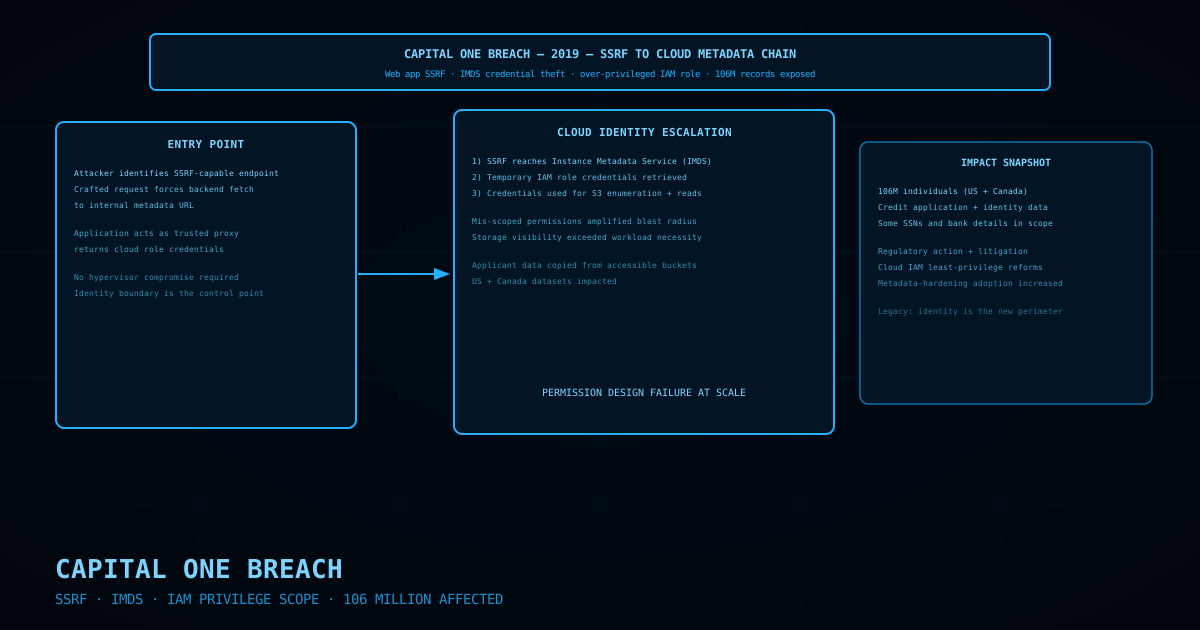
What followed was not a smash-and-grab intrusion. It was a permissions failure at cloud scale: metadata access yielded temporary credentials; those credentials had broad S3 read permissions; those permissions reached sensitive applicant data.
By the time investigators reconstructed the chain, the attacker had accessed data associated with 106 million individuals in the United States and Canada.
The Weak Link: Metadata Service Trust
In AWS environments, the Instance Metadata Service (IMDS) provides temporary credentials to workloads. This is normal and secure when only trusted local processes can query it.
SSRF breaks that assumption.
If an application accepts attacker-controlled URLs and does not constrain outbound requests, an attacker can force the application to query IMDS on its behalf. The application becomes a proxy into infrastructure identity.
In the Capital One case, investigators alleged exactly this path:
- SSRF against a misconfigured web application firewall stack
- Retrieval of IAM role credentials from instance metadata
- Use of those credentials to enumerate and copy data from S3 buckets
The breach was not caused by AWS itself being compromised. It was caused by how permissions were configured inside a customer’s cloud tenancy.
Threat Actor Profile
Actor: Paige Thompson
Background: Former cloud infrastructure engineer
Technique Set: SSRF exploitation, credential harvesting, cloud object storage enumeration
Attribution: Strong forensic and operational attribution through logs, account traces, and public disclosures
Investigators later described a blend of technical exploitation and poor operational security by the attacker, including evidence left in channels that aided law enforcement identification.
What Was Exposed
Capital One stated that no credit card account numbers or login credentials were exposed. But the dataset was still severe:
- Credit application data
- Names, addresses, phone numbers, and email addresses
- Dates of birth
- Self-reported income
- Credit scores and limits
- For some customers, Social Security numbers and bank account details
The affected population scale placed the event among the largest publicly disclosed US financial-sector breaches.
Why This Incident Changed Cloud Security Conversations
Capital One was one of the earliest high-visibility cases that forced executives and boards to understand a hard truth:
cloud security incidents are often identity incidents.
Traditional perimeter thinking asks, “Did the attacker get inside?”
Cloud-native security asks, “What can this role do if any one workload is coerced?”
The difference is existential. In a cloud account, overly broad read permissions turn one vulnerable endpoint into a lateral visibility platform across storage and data services.
Regulatory and Legal Aftermath
The breach triggered regulatory action, class litigation, and significant spending on remediation and controls. But the larger impact was architectural: the industry accelerated adoption of least-privilege IAM design, metadata hardening, segmentation of storage policies, and anomaly detection on object-store access patterns.
Cloud security teams also began treating SSRF to metadata as a priority attack flow, not an edge case.
Legacy: Permission Is the New Perimeter
The Capital One breach is now taught in cloud security programs for one reason:
It demonstrates that a single web-layer weakness can become a data-layer catastrophe when identity boundaries are too broad.
No hypervisor escape. No kernel zero-day. No nation-state implant.
Just one request path, one metadata endpoint, and one role that could read too much.
That is modern breach math.
Attack Chain: Capital One Cloud Breach (2019)
graph TD
    A["Initial Access\nAttacker identifies vulnerable\ncloud-hosted web component\nwith SSRF path"] --> B["SSRF Execution\nCrafted request forces server\nto fetch internal resource\ninstead of external content"]
    B --> C["Metadata Query\nServer is coerced to call\nAWS Instance Metadata Service\n(IMDS) endpoint"]
    C --> D["Credential Exposure\nTemporary IAM role creds\nreturned by metadata service\nare captured by attacker"]
    D --> E["Privilege Abuse\nUse role credentials to list\nS3 buckets and objects\nacross accessible scope"]
    E --> F["Data Exfiltration\nCopy applicant datasets\nfrom mis-scoped buckets\n(US + Canada populations)"]
    F --> G["Detection + Disclosure\nAnomalies reported\nincident response triggered\npublic disclosure follows"]
    G --> H["Aftermath\n106M affected\nregulatory actions\nleast-privilege IAM reforms"]

    style A fill:#1a1a2e,color:#e0e0e0
    style C fill:#0d3b66,color:#a9d6ff
    style D fill:#c0392b,color:#fff
    style F fill:#8e44ad,color:#fff
    style H fill:#2c3e50,color:#e0e0e0
// Further Reading & Media
Capital One 2019
How a single SSRF path in a cloud-hosted web application and an over-privileged IAM role gave an attacker access to one of the largest financial data exposures in US history — proving that in cloud security, permission design is often more dangerous than perimeter failure. Use this reference overview as a jumping-off point for deeper reporting, primary-source disclosures, and historical context.
→ View Resource