The Scanner That Turned Inward: Cisco and the ShinyHunters CI Breach
The Scanner That Turned Inward: Cisco and the ShinyHunters CI Breach
On April 3, 2026, Cisco’s security teams are staring at a problem that feels backward.
The company has not lost control of a router fleet. There is no worm racing across customer networks. No ransomware note is blinking on executive laptops. Production systems are still up. Engineers are still committing code. Pipelines are still running.
But somewhere inside that normality, something foundational has broken.
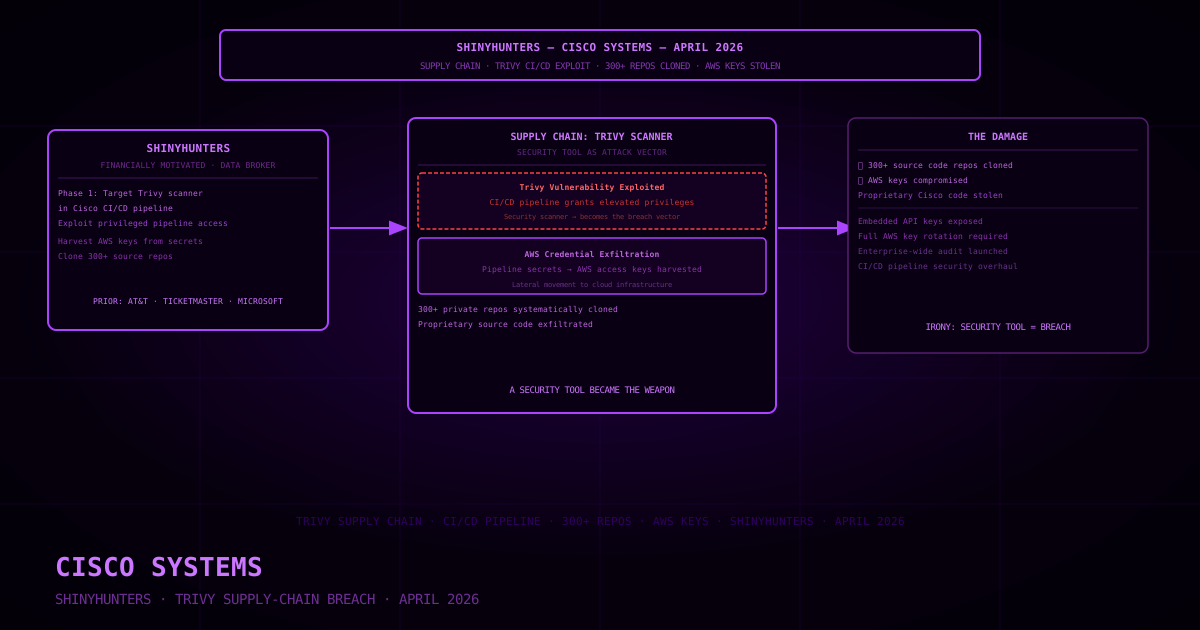
More than 300 Cisco source code repositories have been cloned by an adversary. AWS cloud access keys tied to the company’s build environment have been exfiltrated. And the point of entry, according to reporting that begins circulating that day, is not an old VPN concentrator, a phishing lure, or an exposed admin panel.
It is Trivy.
That detail is what makes the case stick in the memory. Trivy is not obscure software buried in some forgotten corner of the enterprise. It is an open-source security scanner used across the cloud-native world to inspect container images, filesystems, dependencies, Kubernetes manifests, and infrastructure-as-code for vulnerabilities and misconfigurations. It is the sort of tool organizations insert into CI/CD precisely so attackers cannot move unsafe code, leaky dependencies, or broken infrastructure definitions toward production unnoticed.
At Cisco, that defensive checkpoint became the intrusion path.
The irony is almost too neat. A security scanning tool — software meant to look for risk before software ships — becomes the thing through which risk enters the software supply chain itself. A gatekeeper turns into a breach channel. A safety mechanism becomes an access broker.
And because it happens in CI/CD, the compromise is immediately larger than a single server or a single engineer’s laptop. Build systems are where modern organizations concentrate trust. They see everything before release: proprietary source, deployment logic, secrets, signing workflows, cloud credentials, artifact paths, infrastructure templates, internal service relationships. If you want to understand how a company actually works, you do not start with the website. You start with the pipeline.
That is where ShinyHunters went.
What Cisco Was Actually Protecting
To understand the severity of the Cisco breach, you have to understand what a company like Cisco stores inside its engineering systems.
Cisco is not a startup with a single product and a tidy Git tree. It is one of the companies whose software and hardware sit underneath the modern enterprise: networking gear, security products, collaboration platforms, cloud management tools, identity systems, embedded operating environments, deployment frameworks, internal automation, partner integrations. Even when the public imagines Cisco primarily as a hardware company, the internal reality is code — a great deal of it — spread across product lines, business units, platform teams, test harnesses, release tooling, documentation generators, build orchestration, and infrastructure definitions.
In other words: a breach of Cisco’s source repositories is not just an intellectual property story.
It is an operational map theft.
Source code repositories tell an adversary how products are designed, what libraries are trusted, which services call which other services, where legacy dependencies still live, what naming conventions internal teams use, how releases are packaged, how tests are skipped, how debug modes are enabled, how engineers think, and what assumptions they have baked into their systems over years. A cloned repository often contains far more than the code currently deployed:
- Historical commits
- Branches and abandoned features
- Old secrets accidentally committed and later “removed”
- CI job definitions
- Infrastructure manifests
- Internal endpoints and service names
- Build scripts that reveal trust boundaries
The phrase “300+ repositories cloned” sounds, on first reading, like a line item. It is not. It is a census of exposed institutional memory.
That is why the exfiltration of AWS keys matters just as much as the code theft. Source code tells you how the company works. Cloud credentials tell you where the doors are right now.
Threat Actor Profile: ShinyHunters
Designation: ShinyHunters; a financially motivated cybercriminal brand associated with data theft, cloud abuse, access monetization, and extortion
Attribution: Criminal group; no public state attribution attached to this campaign
Origin: Loosely organized, transnational online collective active since at least 2020; membership and structure have shifted over time, but the name has remained durable in underground markets and breach reporting
Primary Mission: Monetization — stealing data, source code, credentials, and platform access that can be sold, extorted over, or used for downstream compromise
Known Tradecraft: Credential theft, SaaS and cloud token abuse, exploitation of trusted service relationships, aggressive exfiltration, opportunistic monetization, public breach branding, resale of high-value data sets
Notorious Operations:
- Microsoft GitHub Repositories (2020): ShinyHunters became globally recognizable after being linked to the theft and attempted sale of private Microsoft source code repositories, demonstrating early interest not just in user records but in developer infrastructure and proprietary engineering assets.
- Tokopedia (2020): More than 90 million user records from Indonesia’s largest marketplace were advertised for sale, showing the group’s willingness to monetize consumer data at massive scale.
- Wattpad (2020): Another large credential and user-data exposure tied to the same brand, reinforcing a pattern: breach at volume, advertise loudly, convert publicity into leverage.
- AT&T Data Breach (2024): The group was widely associated with the commercialization and pressure tactics surrounding the exposure of major telecommunications customer data.
- Ticketmaster / Live Nation (2024): Publicly claimed and widely reported under the ShinyHunters banner, this incident helped cement the group’s reputation as one of the defining criminal brands of the mid-2020s.
What makes ShinyHunters distinct is not subtlety in the nation-state sense. This is not an espionage crew built around silent, ten-year access and perfect deniability. ShinyHunters is better understood as an industrialized theft-and-pressure operation for the cloud era.
Their reputation was built on user databases, developer platforms, and monetizable access. They understand that the most valuable thing in a modern enterprise is often not the perimeter system itself, but the trusted platform sitting behind it: identity, cloud control planes, customer data stores, code repositories, CI/CD, SaaS admin panels. They go where access compounds.
That history matters here. Cisco in April 2026 is not just another logo on a victim page. It is a sign that financially motivated crews are continuing to move up the stack — away from smashing endpoints and toward compromising the automation layers that coordinate entire businesses.
The Irony: A Security Scanner as the Attack Surface
The Cisco story becomes memorable because of the tool involved, but the real lesson is about placement.
Trivy sits in one of the most privileged positions in a modern software pipeline.
Organizations use it because it is flexible. Trivy can scan:
- Container images before release
- Source trees for dependency issues
- Filesystem contents in build environments
- Kubernetes manifests for insecure settings
- Terraform and other IaC for cloud misconfigurations
- SBOM-related artifacts that describe what is inside a build
That flexibility is useful. It is also dangerous.
A scanner cannot inspect what it cannot see. So pipeline teams routinely give scanners broad read access to the working directory, build artifacts, dependency metadata, package caches, image layers, and whatever temporary credentials are needed to retrieve or publish those things. In a mature environment, many of those credentials are short-lived. In the real world, many are not. And even short-lived credentials can be catastrophic if they are scoped broadly enough.
The security scanner therefore occupies an awkward category: it is defensive software with offensive visibility.
That is the paradox. The more useful a scanner becomes, the more sensitive the context it has to inhabit. It must be close enough to production logic to understand what is shipping. It must be early enough in the build to inspect source and dependencies. It must be trusted enough that engineers don’t treat every invocation as suspicious. It often runs automatically, invisibly, and repeatedly.
If an attacker finds a way to exploit that scanner — or the way the scanner is integrated — they do not have to invent a new privilege model. The privilege model has already been built for them by the defender.
That is what makes the Cisco case so clean as a supply-chain lesson. The vulnerability mattered because the scanner sat inside the trust boundary, not outside it.
Why Trivy Had the Keys
Public reporting on the breach centers on a hard core of facts: ShinyHunters exploited a vulnerability in Trivy in Cisco’s CI/CD pipelines, AWS access keys were exfiltrated, and 300+ repositories were cloned. The exact implementation details of the Trivy weakness were less important to defenders than the architecture it exposed.
Because in CI/CD, architecture is destiny.
Consider what a scanning job inside a large enterprise typically touches during one run:
- It receives a checked-out copy of the code or a built image layer.
- It reads dependency manifests, lockfiles, and artifact metadata.
- It may authenticate to cloud services to pull base images or upload scan results.
- It may query internal package mirrors, container registries, or result dashboards.
- It often writes logs rich with filenames, paths, environment variables, and system context.
Every one of those steps is mundane. None of them look like a breach. Together they form a high-value execution environment.
Once ShinyHunters found a way to abuse the Trivy step, the scan stage stopped being a detector and started being a harvesting position.
That matters because AWS keys in CI/CD are rarely there by accident. They are there because pipelines need to do real work. Build systems upload artifacts to object storage. They retrieve base images. They publish software bills of materials. They push metadata. They talk to deployment infrastructure. They cache dependencies. They trigger follow-on jobs. A single set of cloud credentials, even if it is not nominally “admin,” can still reveal:
- Artifact buckets and build outputs
- Audit logs and metadata stores
- Container registry contents
- Cross-account trust assumptions
- Temporary session brokers
- Internal network topology encoded in naming and policy
And once you understand a build environment, you no longer need the breach to remain elegant. You only need it to remain useful.
ShinyHunters is a criminal group, not a research lab. Its success does not depend on maintaining a beautiful exploit chain admired by reverse engineers. It depends on getting to assets that can be converted into money, leverage, or follow-on access. AWS keys and source code repositories are exactly that kind of asset.
From Trivy to AWS Keys
There is a reason defenders dread breaches that begin in CI/CD: the first secrets stolen are often the secrets that explain where all the other secrets live.
In the Cisco intrusion, the exfiltration of AWS cloud access keys appears to have been the first major inflection point.
Cloud keys taken from a pipeline are valuable for two different reasons.
The first is obvious: they can grant direct access to cloud resources. Even if permissions are limited, they may allow an attacker to enumerate buckets, retrieve artifacts, inspect logs, or query infrastructure metadata. That alone can reveal a huge amount about an organization’s internal environment.
The second reason is subtler and often more important: cloud identities are relationship maps. Their policies reveal what the build system is allowed to touch. Their usage trails reveal which resources matter. Their names reveal which teams and products exist. Their logs reveal how automation is chained together. A stolen key is not just a credential; it is a lens into architecture.
Once those keys were exposed, Cisco’s problem expanded from a scanner exploit to a trust collapse.
Security teams facing this kind of incident must assume multiple things at once:
- The keys themselves may have been used directly
- Their surrounding logs may have revealed additional systems
- Any service tokens reachable from the same jobs may also be suspect
- Build outputs produced during the exposure window may require review
- Repository access mediated by automation may have been abused
This is where the exfiltration of 300+ repositories becomes easier to understand. Attackers do not necessarily need to compromise each repository individually through bespoke tricks if the pipeline already possesses the integrations to touch them at scale. CI/CD systems are, by design, automation hubs. They connect code hosts, artifact stores, cloud services, policy engines, and deployment frameworks into one machine. Compromise that machine and the distinction between “cloud access” and “source code access” starts to dissolve.
In practical terms, once a build environment is abused, an attacker can often leverage the same trusted paths Cisco’s own automation uses:
- Repository mirrors
- Build service accounts
- Tokenized checkouts
- Artifact synchronization workflows
- Metadata systems that know where code lives
The result is not a smash-and-grab in the classic sense. It is a bureaucratic breach. The attacker inherits paperwork, permissions, and process.
That is what modern compromise looks like at scale.
300 Repositories Is Not a Round Number. It Is a Map.
When the public reads that 300+ Cisco repositories were cloned, the natural reaction is to visualize source files disappearing into an archive. That is true, but incomplete.
A repository clone is a much richer theft than a document download.
A modern Git repository often contains:
- Full commit history
- Branch names that describe projects and planned releases
- Tags that correspond to internal milestones
- Pull request merge traces
- CI configuration
- Test fixtures
- Infrastructure definitions
- Dependency changes over time
And critically, Git history is full of things organizations believe they have deleted.
A password removed in 2024 may still exist in an old commit. A deprecated internal hostname may still appear in a migration script. A one-off debug token may survive inside test data. A service integration abandoned months ago may still be visible in workflow files. Security teams conducting post-incident audit work know this grim truth well: the past remains accessible to anyone who clones the repository deeply enough.
So the repository count matters not only because of intellectual property exposure, but because it multiplies the probability that the stolen corpus contains:
- Reusable secrets
- Architectural weak points
- Product roadmaps
- Customer-specific integrations
- Hardening gaps visible only in configuration
- Hidden assumptions future attackers can operationalize
This is why Cisco’s required response included not just cloud key rotation but repo-by-repo audit.
An audit after source exfiltration is not a ceremonial exercise. It means investigators have to ask, over and over:
- Did this repository contain secrets in current or historical commits?
- Did it describe internal infrastructure that now needs renaming or segmentation?
- Did it include signing, release, or deployment logic that can no longer be trusted as private?
- Did the attacker merely read it, or is there any evidence of tampering?
- Which engineers, products, customers, or partners need to know?
Multiply those questions by more than 300 repositories and the scale of the operational burden becomes clear. The theft is immediate. The cleanup is administrative, forensic, and slow.
This is one of the least glamorous truths in cybersecurity: the most expensive part of a breach is often not the intrusion. It is the obligation to restore trust across systems that were designed on the assumption that trust already existed.
Discovery and Response
Cisco’s public burden on April 3, 2026 is not only to contain an intrusion. It is to answer a much harder question:
What exactly can no longer be trusted?
That is the question every build-system incident creates. Once the pipeline is implicated, the blast radius is never just the initial access vector. It is:
- Any credentials exposed to affected jobs
- Any artifacts built during the exposure window
- Any repositories reachable through the same automation
- Any logs or metadata that could have amplified attacker knowledge
- Any downstream environments connected by trust to the compromised stage
In the Cisco case, the first emergency move is the obvious one: rotate all AWS keys associated with the compromised environment.
That instruction is concise. The work it represents is not.
Rotating keys in a global engineering organization means identifying every human and non-human identity the affected workflows relied on, determining which ones were exposed directly versus indirectly, replacing them without breaking production build pipelines, updating dependent systems, verifying that no stale credentials remain cached anywhere, and then watching for attacker reuse attempts after the cutover. In a mature cloud environment, credentials are not isolated objects. They are dependencies.
The second major task is the audit of compromised repositories.
This is where incident response becomes archaeology. Investigators have to determine what was cloned, what was inside it, whether any of it included recoverable secrets or partner-sensitive material, whether any code-signing, packaging, or release procedures were documented there, and whether the mere exposure of that information changes the risk posture of downstream systems. Some repositories will be mundane. Some will not. Incident responders do not get to choose which is which before looking.
The third task is establishing whether the attacker’s access was read-only exfiltration or whether anything in the build chain could have been altered. Public reporting emphasized the theft of keys and source code, but for defenders the nightmare scenario in any CI/CD breach is always the same: if the attacker could read, could they also write? If they could write, even briefly, was anything shipped, signed, or promoted during that window? A source-code theft is severe. A source-code theft combined with release-path tampering becomes an ecosystem event.
That is why organizations treat build environment compromise as a near-worst-case scenario even when no customer exploitation is yet proven. The pipeline is where software becomes real. Anything that touches that layer touches future trust, not just past secrecy.
And then there is the final response burden: narrative control.
Cisco is not just any victim. It is a security vendor, a networking giant, and a company whose customers include enterprises that buy Cisco products partly because they assume Cisco understands infrastructure risk at a very high level. When an attacker enters through a security scanner inside Cisco’s own CI/CD, the incident carries symbolic force beyond the technical facts. It invites an uncomfortable but fair question from every customer in the market:
If the scanner can be turned against Cisco, what exactly are the rest of us supposed to trust?
Why This Attack Worked
The most useful way to think about the Cisco breach is not as a Trivy story, or even as a ShinyHunters story. It is a permission concentration story.
Modern engineering organizations solved software velocity by concentrating privileges inside automation:
- Pipelines can pull code from everywhere
- Pipelines can publish artifacts everywhere
- Pipelines can talk to cloud accounts
- Pipelines can run scanners, tests, signers, and deployers
- Pipelines can move faster than any human change board ever could
That velocity is real. So is the risk. Every tool inserted into the pipeline inherits some slice of that privilege concentration. A vulnerability in one component can therefore become a shortcut past controls that would have stopped the same attacker everywhere else.
Security teams often talk about “shifting left” — moving security checks earlier in the development lifecycle. The Cisco incident demonstrates the shadow side of that philosophy. When you shift security left, you also shift security tooling closer to the raw materials of software creation: source code, build secrets, dependency graphs, cloud credentials, release automation. If those tools are not isolated with extraordinary care, they become some of the most valuable exploitation targets in the company.
That is the irony at the heart of April 2026. Cisco inserted a scanner to reduce supply-chain risk. The scanner, sitting deep inside the build trust boundary, became the supply-chain risk.
Legacy: The New Criminal Interest in Developer Infrastructure
It would be easy to read the Cisco breach as a one-off irony and move on. That would be a mistake.
The broader pattern is that developer infrastructure is becoming prime criminal territory.
For years, discussions of software supply-chain compromise were dominated by nation-state exemplars: SolarWinds, XZ Utils, highly resourced operations built around strategic access and geopolitical advantage. The Cisco/ShinyHunters case illustrates something slightly different and, in its own way, more destabilizing: ordinary criminal groups now see the software pipeline itself as a monetizable target.
That shift matters.
When financially motivated crews target CI/CD, they are not necessarily looking for elegant persistence or geopolitical intelligence. They are looking for assets that can be turned into leverage fast:
- Cloud credentials
- Proprietary code
- Customer or partner trust
- Extortion opportunities
- Resale value in underground markets
- Footholds into downstream environments
ShinyHunters did not need to defeat every layer of Cisco’s security architecture one by one. They needed one strategically placed weakness inside a trusted tool and the ability to cash out what that weakness revealed.
And that, more than any single indicator of compromise, is the enduring lesson of the breach.
Security tools are part of the attack surface now.
Not metaphorically. Not academically. Operationally.
Every scanner, linter, SBOM generator, artifact signer, dependency auditor, and policy engine embedded into CI/CD should now be understood as software that runs with meaningful privilege against high-value assets. Organizations that once asked, “Does this tool improve our security posture?” have to ask a second question that is at least as important:
What happens if this tool fails inside the trust boundary?
Cisco’s answer in April 2026 was expensive and public: rotate the keys, audit the code, re-evaluate the pipeline, and explain how a product designed to catch risk became the risk itself.
The companies paying attention did not need ShinyHunters to target them next to understand the warning.
The build pipeline is no longer just where software is assembled.
It is where trust is warehoused.
And once attackers learn how to steal from the warehouse, they do not need to break the front door anymore.
Attack Chain: Cisco / ShinyHunters — Trivy CI/CD Compromise
graph TD
    A["Target Selection\nCisco CI/CD environment trusted by\nhundreds of internal repositories\nand cloud-connected build workflows"] --> B["Trusted Security Layer\nTrivy embedded in pipeline to scan\ncontainers, filesystems, and IaC\nbefore promotion or release"]
    B --> C["Exploit Trivy Vulnerability\nShinyHunters abuses weakness inside\nscan stage running within Cisco's\ntrusted build environment"]
    C --> D["Pipeline Foothold\nAttacker gains access to job context:\nsource checkout, logs, artifacts,\nand environment-level secrets"]
    D --> E["Credential Theft\nAWS cloud access keys exfiltrated\nfrom CI/CD execution context"]
    E --> F["Cloud Enumeration\nStolen keys reveal build relationships,\nartifact paths, automation roles,\nand additional trust boundaries"]
    F --> G["Repository Access Abuse\nSame pipeline trust paths leveraged to\nclone 300+ Cisco source code repositories"]
    G --> H["Mass Exfiltration\nProprietary code, history, configs,\nand potentially sensitive commit-era\nartifacts leave Cisco control"]
    H --> I["Incident Discovery\nSuspicious pipeline/cloud activity\nprompts investigation and scope review\nreported April 3, 2026"]
    I --> J["Emergency Response\nCisco rotates all AWS keys,\naudits compromised repositories,\nand reassesses CI/CD trust model"]
    J --> K["Legacy\nSecurity tooling inside CI/CD\nrecognized as privileged attack surface\nfor financially motivated crews"]

    style A fill:#1a1a2e,color:#e0e0e0
    style C fill:#c0392b,color:#fff
    style E fill:#c0392b,color:#fff
    style G fill:#8e44ad,color:#fff
    style H fill:#8e44ad,color:#fff
    style J fill:#2c3e50,color:#e0e0e0
    style K fill:#2c3e50,color:#e0e0e0
// Further Reading & Media
How a Vulnerability Scanner Opened Cisco's Build Perimeter
A technical reconstruction of how security scanners inherit privileged access inside modern CI/CD, why Trivy became the perfect target, and how AWS key exposure turned a build-stage foothold into mass source-code theft.
→ View ResourceBuilds, Breaches, and Broken Trust: The Cisco/ShinyHunters Story
A long-form discussion tracing the Cisco intrusion from a trusted open-source scanner to stolen AWS credentials, cloned repositories, and the operational grind of re-securing a global software delivery pipeline.
→ View Resource