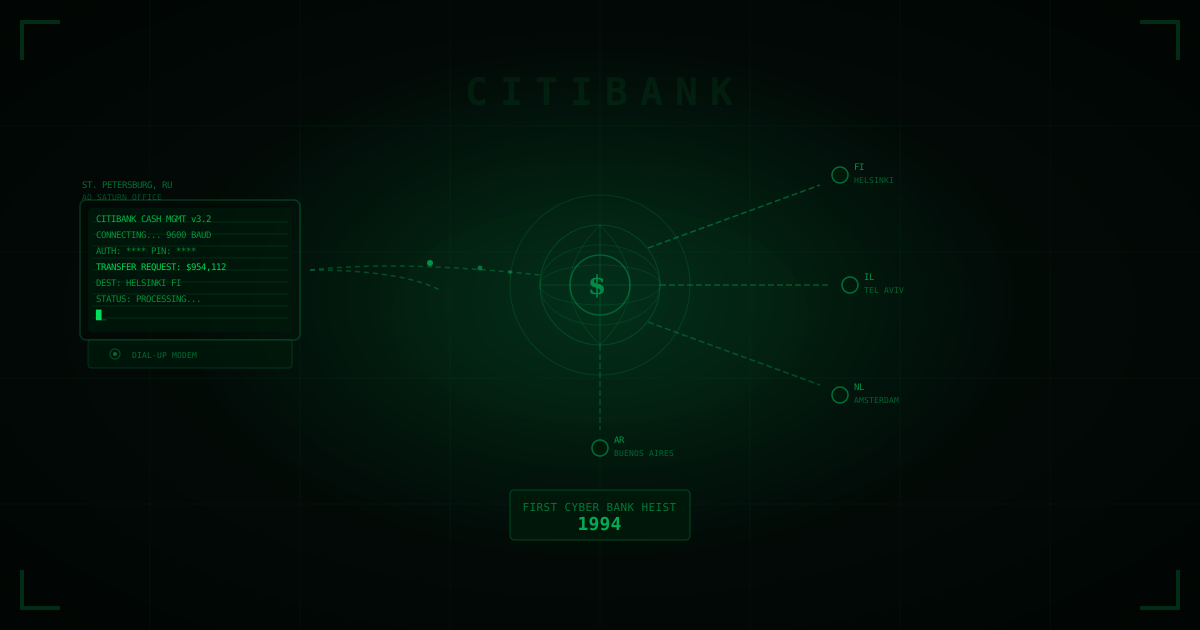
The First Great Bank Heist: Citibank 1994
Citibank: The First Great Bank Heist
It is the summer of 1994. The World Wide Web is barely a year old. Most Americans have never sent an email. The term “cybercrime” does not yet exist in common use.
In a cramped office on the outskirts of St. Petersburg, Russia, a soft-spoken mathematician named Vladimir Levin is sitting in front of a UNIX terminal, listening to the squeal of a modem connecting through an international telephone line.
On the other end: Citibank’s Cash Management System — a private dial-up network allowing corporate clients to initiate international wire transfers authenticated by nothing more than an account number and a PIN.
Levin types a few commands. He has a customer’s credentials. He initiates a transfer. Somewhere across the Atlantic, $954,000 moves to an account in Helsinki, Finland. Nobody at Citibank notices.
He does it again. Over the following weeks and months, Levin would initiate more than 40 fraudulent wire transfers totaling $10.7 million, routing funds across Finland, Israel, the Netherlands, Germany, the United States, Argentina, Indonesia, and Switzerland.
It was the world’s first major cyber bank heist — pulled off not with exotic zero-days or nation-state infrastructure, but with a modem, stolen credentials, and a banking system that trusted anyone who knew the right numbers.
Threat Actor Profile: Vladimir Levin
Designation: Vladimir Levin; no known hacker handle
Attribution: Independent criminal actor; small network of “mule” accomplices in at least six countries
Origin: St. Petersburg, Russia; employee of AO Saturn, a small computer sales and repair company
Primary Mission: Financial fraud through unauthorized wire transfers from Citibank corporate accounts
Known Tradecraft: Credential theft (via social engineering or purchase), exploitation of plaintext authentication in dial-up banking systems, international money mule networks
Notorious Operations:
- Citibank Wire Fraud (June–October 1994): 40+ fraudulent wire transfer requests totaling $10.7 million routed to accounts across eight countries. The first major cyber-enabled bank robbery in recorded history. Levin was arrested at Heathrow Airport in March 1995, extradited to the United States in 1997, and sentenced to three years in federal prison in 1998.
Levin was a mathematician from St. Petersburg Technical University, employed at a modest computer company called AO Saturn. In 1994, with the Soviet Union three years collapsed and the economy in chaos, technical talent vastly outpaced legitimate employment. At some point that year, Levin came into possession of something extraordinarily valuable: the account credentials of dozens of Citibank corporate clients.
Exactly how remains disputed. The FBI’s working theory was social engineering — calling clients or Citibank staff posing as technical support, eliciting PINs over the phone. A competing theory held that Levin had purchased credentials from a group of Russian hackers who had previously breached Citibank but lacked the international connections to monetize the access. The full truth was never definitively established in court.
The System: Citibank’s Cash Management Network
To understand the heist, you need to understand how corporate wire transfers worked in 1994.
Citibank had built the Cash Management System (CMS), accessed via a proprietary dial-up network called FNET (Financial Network). Corporate treasurers could initiate international wire transfers from their own UNIX terminals — remarkable for the era, giving major clients direct access to global financial infrastructure without setting foot in a branch.
The authentication system, however, was primitive. Customers authenticated using an account number and a PIN — static credentials transmitted in plaintext, with no second factor, no hardware token, no time-based verification. Once authenticated, the system placed complete trust in whoever was on the other end. If you had the right credentials, you were the authorized customer.
The system had been designed assuming corporations would be the only entities ever holding their own credentials. In a world before credential markets and organized cybercrime, this had seemed reasonable. Vladimir Levin proved it wasn’t.
The Attack: 40 Wire Transfers Over Four Months
Working from AO Saturn in St. Petersburg with a standard UNIX workstation and a dial-up modem, Levin initiated transfers incrementally — spread over approximately four months from June through October 1994, with amounts ranging from tens of thousands to low seven figures.
The destination accounts spanned eight countries, controlled by a network of accomplices — local “mules” who would receive the funds, withdraw cash, and transmit it onward through Finland, Israel, Netherlands, Germany, the US, Argentina, Indonesia, and Switzerland. Total across all transfers: $10.7 million.
What is striking in retrospect is the audacity combined with patience. Levin ran a sustained criminal enterprise for months from a computer in Russia, against one of the most powerful financial institutions in the world, at a time when law enforcement had almost no framework for investigating such crimes.
The Detection: When Citibank Noticed the Pattern
Transaction monitoring systems flagged anomalies in mid-1994 — transfers to unfamiliar accounts in unusual destination countries, initiated from connection points that didn’t match clients’ known access patterns.
Citibank did not immediately alert the FBI. Instead, the bank took a calculated approach: cooperating quietly with investigators while allowing some fraudulent activity to continue, building evidence and tracing the network. If the compromised accounts had simply been shut down, Levin and his accomplices would have vanished.
Working with the FBI’s financial crimes unit and international law enforcement partners across the destination countries, Citibank assembled an unprecedented cross-border dragnet. Mule accounts were monitored. Accomplice identities were established. By late 1994, enough evidence existed to move.
The Arrests: Heathrow Airport, March 1995
The accomplices fell first. Through late 1994 and into 1995, arrests were made in Finland, Israel, the United States, and the Netherlands. Several cooperated with investigators, pointing back to the Russian orchestrator.
Vladimir Levin remained in Russia — effectively unreachable, since the US and Russia had no extradition treaty. His downfall came through travel.
On March 3, 1995, Levin landed at Heathrow Airport in London. British authorities were waiting. He was arrested on a US warrant — the UK did have an extradition relationship with the United States.
The extradition fight consumed two and a half years. Levin’s lawyers argued the crimes had occurred in Russia, that UK courts lacked jurisdiction, and that US charges were improperly framed. British courts rejected every argument. In September 1997, Levin was extradited to the Southern District of New York.
The Prosecution: Three Years
In January 1998, Vladimir Levin pleaded guilty to conspiracy to commit bank fraud. Facing overwhelming evidence and multiple cooperating accomplices, a full trial offered little prospect of acquittal.
Of the $10.7 million transferred, approximately $10.3 million had been recovered or frozen — a remarkably high recovery rate attributable to months of careful pre-arrest monitoring and international coordination. Approximately $400,000 was never recovered.
The sentence: three years in federal prison, plus $240,015 in restitution. By later standards — Albert Gonzalez received 20 years, Roman Seleznev 27 — three years looks extraordinarily light. But in 1998, there was almost no legal precedent for sentencing cybercriminals at this scale. The law had not yet caught up with the crime.
Levin served his sentence, returned to Russia, and disappeared from the public record. The first cyber bank robber in history returned to the ordinary world.
The Legacy: Banking Security Before and After
The Citibank hack did not generate immediate sweeping regulatory reform — it was too early and too poorly understood. But it planted seeds.
Inside Citibank, the response was immediate: static PIN authentication was replaced with stronger credential systems, FNET was hardened, and transaction monitoring was expanded. More broadly, the case was studied intensively by financial regulators who recognized it as a proof of concept for a new category of crime the financial system was entirely unprepared to defend against.
The Federal Financial Institutions Examination Council (FFIEC) began incorporating information security guidance into its examination standards in the years following the incident — laying the groundwork for requirements that would govern US financial institutions through the 1990s and 2000s.
The case also provided the first major demonstration of international law enforcement coordination for cybercrime. The FBI’s improvised partnerships with Interpol and law enforcement in Finland, Israel, the Netherlands, and Argentina were imperfect — but they worked. The mechanisms they established were referenced and refined in every major international cybercrime prosecution that followed.
The deepest legacy is what the heist revealed about electronic authentication. In 1994, the financial industry assumed that knowing a credential was equivalent to being the authorized account holder. Levin’s attack demolished that equation. Credentials could be stolen, purchased, or otherwise obtained without the account holder’s knowledge. That insight drove three decades of layered authentication: hardware tokens, transaction signing, behavioral analytics, device fingerprinting, and the multi-factor frameworks governing electronic banking today.
All of it traces back to a modem squealing in a St. Petersburg office in the summer of 1994.
Attack Chain: Citibank Wire Fraud — 1994
graph TD
    A["🇷🇺 Vladimir Levin\nSt. Petersburg, Russia\nEmployee, AO Saturn"] --> B["Credential Acquisition\nSocial Engineering of Citibank\nCorporate Clients OR\nPurchase of Stolen Credentials\nfrom Russian Hacker Group\n(Exact method disputed)"]

    B --> C["Possess: Account Numbers +\nPINs for Dozens of\nCitibank Corporate Clients\n(CMS / FNET Credentials)"]

    C --> D["Dial-Up Connection\nvia International Phone Network\nSt. Petersburg → FNET\n(Citibank Cash Management System)\n9600 baud modem"]

    D --> E["Authenticate to CMS\nAccount Number + PIN\nTransmitted in Plaintext\nNo Second Factor\nNo MFA"]

    E --> F["Initiate Fraudulent\nWire Transfer Request\n(Posing as Authorized\nCorporate Client)"]

    F --> G["Citibank Processing\nTransfer Executes\n(System Trusts Valid Credentials)"]

    G --> H{"Destination Country"}

    H --> H1["Finland\nHelsinki\n(Mule Accounts)"]
    H --> H2["Israel\nTel Aviv\n(Mule Accounts)"]
    H --> H3["Netherlands\nAmsterdam\n(Mule Accounts)"]
    H --> H4["Germany\nFrankfurt Area\n(Mule Accounts)"]
    H --> H5["USA / Argentina\n/ Indonesia\n/ Switzerland\n(Mule Accounts)"]

    F --> I["Repeat\n40+ Wire Transfers\nJune–October 1994\nTotal: $10.7 Million"]

    G --> J["Mid-1994:\nCitibank Transaction\nMonitoring Flags Anomalies\nUnfamiliar Beneficiaries\nUnusual Patterns"]

    J --> K["Citibank Coordinates\nWith FBI Financial Crimes Unit\n(Covert Investigation — No Immediate Disclosure)"]

    K --> L["International Dragnet Assembled\nFBI + Interpol + Law Enforcement:\nFinland, Israel, Netherlands,\nGermany, USA, Argentina, Indonesia"]

    L --> M["Mule Accounts Monitored\nAccomplice Identities Established\n(Months of Parallel Investigation)"]

    M --> N["Late 1994 – Early 1995:\nAccomplice Arrests Begin\nMultiple Countries\nSeveral Cooperate With FBI"]

    N --> O["Vladimir Levin\nRemains in Russia\n(No US–Russia Extradition Treaty)"]

    O --> P["March 3, 1995:\nLevin Transits Heathrow Airport\nLondon, United Kingdom\nArrested on US Warrant"]

    P --> Q["30-Month Extradition Fight\nBritish Courts Reject\nLevin's Legal Challenges\nSeptember 1997: Extradited to USA"]

    Q --> R["January 1998:\nLevin Pleads Guilty\nConspiracy to Commit Bank Fraud\nSDNY Federal Court"]

    R --> S["Sentence: 3 Years Federal Prison\nRestitution: $240,015\n$10.3M of $10.7M Recovered\n~$400K Never Recovered"]

    S --> T["Legacy:\nFirst Major Cyber Bank Heist\nEstablishes International Cybercrime\nCooperation Framework\nDrives Financial Authentication Reform\nPrecursor to Modern Multi-Factor Auth"]