The Update That Stopped the World: CrowdStrike Falcon Outage
The Update That Stopped the World: CrowdStrike Falcon Outage
At approximately 04:09 UTC on Friday, July 19, 2024, CrowdStrike — the cybersecurity company responsible for protecting roughly half of the Fortune 500 and thousands of critical infrastructure organizations worldwide — pushed a routine content update to its Falcon endpoint detection and response (EDR) platform.
Within minutes, Windows machines began crashing.
Not some machines. Not a targeted subset. Millions of systems across every time zone, every industry, every continent where Falcon was deployed experienced immediate Blue Screen of Death (BSOD) failures, rendering them unbootable in a continuous crash loop.
By the time CrowdStrike engineers had identified the problem and pushed a remediation update approximately 90 minutes later, the damage had cascaded across the global economy. Airlines grounded flights. Hospitals cancelled surgeries. Banks froze operations. Emergency services lost dispatch systems. Broadcasters went dark. Retail checkout systems failed.
The cause was not a cyberattack. It was not malware. It was not a nation-state operation.
It was a faulty configuration file containing a logic error that had bypassed every stage of CrowdStrike’s testing and quality assurance process before being deployed automatically to millions of production systems in a single global push.
This was the largest IT outage in recorded history — and it happened because a security company designed to prevent disasters had accidentally become the disaster itself.
The Platform: CrowdStrike Falcon
CrowdStrike Falcon is an endpoint detection and response (EDR) platform — a category of security software that runs at the kernel level on Windows, macOS, and Linux systems to monitor for malicious behavior, block threats in real time, and provide centralized visibility and response across an organization’s entire fleet of devices.
Falcon operates through a sensor — a lightweight kernel driver that loads before the operating system fully boots, grants itself deep system privileges, and continuously monitors file operations, network connections, process creation, memory access, and registry changes. The sensor reports telemetry to CrowdStrike’s cloud platform, which applies machine learning models, threat intelligence, and behavioral analytics to identify sophisticated attacks that traditional antivirus products would miss.
The reason Falcon runs at the kernel level — the most privileged layer of the operating system — is that modern malware operates there too. Rootkits, bootkits, and advanced persistent threats cannot be detected by user-space tools. To see them, security software must run at their level.
The trade-off is catastrophic blast radius if something goes wrong. A kernel-mode driver that crashes takes the entire operating system with it. And because Falcon was deployed across millions of enterprise systems with automatic update policies enabled, a single faulty update could propagate globally before anyone noticed it was broken.
That is exactly what happened.
The Update: Channel File 291
CrowdStrike’s Falcon platform receives two distinct types of updates:
Sensor updates: Full software updates to the Falcon sensor itself, versioned and tested through a staged deployment process before general availability. These updates occur infrequently and are subject to rigorous validation.
Content updates (Channel Files): Rapid threat intelligence updates that modify the sensor’s detection logic without requiring a full sensor upgrade. These updates are delivered multiple times per day to keep pace with evolving threats and are pushed automatically to all Falcon-protected systems globally.
On the morning of July 19, 2024, CrowdStrike pushed Channel File 291 — a content configuration update designed to refine detection logic for a specific class of malicious behavior. The file was digitally signed by CrowdStrike, passed automated distribution checks, and was delivered via Falcon’s standard cloud-based update mechanism.
The file contained a logic error in its configuration data — specifically, a reference to a detection pattern that did not exist in the sensor’s runtime template library. When the Falcon sensor attempted to parse and load Channel File 291, it encountered a null pointer dereference: the sensor tried to read memory at an invalid address, triggering an unhandled exception in kernel space.
In user-space software, an unhandled exception might cause an application to crash and display an error message. In kernel-space software, an unhandled exception triggers a kernel panic — the operating system’s emergency shutdown mechanism. On Windows, this manifests as the Blue Screen of Death (BSOD).
Because the Falcon sensor loaded before Windows completed its boot sequence, affected systems entered a boot loop: Windows would attempt to start, load the Falcon driver, crash immediately, reboot automatically, and repeat the cycle indefinitely. The systems were effectively bricked until manual intervention could disable or remove the faulty Channel File.
The Blast Radius: A World Offline
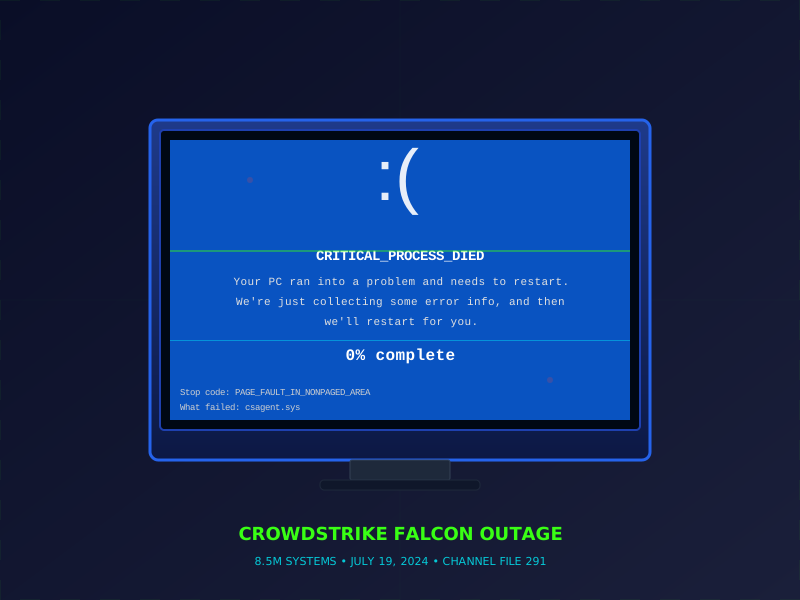
The outage unfolded with shocking speed. Within the first hour, reports began flooding social media and IT operations channels from administrators across the world describing identical symptoms: Windows machines with CrowdStrike Falcon installed were experiencing persistent BSOD crashes with the error code 0x50: PAGE_FAULT_IN_NONPAGED_AREA and references to the csagent.sys driver (Falcon’s kernel sensor).
Aviation: Airlines worldwide experienced catastrophic disruptions. Delta Air Lines, United Airlines, American Airlines, Ryanair, and dozens of others grounded flights or operated under severe delays as their reservation systems, flight planning software, and gate assignment tools crashed. Over 5,000 flights were cancelled globally on July 19 alone, with cascading delays continuing for days.
Healthcare: Hospitals and healthcare systems across the US, UK, and Europe reported outages affecting electronic health records (EHR), scheduling systems, and medical imaging. Mass General Brigham in Boston cancelled non-emergency surgeries and procedures. The UK’s NHS reported widespread IT failures affecting appointment systems and patient data access.
Financial Services: Banks and trading platforms experienced disruptions. The London Stock Exchange reported system interruptions affecting trading infrastructure. Payment processing systems at major retailers failed, forcing many to operate cash-only or close entirely.
Emergency Services: 911 dispatch systems in multiple US states, including Alaska, New Hampshire, and Ohio, went offline, forcing emergency response coordinators to use backup radio systems and manual logging. The UK’s non-emergency NHS 111 service faced severe degradation.
Broadcasting: The Australian Broadcasting Corporation (ABC) and Sky News in the UK went off-air or experienced major disruptions as production and playout systems crashed.
Retail and Logistics: Self-checkout systems at grocery chains froze. Pharmacy systems went offline. Logistics and shipping operations lost visibility into fleet and inventory systems.
Microsoft estimated that approximately 8.5 million Windows devices were affected — less than 1% of all Windows machines globally, but heavily concentrated in enterprise and critical infrastructure environments that relied on Falcon for endpoint protection.
The Response: Manual Remediation at Scale
CrowdStrike identified the faulty Channel File within approximately 90 minutes of the initial deployment and issued a corrective update. However, because the affected systems were stuck in boot loops and could not reach the internet to receive the fix, the remediation required manual intervention on every impacted machine.
The recovery procedure, published by CrowdStrike and Microsoft, required administrators to:
- Boot the affected system into Windows Safe Mode or the Windows Recovery Environment
- Navigate to
C:\Windows\System32\drivers\CrowdStrike\ - Locate and delete the file matching the pattern
C-00000291*.sys(the faulty Channel File 291) - Reboot the system normally
For organizations with hundreds or thousands of affected machines — and especially for systems in remote offices, data centers, or cloud environments without physical access — this meant deploying field technicians, coordinating remote hands support from colocation providers, or using out-of-band management interfaces to access servers.
Airlines dispatched IT staff to airport kiosks and gate systems. Hospitals scrambled to restore critical systems while maintaining patient care under degraded conditions. Retail chains sent technicians to stores to manually remediate point-of-sale terminals.
The recovery effort took days. Some organizations with large distributed fleets reported that full remediation extended into the following week. The outage highlighted a systemic vulnerability in the architecture of modern IT operations: when automatic update mechanisms fail catastrophically, manual remediation does not scale.
Root Cause: What Went Wrong
In the weeks following the outage, CrowdStrike published a Root Cause Analysis (RCA) and Preliminary Post Incident Review (PIR) explaining what had failed internally.
The Technical Failure: Channel File 291 contained a Template Instance referencing detection logic that had not been included in the runtime Template Type library available to the Falcon sensor. When the sensor attempted to instantiate the referenced template, it encountered a null value in a pointer field where a valid memory address was expected. The sensor’s code did not include a validation check or exception handler for this scenario, leading to an unhandled kernel exception and immediate BSOD.
The Process Failure: CrowdStrike’s testing and validation processes for Channel Files had failed to catch the error before production deployment. The company acknowledged that:
- Automated validation had not detected the logic error because the test coverage for this specific class of configuration mismatch was incomplete.
- Staged rollout mechanisms — which could have limited the blast radius by deploying the update incrementally to small populations before global release — were not applied to Channel File updates, which were treated as low-risk content changes rather than potentially system-breaking code.
- Integration testing across diverse system configurations (different Windows versions, hardware platforms, and Falcon sensor versions) had not identified the crash.
CrowdStrike’s CEO, George Kurtz, issued a public statement apologizing for the disruption and committing to significant changes in the company’s testing, deployment, and quality assurance processes.
The Lessons: Availability as a Security Requirement
The CrowdStrike Falcon outage was not a security incident in the traditional sense — no data was stolen, no systems were compromised by adversaries, no malicious actors gained unauthorized access. And yet it became one of the most studied “cybersecurity” events of 2024, because it illustrated several foundational truths that defenders, vendors, and executives must internalize:
1. Availability is a security pillar. Security is classically defined by the CIA triad: Confidentiality, Integrity, and Availability. In practice, most security programs prioritize Confidentiality (preventing breaches) and Integrity (ensuring data is not tampered with). Availability — the guarantee that systems are operational when needed — is often treated as an operations concern rather than a security concern. The Falcon outage demonstrated that availability failures can produce consequences indistinguishable from cyberattacks: critical infrastructure offline, economic disruption, public safety risks.
2. Kernel-mode software is high-consequence infrastructure. Any software running at the kernel level holds the power to destroy the system it is meant to protect. Endpoint security products, device drivers, and low-level system utilities must be held to standards approaching those of aircraft control systems or medical devices, because their failure modes have comparable societal impact.
3. Automatic updates are a single-point-of-failure risk. Automatic updates are essential for security — unpatched vulnerabilities create risk, and manual update processes are too slow to counter modern threats. But automatic updates also concentrate deployment risk. A staged rollout mechanism — where updates are deployed incrementally to small populations, monitored for failures, and rolled back if anomalies are detected — is not merely a best practice; it is a critical control that must apply to all automated changes, not just major version upgrades.
4. Testing is not optional at scale. When software is deployed to millions of systems across industries where downtime means cancelled surgeries, grounded flights, and 911 services offline, “move fast and break things” is not a defensible engineering philosophy. Comprehensive testing — including edge cases, error conditions, and failure scenarios — is a moral and operational obligation.
5. Recovery mechanisms must exist. The outage recovery required manual physical access to millions of machines because the affected systems could not boot to a network-connected state. Organizations dependent on remote or distributed infrastructure need out-of-band recovery mechanisms — BIOS-level remote access, network-bootable recovery images, or automated safe-mode remediation tools — that function independently of the primary operating system.
The Aftermath: Regulatory and Industry Response
In the months following the outage, several governments and regulatory bodies initiated reviews of the incident’s implications:
The US Congress held hearings examining the concentration risk in the endpoint security market and whether critical infrastructure organizations should be required to maintain vendor diversity or offline fallback systems.
The European Union’s NIS2 Directive (Network and Information Security Directive) — which mandates cybersecurity requirements for critical infrastructure — began discussions of whether software quality assurance and resilience testing should be explicitly included in compliance frameworks.
CrowdStrike’s stock price dropped sharply in the days following the outage, reflecting both immediate reputational damage and concerns about potential litigation from affected customers. The company faced lawsuits from shareholders, airlines, and healthcare organizations seeking damages.
The cybersecurity vendor community implemented new testing and deployment practices. Several competitors publicly committed to staged rollout mechanisms and enhanced validation procedures for automated updates, recognizing that the entire industry’s credibility was at stake.
The outage became a case study in business continuity programs worldwide. Security conferences in late 2024 featured multiple sessions analyzing the Falcon incident as a watershed moment in understanding supply chain concentration risk — not from adversaries compromising vendors (as in SolarWinds), but from trusted vendors accidentally breaking their own customers.
Attack Chain: CrowdStrike Falcon Outage — July 19, 2024
graph TD
    A["CrowdStrike Engineering\nDevelops Channel File 291\nContent Update for Falcon Sensor"] --> B["Testing & Validation\nAutomated Tests Pass\n(Incomplete Coverage)"]

    B --> C["Production Deployment\nJuly 19, 2024 — 04:09 UTC\nGlobal Push to All Falcon Systems"]

    C --> D["The Flaw:\nChannel File Contains\nNull Pointer Reference\nto Non-Existent Template"]

    D --> E["Falcon Sensor Loads File\nAttempts to Parse\nEncounters Invalid Memory Address"]

    E --> F["Unhandled Kernel Exception\nNo Validation Check\nNo Exception Handler"]

    F --> G["Windows Kernel Panic\nBlue Screen of Death (BSOD)\n0x50: PAGE_FAULT_IN_NONPAGED_AREA"]

    G --> H["Boot Loop:\nWindows Reboots\nLoads Falcon Driver\nCrashes Again — Repeat"]

    H --> I["8.5 Million Windows Systems\nImmediately Affected\nWorldwide Simultaneous Failures"]

    I --> J["✈️ Aviation\n5,000+ Flights Cancelled\nDelta, United, American, Ryanair"]
    I --> K["🏥 Healthcare\nEHR Systems Offline\nSurgeries Cancelled\nNHS / Mass General Affected"]
    I --> L["💰 Financial Services\nLondon Stock Exchange Disruption\nBanking Systems Degraded"]
    I --> M["🚨 Emergency Services\n911 Dispatch Offline\nUS States + UK NHS 111"]
    I --> N["📺 Broadcasting\nSky News / ABC Offline\nProduction Systems Crashed"]

    J --> O["CrowdStrike Identifies Issue\n~90 Minutes After Deployment\nPushes Corrective Channel File"]

    O --> P["Problem:\nAffected Systems Can't Boot\nCan't Reach Internet\nCan't Receive Fix Automatically"]

    P --> Q["Manual Remediation Required\nBoot to Safe Mode\nDelete C-00000291*.sys\nReboot Normally"]

    Q --> R["Days-Long Recovery\nField Technicians Deployed\nData Center Visits Required\nRemote Hands Coordinated"]

    R --> S["$10B+ Economic Impact\nThousands of Flights\nMass Disruption\nLargest IT Outage in History"]

    S --> T["Root Cause Analysis:\nNull Pointer Dereference\nInsufficient Testing\nNo Staged Rollout for Content Updates"]

    T --> U["Industry Response:\nStaged Rollout Adoption\nEnhanced Validation Requirements\nAvailability-Focused Security Design"]
// Further Reading & Media
CrowdStrike Falcon Outage
A single faulty software update to the world's leading endpoint security platform brought down 8.5 million Windows machines in a matter of hours, grounding airlines, shutting down hospitals, and paralyzing critical infrastructure in what became the largest IT outage in history — caused not by malice, but by a missing validation check. Use this reference overview as a jumping-off point for deeper reporting, primary-source disclosures, and historical context.
→ View Resource