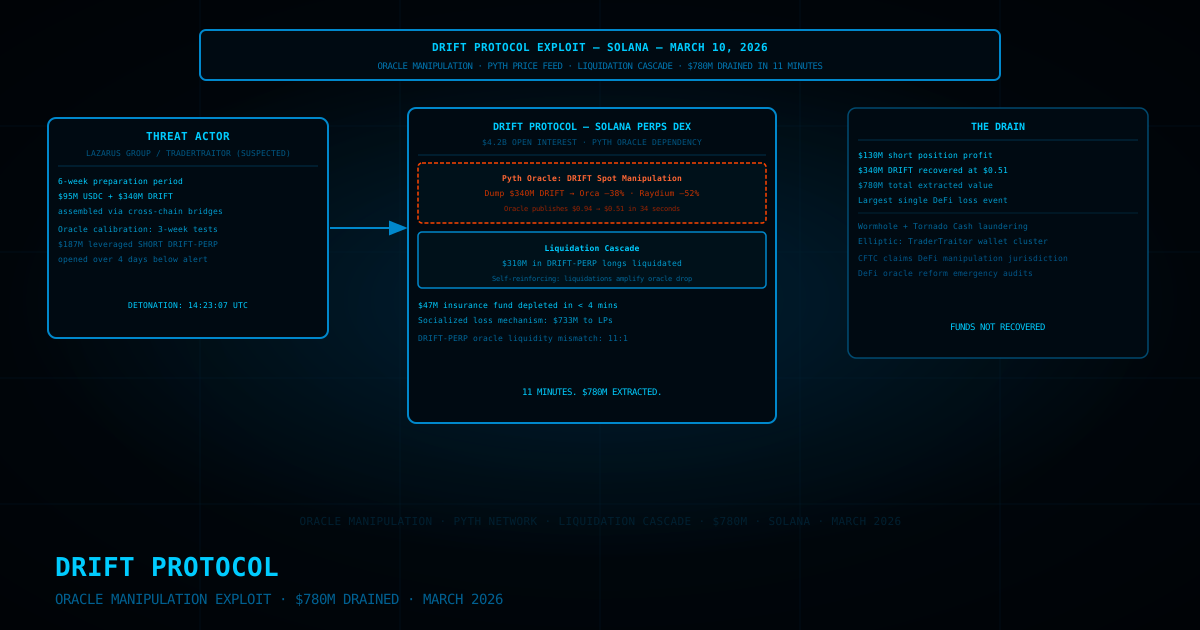
The Drift Protocol Exploit: How a $780 Million Oracle Attack Broke Solana's Largest Perpetuals Exchange
The Drift Protocol Exploit: How a $780 Million Oracle Attack Broke Solana’s Largest Perpetuals Exchange
At 14:23:07 UTC on March 10, 2026, a single transaction landed on the Solana blockchain.
It was not large. It was not unusual in structure. It did not trigger any of Drift Protocol’s automated circuit breakers. But it was the first move in an eleven-minute sequence that would drain $780 million from the largest decentralized perpetuals exchange on Solana — destroying the insurance fund, forcing socialized losses across every liquidity provider in the protocol, and triggering the largest single-event loss in DeFi history.
The attacker had been preparing for six weeks.
The trade logs, reconstructed in the hours after the exploit by blockchain analysts at Chainalysis and on-chain researcher @BowTiedBull, told a story of methodical preparation: small positions opened and closed in specific markets, timing tests at low liquidity windows, and what appeared to be deliberate calibration of the attack parameters against the real-time behavior of the Pyth Network oracle infrastructure that Drift Protocol used to price its perpetual contracts. When the attack executed, it worked exactly as its author had designed — and it was complete before any human on Drift’s operations team could respond.
What Drift Protocol Is — And How Perpetuals Work
Drift Protocol launched in 2021 as one of the first institutional-quality decentralized perpetual futures exchanges on the Solana blockchain. By early 2026, Drift had grown to become Solana’s dominant on-chain derivatives platform — hosting approximately $4.2 billion in open interest across thirty-seven perpetual markets, with a daily trading volume that regularly exceeded $1.5 billion.
A perpetual futures contract (or “perp”) is a derivative instrument that mimics a futures contract but has no expiration date. Traders can take leveraged long or short positions on the future price of an asset — SOL, BTC, ETH, and dozens of other tokens — posting collateral called margin to support their positions. Drift’s architecture allowed up to 20x leverage: a trader posting $100,000 in USDC could control a $2 million position.
The stability of this leveraged system depends entirely on two mechanisms working correctly: liquidation (automatically closing underwater positions before they become insolvent) and oracle pricing (accurately determining the current market price of the underlying asset to trigger those liquidations at the right moment).
Drift used the Pyth Network — a decentralized oracle network that aggregates price data from dozens of financial data providers and publishes real-time price feeds on-chain. For major assets like SOL, BTC, and ETH, Pyth’s feeds were robust: dozens of publishers contributed price data, making manipulation prohibitively expensive. But for the long tail of lower-liquidity markets — smaller tokens with fewer liquidity venues — the Pyth feed was thinner, drawing from fewer publishers, and could be influenced by large trades on the underlying spot markets that those publishers monitored.
The attacker found exactly one such market.
The Target: DRIFT-PERP and the Oracle Dependency
DRIFT-PERP — Drift Protocol’s own governance token perpetual market — was, from a security standpoint, the most dangerous market in the protocol. It was also, from a business standpoint, a natural one to list: letting traders speculate on the governance token of the exchange itself was standard practice in DeFi.
But DRIFT-PERP had a structural vulnerability: the Pyth oracle feed for the DRIFT spot price drew primarily from two liquidity venues — Orca and Raydium, two Solana-based decentralized exchanges — and both had DRIFT/USDC pools with limited depth. The total liquidity in these pools in early March 2026 was approximately $28 million. Drift Protocol’s DRIFT-PERP market used this oracle feed to calculate mark prices for position valuation and liquidation thresholds across $310 million in open DRIFT-PERP positions — a leverage ratio of over 11:1 between the oracle’s underlying liquidity and the positions it was pricing.
A sufficiently large, well-timed trade on the Orca/Raydium DRIFT spot pools could move the Pyth oracle price. If the price moved enough, it would trigger mass liquidations in DRIFT-PERP — and each liquidation would generate losses that Drift Protocol’s insurance fund was designed to absorb. If those losses exceeded the insurance fund, the protocol would socialize losses across all liquidity providers.
This was not a new attack class in DeFi. The Mango Markets exploit in 2022 had used an identical structure against Solana’s lending protocol, and Eisenberg v. Mango Markets had been litigated to a hung jury on the question of whether oracle manipulation for profit constituted market manipulation under US law. The lesson had not been applied systemically across the DeFi ecosystem.
The Six-Week Preparation Period
Blockchain forensics confirmed that the attacker began positioning on January 26, 2026 — forty-three days before the exploit.
The preparation unfolded in three phases:
Phase 1 — Infrastructure Building (Jan 26–Feb 15): The attacker created a cluster of wallets funded through a chain of cross-chain bridges beginning on Ethereum, routed through Wormhole and Allbridge to Solana, then fragmented across twenty-seven intermediate addresses before consolidating into three operational wallets. The bridging route was designed to delay attribution — Ethereum wallet clustering tools would see a single source of funds; the Solana analysts would see apparently independent wallets. The total capital assembled was approximately $95 million in USDC on Solana, plus $340 million in DRIFT tokens accumulated across three weeks on Orca and Raydium in small tranches designed to avoid price impact.
Phase 2 — Oracle Calibration (Feb 16–Mar 5): The attacker executed a sequence of small test trades against the DRIFT spot pools at varying times of day, specifically targeting low-liquidity windows — Asian market close, US pre-market. Each test was logged on-chain and analyzed. The attacker appeared to be measuring exactly how much USDC was required to move the Pyth DRIFT price by specific percentages at each liquidity window, and how quickly the price reverted after the pressure was released. This calibration data determined the precise trade size needed to move the oracle enough to cascade liquidations without overcapitalizing the attack.
Phase 3 — Position Sizing (Mar 6–9): Using the calibrated parameters, the attacker opened a $187 million leveraged short position in DRIFT-PERP via the three operational wallets — sized specifically at the threshold that would become maximally profitable if the oracle price dropped by the amount the calibration tests suggested was achievable. The position was opened gradually over four days, staying below Drift’s automated large-position alert thresholds.
By March 10, everything was in place.
The Eleven-Minute Attack
14:23:07 UTC — Spot Market Pressure. The attacker began selling the accumulated $340 million in DRIFT tokens against the Orca and Raydium liquidity pools. This was not a flash loan — the tokens were real, accumulated over weeks. The sell pressure was massive relative to the pool depth: in the first sixty seconds, the on-chain DRIFT spot price on Orca dropped 38%. Raydium’s thinner pool dropped 52%.
14:23:41 UTC — Oracle Price Movement. Pyth Network aggregated the new prices from its publishers — the market data feeds from Orca and Raydium were primary contributors for DRIFT. The aggregated oracle price published by Pyth dropped from $0.94 to $0.51 — a 45.7% decline in thirty-four seconds.
14:24:02 UTC — Liquidation Cascade. Drift Protocol’s liquidation engine observed the oracle price collapse. Positions in DRIFT-PERP that had been fully solvent at $0.94 were now deep underwater at $0.51 — their collateral no longer sufficient to support their leveraged positions. The automated liquidation mechanism began closing them.
The cascade was immediate and self-reinforcing: as leveraged longs were liquidated, the selling pressure added to the already-collapsing oracle price, which made more positions underwater, which triggered more liquidations. In the four-minute window between 14:24 and 14:28, Drift’s engine processed $310 million in liquidations.
14:28:18 UTC — Insurance Fund Depletion. Drift Protocol’s insurance fund — funded by protocol fees and maintained to absorb losses from insolvent liquidations — was $47 million. The cascade losses exceeded it in under four minutes. The fund was empty.
14:28:44 UTC — Socialized Loss Activation. With the insurance fund depleted, Drift Protocol’s fallback mechanism activated: socialized losses. Every liquidity provider in every Drift market had their positions reduced proportionally to cover the remaining deficit. The mechanism worked exactly as designed. It distributed approximately $733 million in losses across Drift’s liquidity provider base.
14:33:22 UTC — Position Closure. The attacker’s $187 million short position in DRIFT-PERP, opened at an average price near $0.90, was now deeply profitable. The attacker closed it, realizing a gain of approximately $130 million. They also repurchased a portion of the DRIFT tokens at the post-crash price of $0.51, recovering capital from that leg of the operation. Total extracted value: $780 million when including the insurance fund drain and the socializedloss mechanism.
14:34:01 UTC — Withdraw and Bridge. The profits began moving: USDC → ETH via Wormhole → multiple Ethereum wallets → Tornado Cash → fragmentation wallets. The attacker had pre-staged the withdrawal route. Within fifteen minutes of the position closure, funds were in Ethereum.
14:34:55 UTC — First Human Response. Drift Protocol’s operations team saw the alerts. The protocol had already been exploited. There was nothing to pause.
The Technical Architecture: Why the Oracle Couldn’t Stop It
The Drift Protocol exploit raised a question that the DeFi ecosystem had been debating since Mango Markets in 2022: can on-chain oracle systems be made manipulation-resistant for illiquid assets?
The Pyth Network architecture aggregated price data from publishers but had no mechanism to reject inputs that represented a genuine market move — even a manipulated one. The protocol was designed to report real prices accurately. A real price genuinely moved by a large market participant was, by the oracle’s definition, the correct price to report.
Drift Protocol had implemented some oracle manipulation protections: maximum oracle deviation checks that would pause markets if the oracle price deviated too far from the last known price in a single update. The attacker’s calibration phase had been specifically designed to determine the exact manipulation threshold that stayed below this check while still generating sufficient liquidation cascade. The manipulation amount was chosen to be just inside the deviation threshold.
The deeper structural issue was what risk managers call oracle liquidity mismatch: the ratio between the liquidity underlying the price oracle and the total open interest dependent on that oracle. For DRIFT-PERP, this ratio was 11:1. A rational risk parameter — used by centralized exchanges for decades — would cap the open interest in a perpetual market at some multiple of the underlying spot liquidity. Drift’s DRIFT-PERP market had no such cap.
Post-exploit governance proposals immediately addressed this. But for $780 million in LP capital, the analysis came too late.
Attribution and the Lazarus Hypothesis
Within forty-eight hours of the exploit, blockchain intelligence firm Elliptic published an analysis linking the attacker’s pre-attack wallet cluster to infrastructure previously associated with TraderTraitor — the Lazarus Group subunit responsible for the February 2025 Bybit exchange theft.
The evidence was circumstantial but consistent: the cross-chain bridging route through Wormhole, the use of Tornado Cash for post-exploit mixing, the wallet clustering patterns, and the six-week patient preparation period were all consistent with TraderTraitor’s documented methodology. The FBI, which had attributed the Bybit theft to TraderTraitor in 2025, opened an investigation but had not confirmed attribution publicly by April 2026.
If the attribution proved correct, the Drift exploit would represent TraderTraitor’s second major DeFi operation in thirteen months, adding $780 million to the estimated $3+ billion in cryptocurrency the group had stolen on behalf of North Korea’s sanctions-evading weapons programs. The evolution from exchange custody attacks (Bybit) to protocol-level oracle manipulation (Drift) reflected an adversary that was adapting its methodology to the defensive improvements the industry had implemented after each prior attack.
The DeFi Oracle Crisis and Its Aftermath
Drift Protocol entered emergency governance proceedings. A proposal to socialize the remaining losses across the LP base passed within hours — there was no alternative. The protocol suspended new position openings for twenty-two hours while the development team deployed emergency parameter updates: reduced maximum leverage for all DRIFT-PERP positions, oracle deviation circuit breakers tightened from 15% to 5%, and a new open interest cap for DRIFT-PERP set at 3x the spot pool liquidity.
Across the DeFi ecosystem, the Drift exploit triggered an immediate audit of oracle liquidity mismatch ratios. Major protocols — Jupiter, Zeta Markets, Parcl, and others — published emergency risk parameter reviews within days. Pyth Network convened an emergency working group with protocol partners to design circuit-breaker mechanisms that could suspend oracle updates for specific feeds if manipulation indicators were detected, even if the price change itself was technically real.
The more difficult question — whether DeFi protocols can ever safely offer leveraged derivatives on low-liquidity assets — had no easy answer. Every DeFi exchange listing governance token perps was listing a product that required external price feeds for assets whose spot liquidity was a fraction of the protocol’s open interest. The incentive to list (trading fees, governance token value) consistently outweighed the acknowledged risk.
Congressional testimony in April 2026 revisited the Eisenberg precedent — whether oracle manipulation of a DeFi protocol constituted market manipulation under the Commodity Exchange Act. The CFTC issued a statement that it considered manipulative oracle price attacks on DeFi protocols to fall within its enforcement jurisdiction, regardless of the decentralized nature of the protocol. No arrests followed.
The $780 million has not been recovered.
Attack Chain: Drift Protocol — Oracle Manipulation and Liquidation Cascade
graph TD
    A["Target Selection\nAttacker identifies DRIFT-PERP:\noracle from thin Orca/Raydium\npools · $310M open interest\nagainst $28M spot liquidity"] --> B["Capital Assembly\nJan 26: Bridge $95M USDC\n+ accumulate $340M DRIFT\nvia Wormhole · Allbridge\n27 fragmented wallets"]
    B --> C["Oracle Calibration\nFeb 16–Mar 5: Execute test\ntrades at low-liquidity windows\nMeasure price impact per $\nCalibrate exact attack size"]
    C --> D["Position Sizing\nMar 6–9: Open $187M\nlevered SHORT on DRIFT-PERP\nstaged over 4 days to stay\nbelow alert thresholds"]
    D --> E["Oracle Attack\n14:23:07 UTC Mar 10, 2026\nDump $340M DRIFT on spot\nOrca –38% · Raydium –52%\nin under 60 seconds"]
    E --> F["Pyth Price Collapse\nPyth oracle aggregates\nmanipulated spot prices\nPublishes $0.94 → $0.51\n45.7% drop in 34 seconds"]
    F --> G["Liquidation Cascade\n$310M in DRIFT-PERP longs\ninstantly underwater\nLiquidation engine fires\nSelf-reinforcing selloff"]
    G --> H["Insurance Fund Drained\n$47M insurance fund\ndepleted in under 4 mins\nSocialized loss mechanism\nactivates automatically"]
    H --> I["Profit Extraction\n$130M short position gain\n+ recovered DRIFT at $0.51\n$780M total extracted\nUSDC bridged to Ethereum"]
    I --> J["Laundering\nWormhole · Tornado Cash\nFragmentation wallets\nPre-staged withdrawal route\nexecuted in < 15 mins"]
    J --> K["Attribution\nElliptic: wallet cluster linked\nto TraderTraitor / Lazarus\nFBI opens investigation\nCFTC claims jurisdiction"]
    K --> L["Legacy\n$780M LP losses socialized\nOracle liquidity mismatch\nreform across DeFi ecosystem\nFunds not recovered"]

    style A fill:#051a2e,color:#e0e0e0
    style B fill:#0a1a3a,color:#9ab8ff
    style E fill:#c0392b,color:#fff
    style F fill:#c0392b,color:#fff
    style G fill:#8e44ad,color:#fff
    style H fill:#8e44ad,color:#fff
    style L fill:#2c3e50,color:#e0e0e0