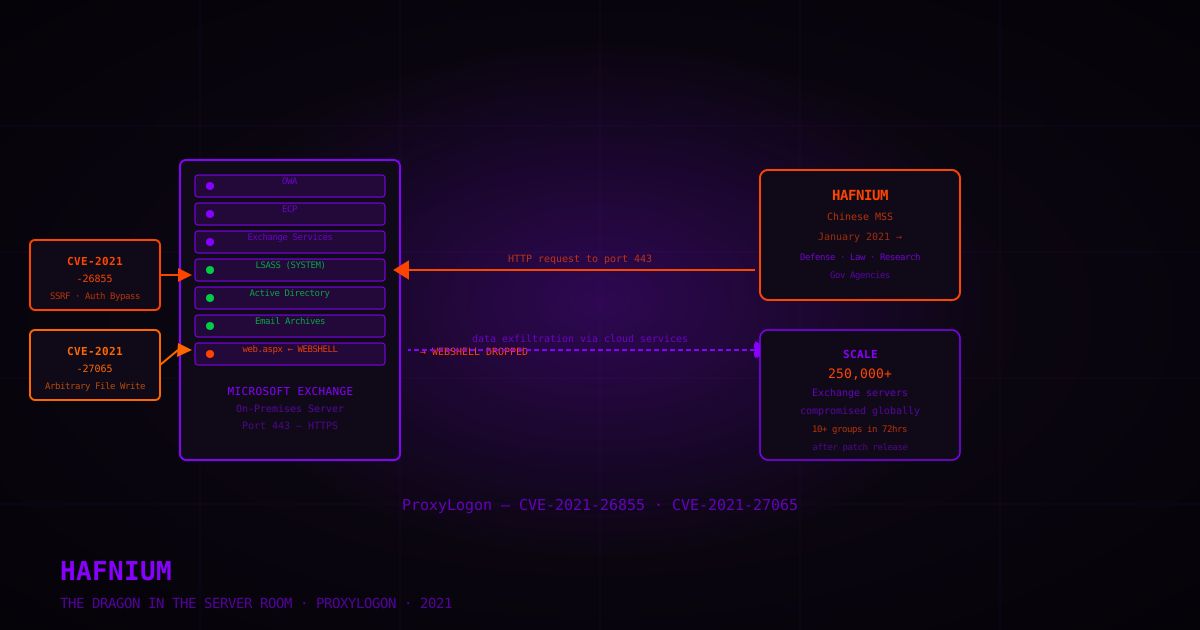
The Dragon in the Server Room: HAFNIUM and ProxyLogon
HAFNIUM: The Dragon in the Server Room
On the morning of March 2, 2021, Microsoft published what appeared, at first glance, to be a routine security advisory. It described four vulnerabilities in Microsoft Exchange Server — the on-premises email infrastructure running inside the networks of tens of thousands of organizations worldwide.
The advisory was unusual in two respects: released out of cycle — not on Patch Tuesday — signaling urgency, and naming a specific threat actor: HAFNIUM, a Chinese state-sponsored group assessed to have been actively exploiting these vulnerabilities for approximately two months.
What the advisory could not fully convey in its careful corporate language was the scale of what had already happened, and what was about to happen.
The vulnerabilities had been live and exploited since at least January 2021. By the time Microsoft released the patches, an estimated tens of thousands of Exchange servers had already been compromised and had web shells planted on them. Within 72 hours of the patch’s public release — which effectively broadcast the vulnerability’s existence to the entire global attacker community — at least ten separate threat actor groups had developed or reverse-engineered working exploits and were deploying them indiscriminately. By the end of March, estimates ranged from 250,000 to 400,000 Exchange servers compromised globally.
The patch came out. The fire was already burning.
Threat Actor Profile: HAFNIUM
Designation: HAFNIUM (Microsoft designation, named after element 72 on the periodic table); overlapping indicators tracked across multiple vendor frameworks under related Chinese APT clusters
Attribution: People’s Republic of China; assessed to operate under direction of the Ministry of State Security (MSS) — China’s primary civilian foreign intelligence agency
Origin: People’s Republic of China; assessed operations primarily from China
Primary Mission: Strategic espionage — theft of intellectual property, defense sector targeting, infectious disease research collection, legal and policy intelligence gathering from adversary governments and institutions
Known Tradecraft: Zero-day exploitation of internet-facing servers, web shell deployment for persistent backdoor access, living-off-the-land lateral movement using legitimate Windows tools, exfiltration to cloud file-sharing services (OneDrive, Dropbox) to blend with normal traffic
Notorious Operations:
- ProxyLogon Exchange Exploitation (January–March 2021): Zero-day exploitation of four Microsoft Exchange Server vulnerabilities, compromising an estimated 250,000+ servers globally before and in the immediate aftermath of patch release.
- COVID-19 Research Targeting (2020): HAFNIUM and related Chinese APT clusters targeted US-based infectious disease research institutions, pharmaceutical companies, and universities conducting COVID-19 vaccine research — seeking to obtain research data ahead of authorized publication.
- Defense Contractor Intellectual Property Theft: HAFNIUM targeted aerospace and defense industrial base entities — consistent with China’s strategy of technology acquisition through cyber means, attributed with accelerating programs including the J-20 and J-31 stealth aircraft.
- Law Firm and NGO Targeting: HAFNIUM targeted law firms conducting litigation involving Chinese entities and policy NGOs focused on Chinese foreign policy interests — seeking legal strategy and diplomatic intelligence.
The Vulnerability: ProxyLogon
The four vulnerabilities were named ProxyLogon by security researcher Orange Tsai of DEVCORE, who discovered them and reported the critical flaw to Microsoft on January 5, 2021 — a vulnerability chain of exceptional severity.
The cornerstone was CVE-2021-26855: a Server-Side Request Forgery (SSRF) flaw in Exchange Server’s authentication handling for its web-facing interfaces — specifically, the Exchange Control Panel (ECP) and Outlook Web Access (OWA).
Exchange exposes certain services over HTTPS to allow remote mail access and administration. CVE-26855 allowed an unauthenticated attacker to send a specially crafted HTTP request to Exchange’s HTTPS service that caused the server itself to issue an authenticated request to internal components — effectively impersonating the Exchange server’s own internal authentication. The exploit required no credentials, no user interaction, and no prior access.
One HTTP request. Authentication bypassed.
Combined with CVE-2021-27065 — a post-authentication arbitrary file write — an attacker who had bypassed authentication could write arbitrary files to any path on the Exchange server’s filesystem, including web-accessible directories.
The combined effect of chaining these two CVEs: unauthenticated remote code execution on any vulnerable Exchange server accessible from the internet, with no user interaction required. An attacker could drop a web shell — a lightweight ASP.NET script — anywhere in Exchange’s web-accessible folders and have persistent remote code execution capability through nothing more than an HTTP request.
The remaining two vulnerabilities in the chain (CVE-2021-26857 and CVE-2021-26858) provided privilege escalation and additional persistence mechanisms once initial access was established.
The Target: Who Runs On-Premises Exchange?
To understand the ProxyLogon impact, you have to understand the deployment landscape.
Exchange Online — Microsoft’s cloud-hosted version through Microsoft 365 — was not affected. The vulnerability existed only in on-premises Exchange Server: the version that organizations host on their own hardware, within their own networks.
In 2021, on-premises Exchange remained the dominant email infrastructure for:
- Federal, state, and local government agencies — including agencies handling classified or sensitive national security information
- Defense contractors and the defense industrial base
- Law firms, particularly those handling sensitive commercial litigation or government work
- Healthcare systems and hospitals
- Universities and research institutions
- Financial institutions not yet migrated to cloud services
- Small and medium enterprises across every sector
These were almost precisely the categories a Chinese state intelligence program would most want to access — the overlap with HAFNIUM’s documented collection priorities was not coincidental.
The Timeline: Before and After the Patch
January 5, 2021: Orange Tsai (DEVCORE) reports the critical vulnerability to Microsoft.
Early January 2021: HAFNIUM begins active exploitation. Separately, monitoring by Volexity — a security firm observing unusual Exchange behavior in its customer networks — logs exploitation activity beginning around January 6, suggesting HAFNIUM may have begun using these vulnerabilities before Tsai’s report, or that multiple parties discovered the same flaws independently.
Late January – February 2021: HAFNIUM exploitation continues at a measured pace, targeting high-value organizations consistent with its espionage mandate. Other threat actor groups begin observing and exploiting the same vulnerabilities.
March 2, 2021: Microsoft releases emergency out-of-cycle patches for Exchange Server and simultaneously publishes threat intelligence attributing the exploitation to HAFNIUM. The patch release is both a remedy and a signal: it broadcasts the existence and nature of the vulnerability to every attacker watching.
March 3–10, 2021: The exploitation rate escalates dramatically. Security researchers reverse-engineer working exploit code from Microsoft’s patches within hours of release. Within 72 hours, a functional automated exploitation tool is available publicly online. At least ten distinct threat actor groups — including criminal ransomware operators, additional nation-state actors, and opportunistic exploitation services — begin mass-scanning for vulnerable Exchange servers.
By mid-March, estimates of compromised servers globally ranged from 250,000 to 400,000.
The Web Shell Wave
The most consequential aspect of the ProxyLogon exploitation was not the initial access. It was what came after.
When HAFNIUM (and, subsequently, a dozen other actors) successfully exploited ProxyLogon, they planted web shells — small ASP.NET scripts with innocuous-looking names like error.aspx, web.aspx, or randomized character strings — in Exchange’s web-accessible directories.
A web shell is a backdoor accessible via HTTP request. Anyone who knew the URL could issue commands; the shell executed them with SYSTEM-level privileges — the highest local access.
Web shells are architecturally simple, highly persistent, and extraordinarily difficult to detect without deliberate hunting — they blend into the thousands of legitimate .aspx files that constitute Exchange’s web interface. An organization could patch the ProxyLogon vulnerability and still have a functioning attacker web shell installed in a pre-exploitation window.
CISA issued Emergency Directive 21-03 on March 3, 2021, requiring all federal civilian executive branch agencies to immediately apply the Exchange patches — and, critically, to actively hunt for web shells already planted before the patch. CISA’s directive acknowledged what the security community had rapidly recognized: patching closed the door, but it did not evict the attackers who were already inside.
The instruction was: patch and hunt. The implication was clear: patching alone was insufficient.
The Geopolitical Response: An Unprecedented Coalition
Microsoft’s initial March 2 attribution of exploitation to HAFNIUM was followed by a coordinated international response that was remarkable for its breadth.
On July 19, 2021, the United States, European Union, NATO, United Kingdom, Australia, Canada, New Zealand, and Japan issued a joint statement formally attributing the Microsoft Exchange exploitation to Chinese state actors operating under the direction of the MSS. The joint attribution statement — spanning the full Five Eyes alliance and extending to NATO and EU partners — was described at the time as the most extensive multilateral cyber attribution ever assembled.
The statement went further: it described China’s MSS as using “criminal contract hackers” who conducted state-directed espionage while simultaneously running financially motivated cybercrime for personal enrichment — providing the MSS deniability while exploiting the criminal ecosystem’s technical capabilities.
The US Department of Justice simultaneously indicted four Chinese nationals — three MSS intelligence officers and one MSS contractor — for their roles in the Exchange exploitation and related computer intrusion campaigns against defense, maritime, aviation, research, and pharmaceutical sectors.
China denied involvement. As it always does.
The Legacy: Public Servers as Attack Surface
The HAFNIUM Exchange operation crystallized a strategic lesson that the security industry had been articulating for years without sufficient urgency: every internet-facing server is a potential beachhead, regardless of how trusted or internal the organization considers it.
Exchange was not a perimeter server in the traditional sense. It was deep infrastructure — email, which organizations treat as an internal communication backbone. Running Exchange on-premises meant exposing a deeply trusted component of internal network architecture to the public internet, maintained by organizations whose core competency was law, medicine, government, or education — not server security.
For organizations globally, ProxyLogon accelerated the migration from on-premises Exchange to cloud-hosted Exchange Online, where Microsoft manages the patching and security architecture. The vulnerability was widely cited as the most consequential argument for cloud migration of enterprise email infrastructure.
For the intelligence community, the HAFNIUM operation provided a clear data point on the scale of Chinese MSS collection ambitions: the targeting profile — defense, aerospace, research, legal, policy, healthcare — was a map of the institutional nodes through which American strategic advantage flows. The Exchange exploitation was not an opportunistic crime. It was a collection programme.
For incident response teams globally, the ProxyLogon aftermath established a new procedural baseline: emergency patches must be accompanied by active threat hunting. The assumption that a rapid patch prevents compromise was permanently retired.
Attack Chain: HAFNIUM — ProxyLogon Exchange Zero-Days
graph TD
    A["🇨🇳 HAFNIUM\n(Chinese State / MSS Nexus)"] --> B["Strategic Collection Mandate\nDefense Contractors · Law Firms\nInfectious Disease Research\nPolicy NGOs · Gov Agencies"]

    B --> C["Identify On-Premises\nMicrosoft Exchange Servers\nInternet-Exposed on Port 443"]

    C --> D["CVE-2021-26855\nServer-Side Request Forgery (SSRF)\nIn Exchange Authentication Layer\nZero Credentials Required"]

    D --> E["Craft Malicious HTTP Request\nto Exchange HTTPS Service\nForce Server to Self-Authenticate\nInternal Components Trust Exchange"]

    E --> F["Authentication Bypassed\nUnauthenticated = Authenticated\n(From Exchange's perspective)"]

    F --> G["CVE-2021-27065\nPost-Auth Arbitrary File Write\nWrite Any File to Any Path\nUsing Exchange Service Account"]

    G --> H["Web Shell Dropped\nASP.NET Script in\nExchange Web Directory\ne.g. /owa/auth/error.aspx\n(Blends with Legitimate Files)"]

    H --> I["Persistent Backdoor\nHTTP Request → Shell URL\n= Remote Code Execution\nRunning as SYSTEM"]

    I --> J["CVE-2021-26857 / 26858\nPrivilege Escalation +\nExtended Persistence Mechanisms"]

    J --> K["Network Reconnaissance\nActive Directory Enumeration\nCredential Harvesting (LSASS)"]

    K --> L["Lateral Movement\nLiving-off-the-Land\nWMI · PowerShell · PsExec\n(Legitimate Windows Tools)"]

    L --> M["Data Exfiltration\nEmail Archives (PST Files)\nIntellectual Property\nTo Cloud Services: OneDrive\nDropbox · MEGA\n(Blend with Normal Traffic)"]

    A --> N["Timeline: January 2021\nHAFNIUM Exploitation Begins\nBefore Public Knowledge\nSelective High-Value Targets"]

    N --> O["March 2, 2021\nMicrosoft Emergency Patches\n+ HAFNIUM Named Publicly"]

    O --> P["Patch = Vulnerability Broadcast\nWorking Exploits Reverse-Engineered\nfrom Patches Within Hours"]

    P --> Q["10+ Threat Groups Active\nWithin 24 Hours of Patch\nCriminal + Nation-State"]

    Q --> R["Public Exploit Tool Released\nWithin 72 Hours"]

    R --> S["250,000–400,000\nExchange Servers Compromised\nGlobally (Jan–Mar 2021)"]

    S --> T["Web Shells Persist\nEven on Patched Servers\nPatch ≠ Clean"]

    T --> U["CISA Emergency Directive 21-03\nFederal Agencies:\n'Patch AND Hunt for Web Shells'"]

    O --> V["July 19, 2021\nUS + EU + NATO + UK\nAustralia + Canada + Japan\nJoint Attribution: Chinese MSS\n'Criminal Contract Hackers'"]

    V --> W["DOJ Indicts 4 Chinese Nationals\n3 MSS Officers + 1 Contractor\nEspionage + Cybercrime"]