Love Letter, Global Outage: The ILOVEYOU Worm
Love Letter, Global Outage: The ILOVEYOU Worm
At midday in Manila on May 4, 2000, office workers started opening an email with a subject line that looked too personal to ignore:
ILOVEYOU
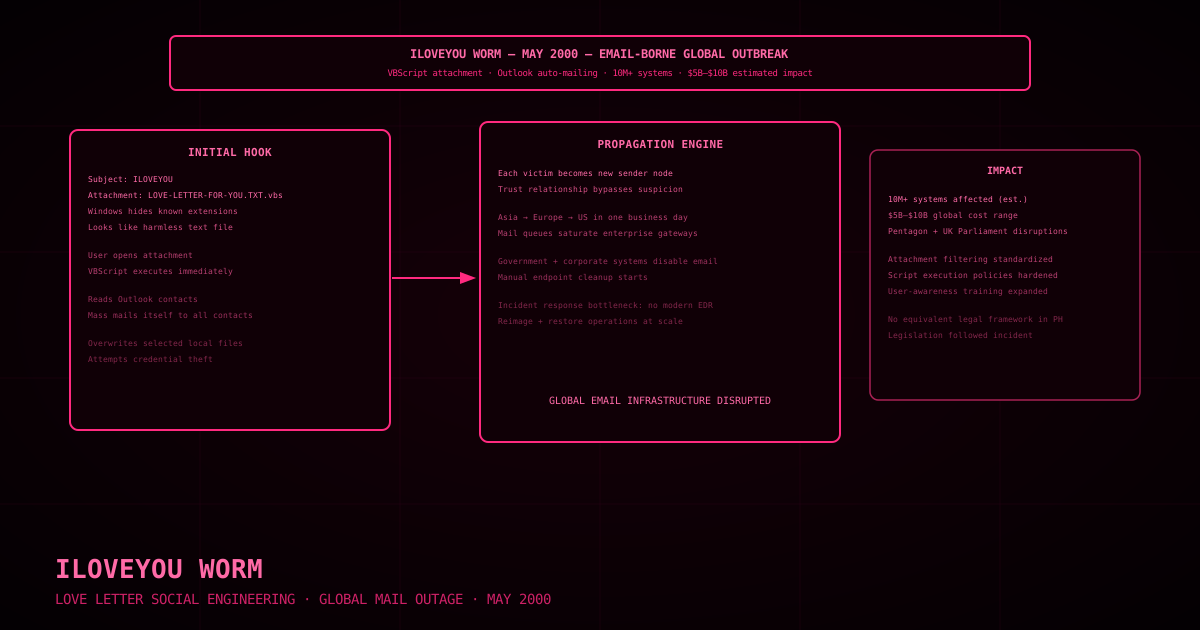
The attachment was named LOVE-LETTER-FOR-YOU.TXT.vbs. On most Windows systems, file extensions were hidden by default. Users saw what looked like a harmless text file. It was not a text file. It was executable VBScript.
Within hours, email servers in Hong Kong, London, New York, and Washington began choking under self-replicating outbound mail floods. By the end of the day, major banks, telecoms, media organizations, and government agencies had unplugged mail gateways entirely. Parliament staff in the UK lost internal messaging. The Pentagon disconnected segments of its email network. Corporate IT teams worked overnight deleting infected scripts from thousands of desktops by hand.
A worm small enough to fit in a single instant message had done what nation-states had not yet accomplished: temporary global disruption at internet scale, in one business day.
Why It Worked: Trust + Defaults + Speed
ILOVEYOU’s success was not based on technical sophistication. It was based on the interaction of three ordinary design decisions:
- Trust in personal-looking email subjects
- Windows hiding known file extensions by default
- Outlook automation that allowed script-driven mass mailing
Once launched, the script copied itself to multiple locations, modified Windows registry keys for persistence, replaced selected user files with copies of itself, and harvested addresses from Microsoft Outlook to propagate to every contact in the victim’s mailbox.
This created a compounding growth loop. Every infected user became a broadcast node to trusted relationships: coworkers, vendors, clients, friends.
The worm did not need exploit chains. It used social trust as the exploit.
Threat Actor Profile: The Love Bug Authors
Primary Suspect: Onel de Guzman, a student in the Philippines
Attribution Basis: Local investigation, source code similarities, witness testimony, and recovered script artifacts
Intended Objective (assessed): Credential theft and opportunistic monetization, with mass spread likely beyond original intent
ILOVEYOU included code to steal internet access credentials from infected systems and exfiltrate them via email. At the time, dial-up credentials could be monetized in underground markets or used directly for unauthorized internet access.
In other words, the worm carried both propagation logic and theft logic. It was not only vandalism.
The 24-Hour Cascade
Phase 1 — Initial Seeding (Manila): The first wave appears in Philippine inboxes and quickly escapes local networks.
Phase 2 — Asia-Pacific Amplification: Corporate and telecom address books multiply delivery paths across regions.
Phase 3 — Europe and US Business Hours: As time zones roll west, organizations open inboxes into already-saturated mail systems.
Phase 4 — Defensive Shutdowns: Enterprises disable Exchange/Outlook connectivity and block all .vbs attachments. Some organizations disable external email entirely.
The fastest major control was blunt: pull the plug on mail.
Damage Beyond Infection Counts
The raw infection figure — often reported at 10 million+ systems — understates the operational impact.
The real damage came from recovery:
- Reimaging endpoints
- Rebuilding mail queues
- Restoring overwritten files from backups
- Rotating credentials potentially exposed by the worm
- Rewriting attachment and script execution policies enterprise-wide
For many organizations in 2000, centralized endpoint management was immature. Remediation was labor-intensive and manual. That is why cost estimates climbed into the multi-billion-dollar range.
Legal Aftermath: A Worm Ahead of the Law
Philippine investigators quickly identified likely authorship. But prosecutors faced a structural problem: the country’s legal framework did not yet clearly criminalize this specific form of cyber intrusion at global scale.
The result became a recurring pattern in cyber history: a major incident exposes a legal vacuum, and legislation follows the incident rather than preventing it.
ILOVEYOU accelerated cybercrime lawmaking discussions not only in the Philippines but globally. It also pushed enterprises to adopt controls that later became baseline hygiene: attachment filtering, extension visibility enforcement, script restrictions, and user-awareness training focused on social engineering.
Legacy: The Human Layer Became a Security Perimeter
ILOVEYOU’s long-term contribution to cybersecurity was brutally simple:
a believable pretext can outperform a technical exploit.
The worm did not break cryptography. It did not require privileged zero-days. It asked users to open what looked like a love letter and relied on UI defaults to hide the real file type.
Twenty-five years later, phishing kits, business email compromise crews, and ransomware initial-access brokers still depend on the same core mechanism: human trust chained to automation.
ILOVEYOU was one of the first global proofs that social engineering is not a side-channel in cybersecurity.
It is the main channel.
Attack Chain: ILOVEYOU Worm (May 2000)
graph TD
    A["Initial Delivery\nEmail subject: ILOVEYOU\nAttachment: LOVE-LETTER-FOR-YOU.TXT.vbs"] --> B["User Execution\nWindows hides file extensions\nUser opens 'text file'\nVBScript executes"]
    B --> C["Persistence + File Actions\nCopies itself to system paths\nModifies registry run keys\nOverwrites selected media/script files"]
    C --> D["Mass Propagation\nReads Outlook address book\nEmails itself to all contacts\nTrusted sender relationship abused"]
    D --> E["Credential Theft\nHarvests dial-up / internet creds\nPrepares exfiltration via email"]
    E --> F["Global Mail Flood\nCorporate mail queues saturate\nGateway performance collapses\nIT teams disable email services"]
    F --> G["Operational Disruption\nGovernments and enterprises\nshut down messaging infrastructure\nmanual endpoint cleanup begins"]
    G --> H["Aftermath\n$5B–$10B estimated losses\npolicy changes: script filtering\nattachment controls + awareness"]

    style A fill:#1a1a2e,color:#e0e0e0
    style B fill:#0d3b66,color:#a9d6ff
    style D fill:#c0392b,color:#fff
    style F fill:#8e44ad,color:#fff
    style H fill:#2c3e50,color:#e0e0e0
// Further Reading & Media
The ILOVEYOU Worm
How a 6-kilobyte VBScript attachment disguised as a confession of love ripped through the global internet in under 24 hours, shut down government and corporate email systems across three continents, and proved that the most scalable exploit in history was human curiosity. Use this reference overview as a jumping-off point for deeper reporting, primary-source disclosures, and historical context.
→ View Resource