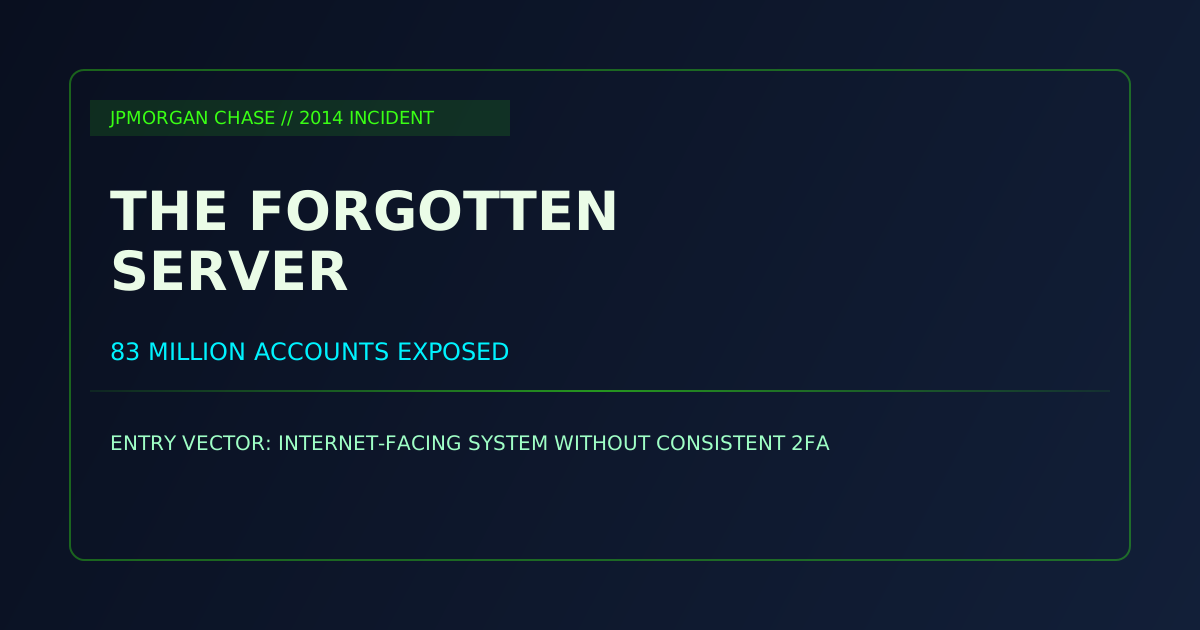
The Forgotten Server: Inside the JPMorgan Chase Breach
The Forgotten Server: Inside the JPMorgan Chase Breach
In the summer of 2014, security teams at JPMorgan Chase began seeing traffic patterns that did not fit normal banking behavior.
The anomaly was subtle at first. Then it wasn’t.
Attackers had moved through the bank’s internal network and accessed customer data associated with 83 million households and small businesses. Names, addresses, phone numbers, and email addresses were exposed at a scale large enough to map a meaningful slice of the US financial system.
No vaults were emptied. No retail accounts were visibly drained in a single dramatic event. That almost made it worse. This was a breach built for infrastructure: identity enrichment, market abuse, and long-tail fraud.
Threat Actor Profile: Gery Shalon Network
Designation: Financial cybercrime group linked to Gery Shalon and associated operators
Attribution: US federal indictments tied components of the operation to a transnational criminal network operating across Israel, the United States, and Eastern Europe
Primary Mission: Financially motivated cybercrime at institutional scale — account data theft, market manipulation support, and monetization through secondary fraud ecosystems
Known Tradecraft: Credential theft, exploitation of weak remote access controls, lateral movement through enterprise networks, large-scale data exfiltration, use of shell infrastructure and laundering channels
Notorious Operations:
- JPMorgan Chase Intrusion (2014): Unauthorized access to customer contact data for 83 million accounts.
- Brokerage/Financial Data Intrusions: Campaign elements linked to compromises at additional financial institutions and market data targets.
- Market Abuse Infrastructure: Indictments describe overlap with pump-and-dump infrastructure using stolen identity and contact data.
The Initial Access: One Server, No 2FA
Public reporting and law-enforcement filings converged on a familiar failure mode: an internet-facing server that did not enforce two-factor authentication.
The server was not supposed to become the hinge for an enterprise-scale compromise. But in complex organizations, exceptions become pathways. Once valid credentials were accepted at the edge, the attackers did what disciplined intruders always do: enumerate, blend in, and move quietly.
They did not need a cinematic zero-day chain. They needed one weakly protected entry point in a network built for high trust among internal systems.
Moving Inside a Bank Built for Speed
JPMorgan’s environment was vast, heterogeneous, and optimized for availability. Banking operations demand that systems talk to each other quickly: consumer portals, commercial banking tools, card processing, compliance telemetry, and internal analytics all exchange data continuously.
That operational reality creates friction for defenders. Strict segmentation can break business processes. Broad trust can preserve uptime but widen blast radius when an attacker lands.
The intruders reportedly spent weeks expanding access, pivoting between systems, and collecting data that was useful less for immediate theft than for strategic criminal reuse. The data exposed in public disclosures did not include account passwords, PINs, or Social Security numbers in bulk. It included something else valuable: high-confidence identity and contact graphs.
Why Contact Data Was a Strategic Asset
To the public, a breach of names and email addresses can sound less severe than direct payment theft. To criminal operators, it is often the opposite.
Validated customer identity data tied to a major bank enables:
- Precision phishing campaigns that appear institutionally credible
- Business-email compromise targeting small firms tied to real banking relationships
- Synthetic identity assembly when combined with external breach datasets
- Insider social-engineering against support desks and third-party vendors
In other words, the breach produced ammunition for follow-on operations across the financial ecosystem.
Response and Regulatory Shock
JPMorgan disclosed the breach in October 2014 after incident containment and forensic investigation. The bank stated there was no evidence that account numbers, passwords, or other highly sensitive financial fields were widely compromised in the same dataset.
Even so, regulators and peer institutions interpreted the event as a systemic warning.
If the largest US bank by assets could be penetrated through a control gap as basic as authentication enforcement at a perimeter system, then every major institution was likely carrying similar latent risk. The sector accelerated investments in identity hardening, privileged access governance, and internal anomaly detection.
Legacy: The Enterprise Authentication Lesson
The JPMorgan breach became a boardroom case study because it reframed cyber risk in financial services.
The lesson was not that banks lacked firewalls, encryption, or security budgets. The lesson was that control consistency matters more than control existence. A single unaligned server can nullify an otherwise mature program.
In the decade since, banks have spent heavily on zero-trust segmentation, phishing-resistant authentication, and enterprise identity telemetry. But the core pattern from 2014 remains unchanged across sectors: adversaries do not defeat your strongest control — they route around it.
Attack Chain: JPMorgan Chase Breach (2014)
graph TD
    A["Target Selection\nMajor US bank with vast\nconsumer + commercial footprint"] --> B["Initial Access\nInternet-facing server accepts\ncredentialed access without\n2FA enforcement"]
    B --> C["Foothold Establishment\nAttacker validates persistence\nand begins internal reconnaissance"]
    C --> D["Privilege Expansion\nEnumerate internal trust paths\ncollect credentials/tokens\nmove to higher-value systems"]
    D --> E["Lateral Movement\nPivot across banking network\nusing legitimate admin channels\nto reduce detection"]
    E --> F["Data Discovery\nIdentify customer datasets\nwith names, addresses, email, phone\nfor households + small businesses"]
    F --> G["Mass Exfiltration\n83 million account-linked records\nextracted over staged sessions"]
    G --> H["Monetization Layer\nUse exposed identity/contact data\nfor phishing, fraud enablement,\nand market-abuse ecosystems"]
    H --> I["Detection + Containment\nIncident response isolates systems\nforensics + disclosure follow"]
    I --> J["Sector-Wide Reform\nFinancial industry accelerates\n2FA enforcement, segmentation,\nand identity-centric monitoring"]

    style B fill:#c0392b,color:#fff
    style D fill:#8e44ad,color:#fff
    style G fill:#8e44ad,color:#fff
    style J fill:#2c3e50,color:#e0e0e0
// Further Reading & Media
Inside the JPMorgan Chase Breach
How one internet-exposed server without two-factor authentication gave attackers a foothold into America's largest bank, exposing data tied to 83 million customers and forcing Wall Street to confront industrialized cybercrime at banking scale. Use this reference overview as a jumping-off point for deeper reporting, primary-source disclosures, and historical context.
→ View Resource