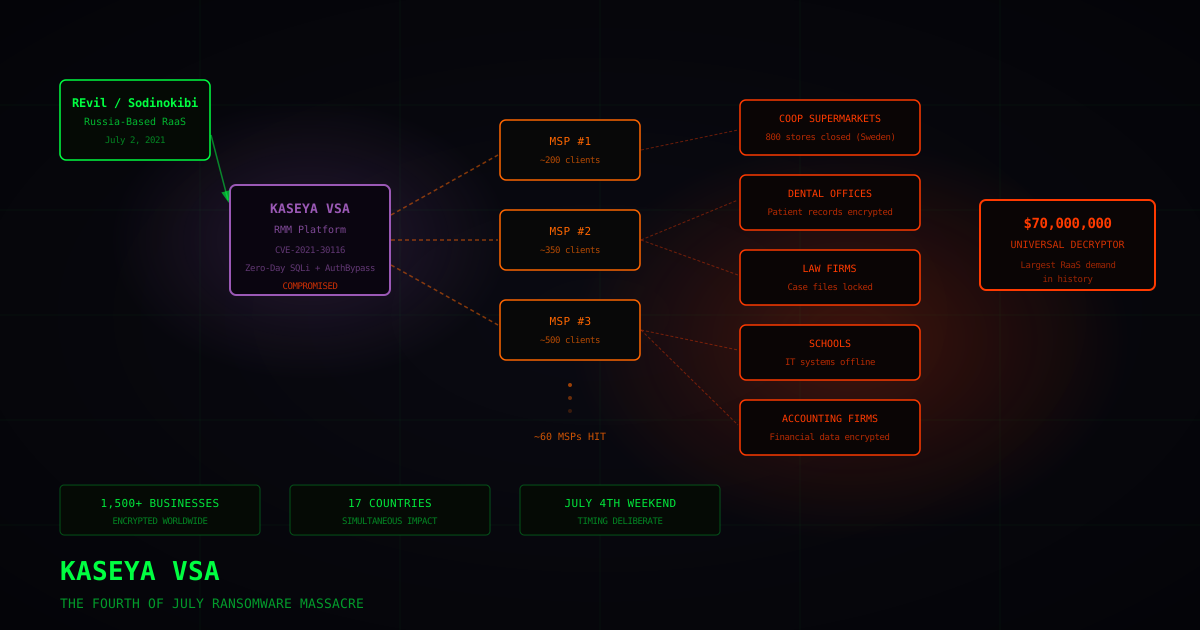
The Fourth of July Massacre: Kaseya VSA and the Ransomware That Hit 1,500 Businesses at Once
Kaseya VSA: The Fourth of July Massacre
At 2:00 PM EDT on Friday, July 2, 2021, system administrators at managed service providers across the United States began watching their consoles fill with alerts they did not understand.
Endpoints managed by Kaseya VSA — the remote monitoring and management platform that these MSPs used to maintain hundreds or thousands of their clients’ systems — were executing a software update. This was not unusual. VSA pushed updates routinely. It was how MSPs patched machines, deployed software, and ran maintenance scripts across their entire customer base without touching each machine individually.
Except this update had not been authorized by anyone at those MSPs. And it was not a patch.
The “update” was a weaponized payload that disabled Windows Defender, dropped a malicious DLL disguised as a legitimate Windows component, and then detonated REvil ransomware — encrypting every file it could reach on every endpoint the MSP managed.
Within ninety minutes, over 1,500 businesses across 17 countries were locked out of their own systems. Dental offices in the American Midwest. Accounting firms in the United Kingdom. Law practices in Canada. Supermarket chains in Sweden. Schools, logistics companies, small manufacturers — the kind of businesses that outsource their IT to managed service providers precisely because they cannot afford dedicated security teams.
The largest ransomware-as-a-service operation in the world had just weaponized the trust relationship between IT service providers and their clients. It was the Friday afternoon before Independence Day weekend. Most of America’s IT workforce was about to go on vacation. The timing was not a coincidence.
Threat Actor Profile: REvil / Sodinokibi
Designation: REvil (Ransomware Evil); Sodinokibi (original name derived from its code); also tracked as Gold Southfield (Secureworks)
Attribution: Russian-speaking cybercriminal group; assessed with high confidence to operate from the Russian Federation
Origin: Russia; emerged in April 2019 as a successor to the GandCrab ransomware operation
Primary Mission: Financially motivated ransomware-as-a-service (RaaS) — operating a franchise model where core developers build and maintain the ransomware platform while affiliates conduct the actual intrusions
Known Tradecraft: Zero-day exploitation, supply chain compromise, double extortion (data theft + encryption), RaaS affiliate model, strategic timing of attacks to maximize pressure, negotiation via Tor-based portals, cryptocurrency laundering through mixers and exchanges
Notorious Operations:
- Travelex (December 2019 – January 2020): REvil’s New Year’s Eve attack on the global foreign exchange company forced Travelex to take all systems offline. The company reportedly paid $2.3 million in Bitcoin ransom. The disruption cascaded through banks and airports that relied on Travelex services. Travelex went into administration seven months later.
- Grubman Shire Meiselas & Sacks (May 2020): REvil breached the entertainment law firm that represented Lady Gaga, Madonna, Bruce Springsteen, and other high-profile clients. The group demanded $42 million and leaked stolen documents when the firm refused to pay, pioneering the double-extortion model at celebrity scale.
- Acer (March 2021): REvil demanded $50 million from the Taiwanese computer manufacturer — at the time, the largest known ransomware demand in history. The attack exploited a Microsoft Exchange vulnerability. Acer did not publicly confirm payment.
- JBS Foods (May 2021): REvil compromised the world’s largest meat processor, forcing shutdowns at facilities across the United States, Canada, and Australia. JBS paid an $11 million ransom within days. The attack briefly threatened the US meat supply chain.
- Kaseya VSA (July 2021): The attack described in this article. REvil exploited a zero-day vulnerability in Kaseya’s VSA remote management platform to deploy ransomware through approximately 60 managed service providers to over 1,500 downstream businesses worldwide. The $70 million universal decryptor demand was the largest ransom ever publicly demanded at the time.
Note: REvil’s infrastructure went offline on July 13, 2021 — eleven days after the Kaseya attack — and remained dark until September 2021, when it briefly resurfaced. In January 2022, Russia’s Federal Security Service (FSB) announced it had arrested 14 members of REvil at the request of US authorities, seizing $6.6 million in cryptocurrency, luxury vehicles, and computer equipment. It was one of the first significant Russian law enforcement actions against a ransomware group, widely interpreted as a geopolitical gesture. By late 2022, the arrests had produced no publicly known trials or extraditions.
The Weapon: Turning Trust Into an Attack Vector
To understand why the Kaseya attack was so devastating, you need to understand what Kaseya VSA does — and why the trust model it represents is simultaneously essential and dangerous.
Kaseya VSA is a Remote Monitoring and Management (RMM) tool. It is the kind of software that most end users never see, but that their IT service providers rely on completely. When a managed service provider takes on a client — a dental practice, a law firm, a school district — the MSP installs a small agent on every device in the client’s environment. That agent connects back to the MSP’s Kaseya VSA server, giving the MSP the ability to push updates, run scripts, deploy patches, and manage configurations across all client devices remotely.
This is the architecture that makes managed IT services economically viable. A single MSP with a dozen technicians can manage thousands of endpoints across hundreds of clients because the RMM platform provides centralized control.
But that centralized control is also a single point of catastrophic failure. If an attacker can compromise the VSA server, they inherit the MSP’s administrative access to every client device managed through it. Every endpoint trusts the VSA server implicitly. When VSA pushes a “software update,” the endpoints execute it without question — because that is exactly what they are designed to do.
REvil understood this architecture perfectly.
The Vulnerability: CVE-2021-30116
The vulnerability that REvil exploited was CVE-2021-30116 — a zero-day authentication bypass and SQL injection vulnerability in the Kaseya VSA web interface.
The irony was bitter: Kaseya already knew about the vulnerability. The Dutch Institute for Vulnerability Disclosure (DIVD) had discovered the flaw in April 2021 and had been working with Kaseya on a coordinated disclosure and patch. Kaseya was actively developing a fix. A patch was in testing.
REvil struck before the patch was deployed. Whether the attackers discovered the vulnerability independently or obtained knowledge of it through other means remains publicly unresolved. What is known is that by the afternoon of July 2, they had a working exploit.
The attack chain was elegant in its simplicity:
Step 1: Exploit the zero-day. REvil used the authentication bypass to gain administrative access to internet-facing Kaseya VSA servers operated by MSPs. The SQL injection component allowed the attackers to execute arbitrary commands on the VSA server itself.
Step 2: Weaponize the management platform. Once inside the VSA server, the attackers used the platform’s own legitimate functionality — the ability to push software updates to managed endpoints — to deploy the ransomware payload. The payload was disguised as a Kaseya agent update, wrapped in a procedure that VSA administrators themselves routinely use.
Step 3: Disable defenses. The malicious update first executed a command to disable Windows Defender real-time monitoring on the target endpoints. It used a legitimate Microsoft tool — certutil.exe — to decode a payload that had been base64-encoded and stored as a seemingly innocuous file. The decoded file was an outdated but validly signed version of Microsoft Defender (MsMpEng.exe), which was exploited via DLL side-loading to execute the actual ransomware binary without triggering security alerts.
Step 4: Encrypt. REvil’s ransomware encrypted files across the compromised endpoints, appending a random extension and dropping a ransom note directing victims to a Tor-based negotiation portal.
The entire attack — from initial exploitation to ransomware detonation — was automated. There was no prolonged dwell time, no weeks of lateral movement, no slow data exfiltration. REvil had pre-staged the operation to execute as a single, devastating automated deployment through each compromised VSA server.
The Blast Radius: 1,500 Businesses in Ninety Minutes
The scale of the Kaseya attack was unlike anything the ransomware landscape had seen.
Approximately 60 managed service providers were directly compromised through their Kaseya VSA servers. Each of those MSPs managed anywhere from a few dozen to several hundred client organizations. The ransomware cascaded through those trust relationships to an estimated 1,500 downstream businesses in at least 17 countries.
The victims were overwhelmingly small and medium-sized businesses — the exact organizations that outsource IT management to MSPs because they lack the resources for in-house security teams. A small dental practice in Iowa. A law office in London. A logistics company in Germany. These businesses had no direct relationship with Kaseya. Many of them had never heard of it. They simply paid their MSP a monthly fee to keep their computers running and their data safe.
When their screens filled with ransom notes demanding payment in Bitcoin, many of them had no idea what had happened or who to call.
Sweden: A Country’s Grocery Stores Go Dark
The most visible impact occurred in Sweden, where one of the compromised MSPs provided IT services to Coop, the country’s largest grocery cooperative. Coop operated approximately 800 supermarket locations across Sweden. When the ransomware encrypted the point-of-sale systems managed through the affected MSP, Coop could not process transactions at any of its stores.
On the morning of July 3, 800 Coop supermarkets did not open. In a country of 10 million people, one of the two dominant grocery chains was simply closed. The shelves were stocked. The employees arrived. The doors stayed shut. The cash registers could not function.
The stores remained closed for nearly a week. It was the most tangible, publicly visible consequence of the attack — and it demonstrated with uncomfortable clarity how a vulnerability in a piece of American enterprise software could, through two degrees of supply-chain trust, close grocery stores five thousand miles away.
Coop’s point-of-sale systems were managed by Visma Esscom, a Swedish MSP that used Kaseya VSA. Visma Esscom’s VSA server was compromised. The ransomware cascaded to Coop’s checkout systems. Coop had no direct exposure to Kaseya. The attack path ran through three layers of trust: Kaseya → Visma Esscom → Coop.
The United States: Dentists, Accountants, and the Long Weekend
Across the United States, the impact was diffuse and personal. MSPs that served small businesses were among the hardest hit. Their clients — dental practices, veterinary clinics, accounting firms, real estate offices — found their appointment systems, patient records, financial databases, and file servers encrypted.
For many of these businesses, the timing was devastating. The attack landed on the Friday afternoon before the July 4th holiday weekend — a long weekend when most of America’s IT workforce was heading out of town, when vendor support lines would be minimally staffed, and when many small businesses would not discover the damage until the following Tuesday.
By the time they realized what had happened, days of productive time had been lost and the clock on REvil’s ransom payment deadline was already running.
The Demand: $70 Million
On July 4, 2021, while Americans watched fireworks, REvil posted a message on its dark web blog claiming responsibility for the attack and offering a single, stunning deal: pay $70 million in Bitcoin, and they would release a universal decryptor capable of unlocking every victim encrypted through the Kaseya attack.
Seventy million dollars. A single key to undo the damage across 1,500 businesses.
The demand was unprecedented. Previous large ransomware demands had typically targeted single organizations — the $50 million ask from Acer, the $11 million JBS paid. But the Kaseya demand was architecturally different: it was a wholesale price for a mass attack. Rather than negotiating with 1,500 individual victims, REvil was offering to resolve the entire incident in a single transaction.
For individual victims, the demands were more modest — $45,000 per endpoint for small businesses, scaling to $5 million for larger organizations. But the universal decryptor offer was the headline. It implied a level of organization and centralized control that went beyond typical ransomware operations.
No one publicly paid the $70 million.
The Response: Governments Move
The Kaseya attack landed on the desk of the President of the United States.
On July 4, President Biden was briefed on the incident and directed the full resources of the federal government toward investigating the attack. The FBI and CISA (Cybersecurity and Infrastructure Security Agency) issued joint advisories. The FBI opened a formal investigation.
On July 9, Biden placed a direct call to Russian President Vladimir Putin, specifically referencing the Kaseya attack and other ransomware incidents attributed to Russian-based groups. Biden stated publicly that he had told Putin the United States would take action if Russia did not act against ransomware operators within its borders. The message was unusually direct for peacetime diplomacy.
Four days later, on July 13, REvil’s entire infrastructure went dark. The group’s Tor-based leak sites, negotiation portals, and payment infrastructure all went offline simultaneously. The disappearance was sudden and total. Whether the takedown was the result of Russian government action responding to Biden’s pressure, an internal decision by REvil to go dormant to reduce heat, or a law enforcement operation by Western agencies remains disputed. Multiple explanations have been offered. No definitive account has been confirmed.
The Decryption Key
On July 22, 2021 — twenty days after the attack and nine days after REvil vanished — Kaseya announced that it had obtained a universal decryption key capable of unlocking every system encrypted in the attack. Kaseya stated it received the key from a “trusted third party” and declined to confirm whether any ransom payment had been made.
Kaseya distributed the decryptor through Emsisoft, a cybersecurity firm that validated the key’s effectiveness and managed the deployment to affected MSPs and their clients.
The origin of the key has never been publicly confirmed. Reporting by The Washington Post later indicated that the FBI had obtained the key through an operation that gained access to REvil’s servers. The FBI reportedly delayed releasing the key for approximately two weeks to avoid tipping off the attackers while it planned a broader operation against REvil’s infrastructure. This delay was controversial: during those two weeks, hundreds of businesses remained encrypted and suffering losses while the FBI weighed operational security against victim relief.
In September 2021, REvil briefly resurfaced, but the operation was compromised. Bitdefender released a universal decryptor for REvil infections from before July 13 — reportedly based on access facilitated by law enforcement. In January 2022, Russia’s FSB arrested 14 REvil members, seizing over $6.6 million in assets. One of the arrested individuals, Yaroslav Vasinskyi, a Ukrainian national, was subsequently extradited to the United States and pleaded guilty to conducting ransomware attacks, including the Kaseya incident. He was sentenced to 13 years and 7 months in federal prison in May 2024.
The Structural Lesson: Trust Chains Are Attack Chains
The Kaseya VSA incident is studied today not because REvil deployed ransomware — thousands of ransomware attacks occur every year. It is studied because it revealed a systemic vulnerability in how the global IT ecosystem is organized.
The MSP model is built on delegated trust. A small business that hires an MSP is saying: I trust you to have administrative access to every one of my systems, and I trust that the tools you use to manage my systems are secure. That trust is transitive. The MSP trusts Kaseya. Kaseya trusts its own developers. The small business, at the end of this chain, has no visibility into any of it.
When REvil compromised a single software platform used by those MSPs, they inherited the trust that thousands of small businesses had placed in their IT providers. The ransomware did not need to defeat any of those businesses’ own security controls. It arrived through the same channel that legitimate software updates used. The endpoint agents welcomed it.
For the MSP industry, Kaseya was existential. Clients who had hired MSPs specifically for security found themselves breached through the MSP relationship. The incident forced a fundamental reassessment of how MSPs secure their own tools — requiring MFA on RMM platforms, implementing network segmentation between MSP management infrastructure and client environments, and establishing monitoring for anomalous mass-deployment events.
For the software supply chain, Kaseya joined SolarWinds, Codecov, and ua-parser-js in a growing catalog of incidents proving that any software component in the chain of trust — from a source code library to an enterprise management platform — can be weaponized to compromise every organization downstream.
For governments, the speed and scale of the response — a presidential phone call to a foreign head of state, followed by the disappearance of a ransomware operation within days — demonstrated that ransomware had crossed the threshold from cybercrime into national security. The Kaseya attack, combined with the Colonial Pipeline and JBS incidents in the same quarter, created the political momentum for the White House to make ransomware a standing agenda item in bilateral diplomacy.
The fireworks were still going off across America when REvil posted its $70 million demand. Somewhere in the noise of celebration, 1,500 businesses were dark. The IT providers they trusted had been turned into the weapon. The software those providers trusted had been the door.
Three layers of trust. One zero-day. Ninety minutes.
Attack Chain: Kaseya VSA — REvil / Sodinokibi
graph TD
    A["🇷🇺 REvil / Sodinokibi\n(Gold Southfield)\nRussia-Based RaaS Operation\nActive 2019–2022"] --> B["Target Selection\nKaseya VSA — RMM Platform\nUsed by thousands of MSPs globally\nSingle point of mass deployment"]

    B --> C["Zero-Day Acquisition\nCVE-2021-30116\nAuth Bypass + SQL Injection\nKaseya VSA Web Interface\n(Patch in development — not yet deployed)"]

    C --> D["Timing Selection\nJuly 2, 2021 — Friday PM EDT\nUS Independence Day Weekend\nMinimal staffing, maximum dwell time"]

    D --> E["Zero-Day Exploitation\nAuthentication Bypass on\nInternet-Facing VSA Servers\n~60 MSP Servers Compromised"]

    E --> F["Platform Weaponization\nMalicious 'Agent Update'\nPushed via VSA's Own\nLegitimate Deployment Mechanism"]

    F --> G["Payload Execution on Endpoints"]
    G --> G1["Step 1: Disable Windows Defender\nReal-time monitoring off"]
    G --> G2["Step 2: certutil.exe decode\nBase64-encoded payload extracted"]
    G --> G3["Step 3: DLL Side-Loading\nSigned MsMpEng.exe loads\nmalicious DLL"]
    G --> G4["Step 4: REvil Ransomware\nFiles encrypted\nRansom note dropped"]

    F --> H["Cascading Blast Radius"]
    H --> H1["~60 MSPs Compromised\nDirect VSA exploitation"]
    H1 --> H2["~1,500 Downstream Businesses\nDental offices, law firms,\nschools, accounting firms,\nlogistics companies"]
    H2 --> H3["17 Countries Affected\nUS, Sweden, UK, Germany,\nCanada, and more"]

    H3 --> I["🇸🇪 Coop Sweden\n800 Supermarkets Closed\nPOS Systems Encrypted\nVia Visma Esscom MSP"]

    H3 --> J["💰 Ransom Demands\n$45K per endpoint (small biz)\nUp to $5M per org\n$70M Universal Decryptor"]

    J --> K["Response"]
    K --> K1["🇺🇸 President Biden\nBriefed July 4\nCalls Putin July 9\n'Take action or we will'"]
    K --> K2["FBI + CISA\nJoint investigation\nAdvisories issued"]

    K1 --> L["July 13: REvil Goes Dark\nAll infrastructure offline\nTor sites, payment portals\nCause disputed"]

    L --> M["July 22: Universal Decryptor\nObtained by Kaseya\nvia 'trusted third party'\nFBI access to REvil servers\n(reported)"]

    M --> N["Controversy\nFBI held key ~2 weeks\nfor operational security\nwhile victims remained encrypted"]

    L --> O["🚔 Law Enforcement"]
    O --> O1["Jan 2022: Russia FSB\nArrests 14 REvil members\n$6.6M seized"]
    O --> O2["Yaroslav Vasinskyi\nExtradited to US\nPleaded guilty\n13 years 7 months"]

    M --> P["Structural Legacy"]
    P --> P1["MSP Security Overhaul\nMFA on RMM platforms\nNetwork segmentation\nAnomaly monitoring"]
    P --> P2["Trust Chain = Attack Chain\nSolarWinds + Kaseya = proof\nDelegated access is\ndelegated risk"]
    P --> P3["Ransomware → National Security\nPresidential-level response\nBilateral diplomacy agenda item"]
// Further Reading & Media
Kaseya VSA and the Ransomware That Hit 1,500 Businesses at Once
How REvil exploited a zero-day in a remote management tool used by IT service providers, weaponized the trust between managed service providers and their clients, and detonated ransomware across 1,500 businesses in 17 countries — all on the Friday afternoon before America's Independence Day weekend. Use this reference overview as a jumping-off point for deeper reporting, primary-source disclosures, and historical context.
→ View Resource