The Most Wanted Hacker in the World: Kevin Mitnick
The Most Wanted Hacker in the World: Kevin Mitnick
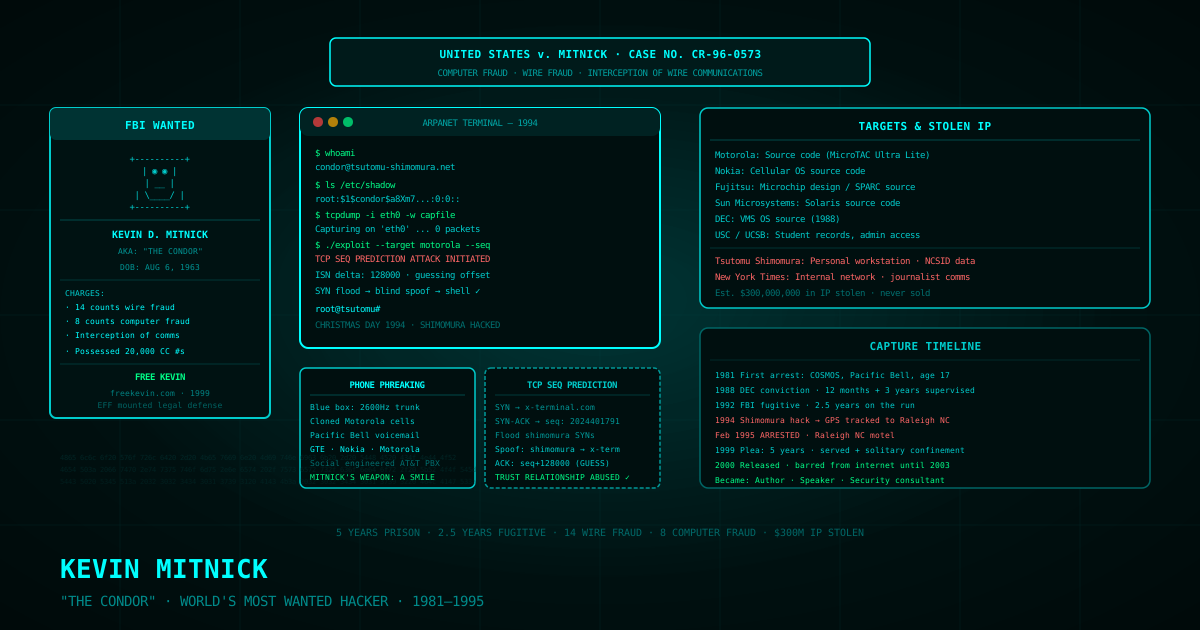
It was Christmas Day, 1994, and Tsutomu Shimomura — computational physicist, world-class security researcher, and consultant to the FBI and NSA — was visiting friends in Nevada. His workstations back home in San Diego, connected to the internet through a Sun Microsystems setup that most people would have considered impregnable, were unattended.
Somewhere in the dark, a ghost was moving through them.
Over the course of that afternoon, an intruder executed a technical assault of extraordinary precision: a TCP/IP sequence number prediction attack paired with SYN flooding that knocked one of Shimomura’s machines offline and then, critically, impersonated it. The attacker spoofed the IP address of a trusted host, bypassed authentication on Shimomura’s X-terminal server, and silently exfiltrated source code for security tools that Shimomura had spent years developing — tools he built to catch people like the man now stealing them.
The gall of it was almost mythological.
Shimomura took the intrusion personally. He joined the FBI hunt. Within two months, Kevin David Mitnick — The Condor, the man the Justice Department called “the most wanted computer criminal in United States history” — was arrested in his apartment in Raleigh, North Carolina, wearing sweatpants.
He had been running for three years.
Threat Actor Profile: Kevin Mitnick (The Condor)
Designation: Kevin David Mitnick; alias “Condor” (taken from the 1975 film Three Days of the Condor)
Attribution: Individual threat actor; no nation-state affiliation. Operated solo and with small trusted associates.
Origin: Los Angeles, California, USA
Active: 1978–1995 (criminal hacking career); later career as security consultant post-incarceration
Primary Mission: Intellectual curiosity, technical mastery, acquisition of source code and proprietary systems access. Not financially motivated in the conventional sense — Mitnick rarely profited monetarily from his intrusions. He hacked for the knowledge, for the thrill, and because he could.
Known Tradecraft: Social engineering (his defining capability), phone phreaking, IP spoofing, TCP sequence number prediction, dumpster diving, physical infiltration, source code exfiltration, identity fabrication
Notorious Operations:
- Pacific Bell VERT Hack (1981–1992): Repeated, sustained intrusions into Pacific Bell’s COSMOS computer system — the nerve center managing phone line records in California. Mitnick obtained thousands of phone records, manipulated lines, and accessed internal switching systems.
- DEC VAX Source Code Theft (1988): Penetrated Digital Equipment Corporation’s network and exfiltrated source code for its VMS operating system, estimated to have taken over a year of developer time to produce. Resulted in his first federal conviction.
- Shimomura Penetration (December 25, 1994): The attack that ended his run. An IP-spoofing intrusion against the San Diego workstations of Tsutomu Shimomura, stealing security research tools. Shimomura personally aided FBI investigation efforts that led to Mitnick’s capture.
- Nokia/Motorola Intrusions (1992–1994): Source code theft from Nokia, Motorola, Sun Microsystems, NEC, and Fujitsu. Estimated damages of tens of millions of dollars in proprietary intellectual property.
The Making of a Ghost
Kevin Mitnick was born in Los Angeles in 1963 and grew up in the San Fernando Valley, raised largely by a single mother. By his own account, he was restless, brilliant, and bored by the ordinary pace of school. He found his first great teacher in a bus driver who showed him how to use discarded transfer slips to ride the LA transit system for free.
He was twelve.
The lesson wasn’t about free bus rides. The lesson was that every system — even a public transit system — had rules, and that rules could be understood, subverted, and bent if you were willing to study them carefully enough.
By fifteen, he had graduated to phone phreaking — the art of manipulating the public telephone network to make free calls, re-route lines, and access restricted operator functions. In the late 1970s and early 1980s, the phone network was a magnificent, underprotected beast of aging analog infrastructure, and the phreaking subculture had grown up around its exploitation. Mitnick fell into it completely.
He joined a loosely organized group of teenage phone phreaks in Los Angeles. He learned to use a blue box — a device that generated the 2,600 Hz tone used by long-distance phone switching equipment to indicate an idle trunk line, allowing callers to seize the line and make free long-distance calls. He learned about DISA (Direct Inward System Access) codes, COSMOS (Computer System for Mainframe Operations), and the arcane internal telephony systems that AT&T and its regional Bell Operating Companies used to manage millions of lines.
More crucially, he learned that talking to people was the most powerful exploit in existence.
The Social Engineering Engine
If Mitnick had one capability that set him apart from every other hacker of his generation, it was his preternatural ability to manipulate human beings. Not through force, not through deception for its own sake, but through the construction of total, convincing authority.
He would call a phone company technician and speak with the casual fluency of someone who obviously belonged there. He knew the jargon. He knew the workflows. He understood who in a telecom organization could authorize what action, and he would call the right person at the right time of day and simply ask for what he needed. He was friendly. He was patient. He was, by all accounts, genuinely likable.
This technique — later formalized by security professionals as social engineering — was Mitnick’s primary attack vector throughout his career, and it was devastatingly effective against systems no piece of software could penetrate.
He would call a help desk posing as an internal IT employee and request a password reset. He would call a network administrator claiming to be from a vendor. He would call the operator of a system he wanted to access and, over the course of a conversation, extract the architecture, the access controls, and sometimes the credentials themselves — all without the target ever suspecting that anything unusual had occurred.
“The human element,” Mitnick would later write, “is always the weakest link.”
By the early 1980s, he had applied this combination of social engineering and technical skill to Pacific Bell’s COSMOS system — the database that managed physical line assignments for California’s telephone network. COSMOS controlled which phone number was assigned to which physical pair of copper wires, and access to it meant the ability to redirect, disconnect, or eavesdrop on virtually any phone line in California.
He accessed it repeatedly, over years, with enough sophistication that Pacific Bell security teams initially couldn’t determine how.
Federal Radar
His first serious legal trouble came in 1988, when a grand jury indicted him for the DEC VAX source code theft. He had penetrated Digital Equipment Corporation’s network and walked away with source code for VMS — the operating system that powered DEC’s VAX minicomputer line. DEC estimated the code had cost over a million dollars to develop.
Mitnick received a twelve-month prison sentence and three years of supervised release.
He violated supervised release. He fled.
For the next several years, he lived as a fugitive, moving between cities, acquiring false identities with the same social engineering instincts he applied to computer systems — calling Social Security offices, DMV databases, and background check services to construct layered fake identities for himself. He lived in Denver for a time, then Seattle, then elsewhere, always moving, always watching.
He kept hacking.
The period between 1992 and 1995 was arguably the most technically sophisticated of his career. He penetrated the networks of Nokia, Motorola, NEC, Fujitsu, and Sun Microsystems, exfiltrating source code from each. He wasn’t selling this code — at least not significantly. He was consuming it. Learning from it. Building, in his head, an ever-more-complete map of the systems that ran the world.
He accessed corporate email. He listened to the voicemails of security researchers who were looking for him. In at least one documented instance, he intercepted a call between an FBI agent and a security consultant discussing the case, and called the agent back, taunting him.
He had become something beyond a criminal. He had become a character.
The Shimomura Attack: Christmas 1994
By December 1994, Mitnick’s activities had drawn the attention of Tsutomu Shimomura, a computational physicist at the San Diego Supercomputer Center who was also a well-known security researcher and informal NSA/FBI consultant. Shimomura had built a reputation for rigorous, uncompromising security work. He ran his workstations out of his home in Solana Beach, California, connected to a high-speed internet link — a setup that, in 1994, represented a serious technical infrastructure.
On Christmas Day, while Shimomura was away, Mitnick struck.
The attack was technically remarkable for its era. Mitnick executed a TCP/IP sequence number prediction attack, a technique described in academic literature but rarely seen in operational use. Here is how it worked:
Step 1 — SYN Flood the Trusted Host. Mitnick identified x-terminal.sdsc.edu (Shimomura’s X-terminal server) and a second machine, apollo.sdsc.edu, that the terminal trusted implicitly — meaning a connection from apollo would be authenticated automatically without a password. Mitnick bombarded apollo with a SYN flood attack: a torrent of TCP SYN packets that each demanded a three-way handshake response. apollo’s TCP stack became overwhelmed, unable to process legitimate traffic — it was effectively rendered deaf and mute.
Step 2 — Predict the Sequence Numbers. TCP connections are authenticated by sequence numbers — large pseudo-random integers that both sides of a connection agree upon at the start of a session. In 1994, many UNIX implementations used predictable sequence number generation algorithms. Mitnick sent a series of probe packets to x-terminal.sdsc.edu to observe its sequence number increments, and from those observations calculated what sequence number it would generate next.
Step 3 — Spoof the Connection. With apollo unable to respond to any packets (still being flooded) and the sequence number predicted, Mitnick forged packets with a source IP address of apollo.sdsc.edu. When x-terminal sent a SYN-ACK back to the spoofed apollo, it received no response (because apollo was flooded), but Mitnick was ready. He sent a forged ACK with the predicted sequence number — completing the three-way handshake from a machine he didn’t own and couldn’t hear from.
The X-terminal believed it had just accepted a connection from a trusted host. It hadn’t.
Step 4 — Execute and Exfiltrate. Having forged a trusted session, Mitnick issued commands to create a .rhosts entry — a Unix authentication mechanism that would allow him unrestricted future access. He then exfiltrated Shimomura’s security tool source code, which included sophisticated intrusion detection and analysis tools.
The entire attack took less than two minutes.
Shimomura’s systems logged the anomalous traffic. When he returned and reviewed the logs, he knew immediately what had happened — and who had likely done it. He called the FBI and told them he would personally help track the attacker down.
The Hunt
The FBI investigation of Kevin Mitnick was, by 1994, already years old and largely stalled. The bureau knew who he was. They had a federal warrant. They had no idea where he was living.
Shimomura changed that calculus.
After Christmas, Mitnick continued to operate — accessing cellular network infrastructure, monitoring communications between security researchers and FBI agents, and continuing his pattern of source code theft. His connection to internet infrastructure left traces. Shimomura built monitoring systems. The FBI tapped cellular network providers.
In January 1995, forensic analysis of Mitnick’s network activity began to narrow his geographic location. He had been accessing the internet through cellular modem connections — a high-speed (for 1994) 14.4 kbps connection via a cellular data service in the Raleigh-Durham area of North Carolina.
Shimomura and an FBI team flew to Raleigh. They used radio direction-finding equipment to triangulate the cellular data transmissions, driving through residential neighborhoods in the middle of the night with antennas mounted to their car.
On the night of February 14, 1995, they had a building.
On the morning of February 15, they had an apartment number.
At 2:00 in the morning, FBI agents knocked on the door of unit 202 at the Players Court apartment complex in Raleigh. Kevin Mitnick answered. He was wearing sweatpants. He had a cellular phone, a laptop computer, and multiple false identity documents.
He did not resist. “I knew you’d get me eventually,” he reportedly said.
The Charges, the Prison, the Legend
Mitnick was charged with 25 counts of computer and wire fraud. The charges covered intrusions into systems at Nokia, Motorola, Fujitsu, NEC, Sun Microsystems, and the University of Southern California, among others. Prosecutors alleged damages of $291 million in stolen intellectual property.
What followed was one of the most contentious legal proceedings in the history of American computer crime.
Mitnick spent 4.5 years in pretrial detention — an extraordinary length of time, and one that became a cause célèbre in the hacker community. Prosecutors argued he was too dangerous to release, claiming (somewhat fantastically) that he could “start a nuclear war by whistling into a telephone” — an exaggeration so absurd that it entered internet folklore. He was held in solitary confinement for eight months, denied access to a telephone, on the theory that telephone access would allow him to continue hacking.
The “Free Kevin” campaign erupted across the early internet. Hackers defaced websites. Activists demonstrated outside courthouses. Books were written. Documentaries were filmed. His case raised fundamental questions about the proportionality of computer crime sentencing, the government’s understanding of what computer criminals could actually do, and the rights of defendants who remained unconvicted.
He finally pleaded guilty in 1999 and was sentenced to time served plus additional months. He was released in January 2000, with conditions that initially prohibited him from using a computer or mobile phone — restrictions a federal judge eventually relaxed as the internet became increasingly necessary for ordinary life.
He had served nearly five years. He had not profited significantly from any of his crimes.
The Aftermath: From Fugitive to Icon
After release, Mitnick became something genuinely paradoxical: the world’s most famous hacker turned the world’s most celebrated security consultant. He founded Mitnick Security Consulting, wrote three books (The Art of Deception, The Art of Intrusion, and Ghost in the Wires), and spent the next two decades charging large corporations hundreds of thousands of dollars to demonstrate that their employees could be manipulated into handing over their credentials to a politely spoken stranger on the phone.
The corporations always could be.
His core insight — that human beings are the most exploitable component in any security architecture — had been obvious to him since the bus transfer incident at age twelve. It took the rest of the world another thirty years to take it seriously.
Mitnick died on July 16, 2023, of pancreatic cancer. He was 59. The security community — even its law-enforcement-adjacent fringes — mourned him.
He had left no damage in the traditional sense. The source code he stole was never sold. The systems he accessed were never destroyed. The companies whose networks he penetrated are, most of them, still operating. What he left instead was a blueprint: a comprehensive demonstration, running across two decades, of what a single creative human being could do to the most sophisticated technical systems in the world, armed with nothing more than a telephone, a willingness to study, and the absolute conviction that every system has a weakness.
He just had to find it.
Attack Chain: Kevin Mitnick — The Christmas Day Shimomura Penetration (1994)
graph TD
    A["👤 Kevin Mitnick — 'The Condor'\nFugitive Hacker / Social Engineer\nRaleigh, NC (undisclosed location)"] --> B["Target Selection\nTsutomu Shimomura\nSan Diego Supercomputer Center\nSecurity Researcher + FBI Consultant"]

    B --> C["Reconnaissance\nNetwork Topology Mapping\nIdentify Trusted Host Relationships\napollo.sdsc.edu → x-terminal.sdsc.edu"]

    C --> D["Phase 1: Neutralize Trusted Host\nSYN Flood Attack on apollo.sdsc.edu\nHalf-Open TCP Connections Exhaust Backlog\napollo Unable to Send/Receive"]

    D --> E["Phase 2: Sequence Number Prediction\nProbe x-terminal.sdsc.edu with\nTCP SYN Packets\nRecord Sequence Number Increments"]
    E --> E2["Observe ISN Increment Pattern\n(1994 BSD TCP: predictable +128,000)\nCalculate Next Expected Sequence Number"]

    E2 --> F["Phase 3: IP Spoofing\nForge SYN Packet\nSource IP: apollo.sdsc.edu (spoofed)\nDest: x-terminal.sdsc.edu"]
    F --> G["x-terminal Sends SYN-ACK\nto Flooded apollo (no response)\nMitnick Sends Forged ACK\nwith Predicted Sequence Number"]

    G --> H["🔓 Trusted Session Established\nx-terminal Believes Connection\nOriginates from apollo.sdsc.edu"]

    H --> I["Blind Command Execution\necho '++ +' >> .rhosts\nPermanent Backdoor Installed\n(No Password Required)"]

    I --> J["Direct SSH/RSH Access\nFull Filesystem Access\nSimultan Exfiltration of Security Tools"]
    J --> K["Stolen: Shimomura's\nIntrusion Detection Source Code\nCellular Network Analysis Tools\nSecurity Research Scripts"]

    K --> L["Attack Complete: ~90 Seconds Total\nShimomura Away for Christmas\nLog Files Record Anomalous Traffic"]

    L --> M["Shimomura Returns\nAnalyzes Logs\nIdentifies TCP Sequence Attack\nContacts FBI"]

    M --> N["Joint FBI / Shimomura\nCellular Direction-Finding Operation\nRaleigh-Durham, NC"]
    N --> N2["Track Mitnick's 14.4kbps\nCellular Modem Data Sessions\nTriangulate via RF Signal"]

    N2 --> O["February 15, 1995, 2:00 AM\nFBI Knock — Players Court Apt 202\nRaleigh, NC"]
    O --> P["🔴 Kevin Mitnick Arrested\n25 Counts Wire Fraud +\nComputer Fraud\n$291M Alleged Damages"]

    P --> Q["4.5 Years Pretrial Detention\n'Free Kevin' Campaign\nGlobal Hacker Community Outrage"]
    Q --> R["1999: Guilty Plea\nReleased January 2000\nCommunity Supervision + Tech Restrictions"]

    R --> S["Post-Release: Mitnick Security Consulting\nAuthor: The Art of Deception (2002)\nWorld's Most Famous Security Consultant"]