The Vault Wasn't Stolen—It Was Copied: The LastPass Breach
The Vault Wasn’t Stolen—It Was Copied: The LastPass Breach
When LastPass disclosed in late 2022 that attackers had stolen backup copies of customer vault data, many users asked a simple question:
If the vaults were encrypted, was this really a breach?
The uncomfortable answer was yes.
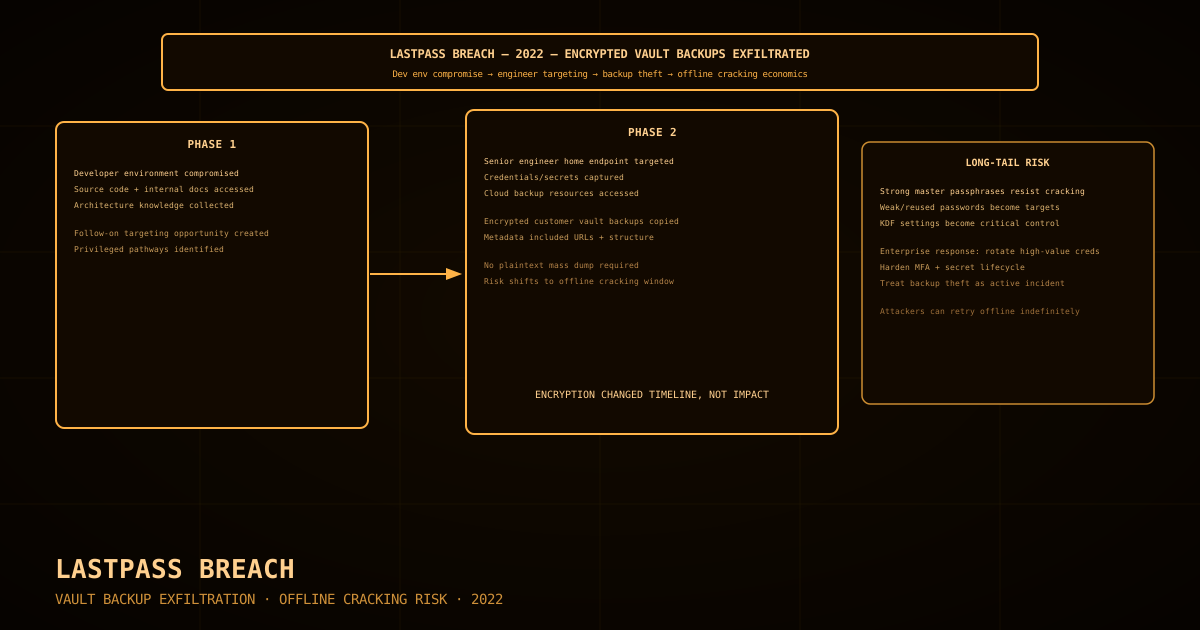
Because encryption did not end the attack. It changed the timeline of exploitation from immediate fraud to offline cracking economics — a contest between attacker GPU budgets and the strength of each victim’s master password configuration.
The Two-Stage Intrusion
The incident unfolded in connected phases.
Phase 1 — Developer Environment Compromise: Attackers obtained source code and internal technical information from a development environment.
Phase 2 — Follow-on Targeting: Using knowledge from phase one, the actors targeted a senior engineer’s home environment, obtained high-value credentials/secrets, and used them to access cloud storage containing production backup data.
That chain mattered. Source code theft alone is serious. Source code theft used to enable deeper operational access is catastrophic.
What Was Taken
LastPass reported theft of:
- Customer account metadata (names, billing/contact details in certain scopes)
- Vault-related metadata (URLs and structural data fields)
- Encrypted vault blobs containing stored credentials/notes/form data
Not every vault carried identical risk. Risk depended heavily on:
- Master password entropy
- PBKDF2 iteration settings on the account
- Whether high-value credentials were rotated quickly after disclosure
Why “Encrypted” Did Not Mean “Safe”
Password managers are designed so providers cannot read vault contents without the user’s master password. That architecture held.
But once encrypted vault copies are exfiltrated, attackers can perform unlimited offline guessing attempts against selected targets. There is no account lockout in offline cracking. The defender no longer controls request rate.
Security then becomes probabilistic:
- Strong, unique master passphrases with robust key-stretching settings are costly to crack.
- Weak, reused, or short master passwords become economically crackable over time.
That is why the incident became a long-tail risk event rather than a one-day blast radius.
Threat Model Shift for Users and Enterprises
Organizations that had treated password-manager compromise as a theoretical edge case suddenly had to execute emergency credential hygiene at scale:
- Rotate high-value credentials first (email, IdP admin, cloud root-equivalent access)
- Invalidate and reissue secrets stored in vault secure notes
- Audit password policy and KDF settings across managed users
- Accelerate phishing monitoring because stolen metadata can sharpen social engineering
The breach also reinforced a critical operational lesson: endpoint security in privileged employee home environments can become a production control boundary.
Industry Impact
The LastPass incident sharpened scrutiny across the password-manager ecosystem around KDF defaults, transparency in incident communication, segmentation of backup infrastructure, and privileged access pathways.
It also pushed more security teams toward layered models:
- Password managers plus hardware-backed MFA
- Secret managers for machine credentials instead of human vault notes
- Faster credential rotation pipelines tied to incident response playbooks
Legacy: Breach Resilience Is About Time
LastPass did not become famous for a plaintext credential dump.
It became a case study in delayed risk: attackers copied encrypted vaults and converted that data into a future attack inventory, sortable by crackability and target value.
In modern security terms, the incident’s central lesson is this:
if an attacker can take your encrypted backups, your password policy becomes an incident response control.
Not after the headlines.
Immediately.
Attack Chain: LastPass Breach (2022)
graph TD
    A["Initial Compromise\nDeveloper environment breached\nsource code + internal docs\naccessed by attacker"] --> B["Knowledge Harvest\nAttacker studies architecture\nidentifies privileged pathways\nand operational dependencies"]
    B --> C["Targeted Follow-on\nSenior engineer home endpoint\ncompromised for credentials\nand sensitive local artifacts"]
    C --> D["Privilege Pivot\nUse captured secrets to reach\ncloud-hosted backup resources\nwith vault data"]
    D --> E["Backup Exfiltration\nCustomer vault backups copied\naccount + vault metadata\nremoved from environment"]
    E --> F["Offline Attack Window\nEncrypted blobs attacked\nwith GPU password cracking\nprioritized by target value"]
    F --> G["User/Enterprise Response\nCredential rotation waves\nMFA hardening + policy updates\nKDF scrutiny"]
    G --> H["Legacy\nLong-tail cryptographic risk\nfor weak master-password cohorts\nnew ecosystem controls"]

    style A fill:#1a1a2e,color:#e0e0e0
    style C fill:#0d3b66,color:#a9d6ff
    style E fill:#c0392b,color:#fff
    style F fill:#8e44ad,color:#fff
    style H fill:#2c3e50,color:#e0e0e0
// Further Reading & Media
The LastPass Breach
How attackers chained a developer-environment compromise, source-code theft, and targeted exploitation of a senior engineer's home workstation to exfiltrate encrypted customer vault backups — turning a password manager incident into a long-tail cryptographic risk event for millions of users. Use this reference overview as a jumping-off point for deeper reporting, primary-source disclosures, and historical context.
→ View Resource