The Week the Web Went Down: Mafiaboy and the DDoS Panic of 2000
The Week the Web Went Down: Mafiaboy and the DDoS Panic of 2000
On February 7, 2000, Yahoo stopped feeling like a website and started feeling like infrastructure.
For much of the late 1990s, Yahoo was the front door of the commercial internet: search engine, news page, directory, finance portal, email launcher, home page. If you wanted to understand the web as the public understood it in 2000, you did not start with protocols or packet routing. You started with Yahoo.
Then it disappeared.
Users trying to load the site did not get a dramatic ransom note or a defacement. They got something worse for the era: nothing. Timeouts. Broken responses. A homepage that would not stay up long enough to reassure anyone. Traders, advertisers, journalists, and ordinary users all saw the same thing at once. One of the largest destinations on the internet had been reduced to intermittence by sheer volume.
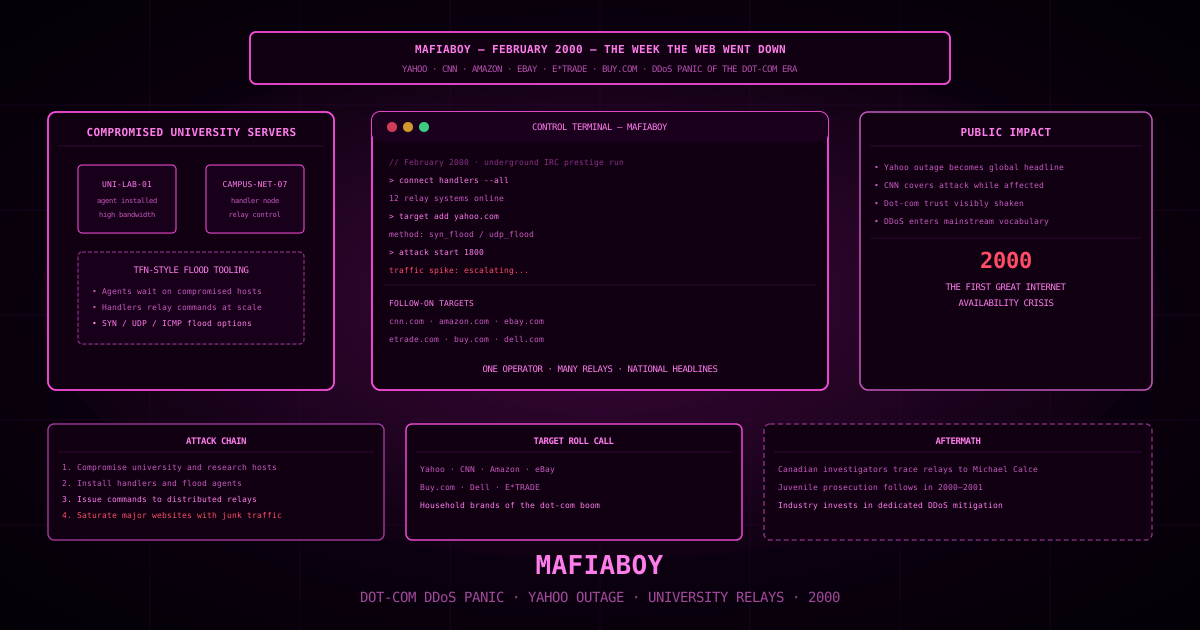
Over the next several days, the same thing happened to CNN, Amazon, eBay, Buy.com, Dell, and E*TRADE. The biggest consumer brands of the dot-com age were knocked off balance one after another by a teenager in Montreal using a borrowed empire of compromised university servers and the crude but devastating logic of early distributed denial of service tooling.
The alias attached to the attacks — Mafiaboy — became instantly famous. The technical method did too. Before February 2000, security professionals knew what a distributed denial of service attack was. After February 2000, everybody else did.
This was the week the public learned that the internet’s giants could be taken offline not by espionage-grade malware or insider sabotage, but by packet floods launched from systems their owners did not even realize they had lost.
Why It Hit So Hard: The Dot-Com Internet Was Built for Growth, Not Abuse
The timing mattered almost as much as the technique.
In early 2000, the public web still carried an aura of permanent upward motion. Capital was pouring into internet companies. The phrase e-commerce still sounded futuristic. Large portals and online retailers were valued not only as businesses but as symbols of an inevitable networked future. Their infrastructure was engineered primarily for scale, convenience, and growth. It was not yet engineered for sustained adversarial traffic generated by hundreds or thousands of distributed hosts.
This was an era before cloud scrubbing, before hyperscale content delivery mitigation, before always-on DDoS protection became a standard line item. Routers, upstream providers, and data centers could absorb bursts of popularity. They were far less prepared for intentionally weaponized floods arriving simultaneously from many directions.
That was the central revelation of the Mafiaboy attacks: availability itself was a security property, and the consumer internet had not yet learned how to defend it.
Threat Actor Profile: Mafiaboy
Real Name: Michael Calce
Alias: Mafiaboy
Origin: Montreal, Quebec, Canada
Age at Time of Attacks: 15
Primary Mission: Reputation, dominance, and thrill-seeking within underground IRC and hacking communities rather than financial extortion or strategic espionage
Known Tradecraft: Compromising poorly secured university and research servers, deploying DDoS agents and handlers, launching coordinated SYN/UDP/ICMP floods, using IRC-based social circles and chat infrastructure for status and control
Notorious Operations:
- Yahoo DDoS (February 7, 2000): The highest-profile opening blow, knocking one of the web’s most visited properties offline for hours.
- CNN / eBay / Amazon / Dell / E*TRADE / Buy.com (February 8–10, 2000): A rolling series of outages against top consumer and media brands that converted a security incident into a global business story.
- University Server Hijacking: The quiet precondition to the whole campaign. Calce first needed other people’s machines — high-bandwidth systems on trusted academic networks — before he could make household-name websites fall over.
The most culturally jarring part of the story was not that a threat actor existed. It was that the threat actor turned out to be a teenager. No state sponsor. No organized crime syndicate. No master criminal running a multinational extortion ring. A minor with time, curiosity, ego, and access to tools that were already circulating in the underground.
That fact shaped public reaction for years. It created the enduring fear that the modern internet might be both globally important and absurdly fragile.
Building the Flood: Borrowed Machines, Real Bandwidth
The attacks did not begin at Yahoo. They began in the less glamorous work of compromising intermediary systems.
Like many intruders of the period, Calce reportedly targeted university networks because they offered exactly what early flood operators wanted: fast connections, numerous Unix hosts, inconsistent patching, and administrators overseeing large decentralized environments. A compromised server in a university lab or research department was more useful than a home PC on dial-up. It had bandwidth, uptime, and institutional trust.
From those footholds, attackers in that era commonly installed agent programs — lightweight daemons waiting for commands from a controller. Above them sat handler systems, which relayed instructions to many agents at once. Some tool families used IRC-adjacent command patterns; others used custom control channels. The architectural idea was the same: one operator, many launch points.
This mattered because raw denial of service from a single host had obvious limits. A single machine could annoy. A network of commandeered hosts could overwhelm.
By early 2000, the underground already had the necessary software. Tools in the Tribe Flood Network family and related DDoS kits made it possible to coordinate large floods of junk traffic toward a single victim. The operator did not need to write the whole stack from scratch. He needed enough access to place the tooling, enough bandwidth to matter, and enough confidence to point it at targets whose outages would be noticed.
Calce had all three.
The Attack Mechanics: Simple Inputs, Asymmetric Effects
A DDoS attack succeeds when the defender has to be right about capacity, filtering, routing, and application behavior, while the attacker only has to generate more bad traffic than the system can gracefully absorb.
The February 2000 attacks appear to have relied on classical flood methods rather than subtle exploit chains. Different reporting over the years has cited SYN floods, UDP floods, and related volumetric traffic. The exact mixture matters less than the outcome. The targets were forced to spend resources accepting, tracking, or discarding massive numbers of bogus requests and half-open connections. Edge links saturated. Routers and firewalls strained. Application servers became unreachable even when the application code itself had not been compromised.
That distinction is one of the enduring lessons of the case. Many executives heard the word hack and imagined stolen data or altered files. But Mafiaboy demonstrated a different truth: sometimes the attack is not theft. Sometimes the attack is making your service unavailable long enough that the market, the press, and your customers all experience your weakness together.
Yahoo’s outage was the psychological turning point. Once the public saw that an internet giant could be knocked offline, each subsequent hit landed harder. CNN going down was not just a technical event; it was a symbolic one. A news outlet covering the story became part of the story. Amazon and eBay going down raised a different fear: if major commerce brands could be disconnected on command, what exactly had the digital economy built its confidence on?
The Week of Cascading Headlines
The sequence of attacks turned a technical disruption into a serialized media spectacle.
February 7: Yahoo suffers a prolonged outage. Engineers and upstream providers scramble to stabilize the service while markets and newsrooms start asking how something so central could fail so visibly.
February 8–9: Buy.com, eBay, CNN, and Amazon experience service degradation or outages. The attacks are no longer treated as isolated events. They are understood as a campaign.
February 10: E*TRADE and Dell are pulled into the same climate of panic. Analysts begin discussing not just direct downtime losses but investor confidence, online trust, and whether major internet businesses are structurally defensible.
The financial damage estimates varied wildly, as they usually do in the immediate aftermath of availability incidents. Some estimates focused on lost sales or advertising impressions. Others tried to price market reaction. But the deepest impact was reputational. The attacks hit at a moment when internet companies depended on the public’s belief that online services were dependable enough to replace physical habits. If you could not reach the portal, the shop, or the brokerage, that belief weakened.
This is why the incident became culturally significant rather than merely operational. It arrived at the exact moment when the web was becoming ordinary life. The outages felt like glimpses of a future in which society would depend on systems that could be disrupted from afar by people with almost no physical proximity to their victims.
Law Enforcement and Attribution: The Myth of Anonymity Shrinks
For all the mythmaking around the Mafiaboy alias, the attacks also showed the limits of adolescent operational security.
Large DDoS campaigns leave traces. Compromised intermediary systems can be examined. Logs can be subpoenaed. ISPs, universities, and investigators can reconstruct control paths, correlate timestamps, and walk backward from command infrastructure to the operator making mistakes at the edge.
Within months, investigators identified Michael Calce as the person behind the Mafiaboy handle. He was arrested in April 2000 by Canadian authorities. Because he was a juvenile, many details of the court proceedings were constrained by Canadian youth-protection rules, which only intensified the public fascination. The attacker was both globally famous and partially shielded by the law because he was still a minor.
Calce ultimately pleaded guilty in Canadian court to multiple charges related to the attacks and the compromise of intermediary systems. The sentence was not the cinematic ending popular culture might have expected. There was probation. Restricted internet use. A youth disposition rather than a life-defining prison term.
That mismatch between damage and punishment became part of the legend too. To many observers, it seemed impossible that one person could trigger international headlines, shake blue-chip internet firms, and then re-enter ordinary life as a teenager subject to rehabilitation rather than permanent ruin.
The Cultural Effect: From Hacker Folklore to Mainstream Fear
The Mafiaboy attacks landed in a media environment hungry for archetypes.
Journalists reached for the most available one: the teenage hacker genius. That framing was not wholly wrong, but it blurred important realities. Calce was not a lone wizard inventing a new science from first principles. He was operating inside an existing ecosystem of underground tools, prestige games, compromised hosts, and insecure networks. The event was shocking not because one prodigy transcended the laws of computing, but because the underlying internet had made this kind of performance possible.
Still, the mythology mattered.
Mafiaboy became a symbol of the late-1990s transition from hacker subculture to mass-market cybersecurity anxiety. Parents heard the story and imagined teenagers in bedrooms able to shut off Wall Street-adjacent services. CEOs heard it and imagined market capitalization evaporating because a few routers filled up. Policymakers heard it and understood that critical digital dependency had arrived earlier than serious defensive maturity.
In the years that followed, DDoS stopped being a niche concern. Enterprises invested in upstream filtering, better peering arrangements, traffic anomaly detection, scrubbing providers, and incident response coordination with ISPs. Security leaders learned to talk about resilience, not just confidentiality. Availability joined the top tier of board-level concerns.
The internet also learned a subtler lesson: the attack surface includes every machine that can be conscripted against you. Mafiaboy’s power did not come from the targets he attacked. It came from the third-party systems he compromised first. That logic would later scale dramatically through botnets like Mirai, but the cultural script was already visible in 2000.
What the Incident Changed
The direct technical innovations of the case were limited. The strategic implications were not.
First: it normalized the idea that DDoS attacks were a boardroom problem. Before February 2000, availability attacks were often treated as operational nuisances or specialist concerns. Afterward, they were executive issues.
Second: it exposed the weakness of perimeter thinking. The victims were not felled because their own application code alone was defective. They were felled because the broader internet path to them could be weaponized.
Third: it accelerated the commercial market for anti-DDoS services. Providers realized they could sell not just bandwidth and hosting, but survivability.
Fourth: it set a template for how cyber incidents become public myths. A short alias, a young attacker, household-name victims, rolling media coverage, and a visible kind of disruption — these ingredients made the event memorable in a way many technically deeper intrusions never become.
Legacy: The First Great Internet Availability Crisis
Looking back from an era of multi-terabit botnets and globally distributed scrubbing centers, the raw packet volumes of February 2000 can seem modest. That misses the point.
Mafiaboy mattered because he attacked the internet when the internet was still deciding what kind of public utility it wanted to be. He showed that the emerging digital economy had concentrated trust in a small number of visible platforms without yet building equally mature defenses around them. He demonstrated that compromise could be indirect, that disruption could be more important than theft, and that a small actor could manufacture a global event by abusing the connective tissue of the network.
The names of the victim companies freeze the story in time: Yahoo, eBay, Amazon, CNN, E*TRADE. They are a snapshot of the early web’s command centers. The attack against them was a rehearsal for every future conversation about internet resilience.
Not every culturally significant hack steals secrets. Some hacks become historic because they make millions of people feel dependence all at once.
That was Mafiaboy’s achievement, if achievement is the word for it.
He did not just knock sites offline.
He introduced the mainstream world to the idea that the internet could have traffic jams on purpose.
Attack Chain: Mafiaboy and the 2000 DDoS Attacks
graph TD
    A["Reconnaissance\nScan universities and high-bandwidth networks\nFind weak Unix hosts and admin gaps"] --> B["Initial Compromise\nExploit or abuse weak credentials\non academic / research servers"]
    B --> C["Relay Infrastructure Built\nInstall handlers + flood agents\nacross multiple compromised systems"]
    C --> D["Command Coordination\nOperator issues instructions\nthrough underground control channels"]
    D --> E["Target Selection\nYahoo first, then CNN, Amazon,\neBay, Buy.com, Dell, E*TRADE"]
    E --> F["Traffic Flood Launch\nSYN / UDP / ICMP-style floods\nfrom many distributed hosts"]
    F --> G["Network Saturation\nLinks, routers, and front-end systems\nstruggle to absorb junk traffic"]
    G --> H["Public Outage\nMajor sites time out or fail\nusers and markets notice immediately"]
    H --> I["Serial Media Panic\nEach new outage reinforces idea\nthat internet giants are fragile"]
    I --> J["Investigation\nLogs, compromised relays, and ISP traces\nlead Canadian authorities to Mafiaboy"]
    J --> K["Aftermath\nJuvenile prosecution + industry shift\ntoward dedicated DDoS mitigation"]

    style F fill:#c0392b,color:#fff
    style H fill:#8e44ad,color:#fff
    style I fill:#8e44ad,color:#fff
    style K fill:#2c3e50,color:#e0e0e0
// Further Reading & Media
Mafiaboy: How I Cracked the Internet and Why It's Still Broken
Michael Calce's memoir of the February 2000 attacks and the culture that produced them. Useful as a first-person account of the panic, the immaturity of early internet defenses, and the mythology that formed around the Mafiaboy alias.
→ View Resource