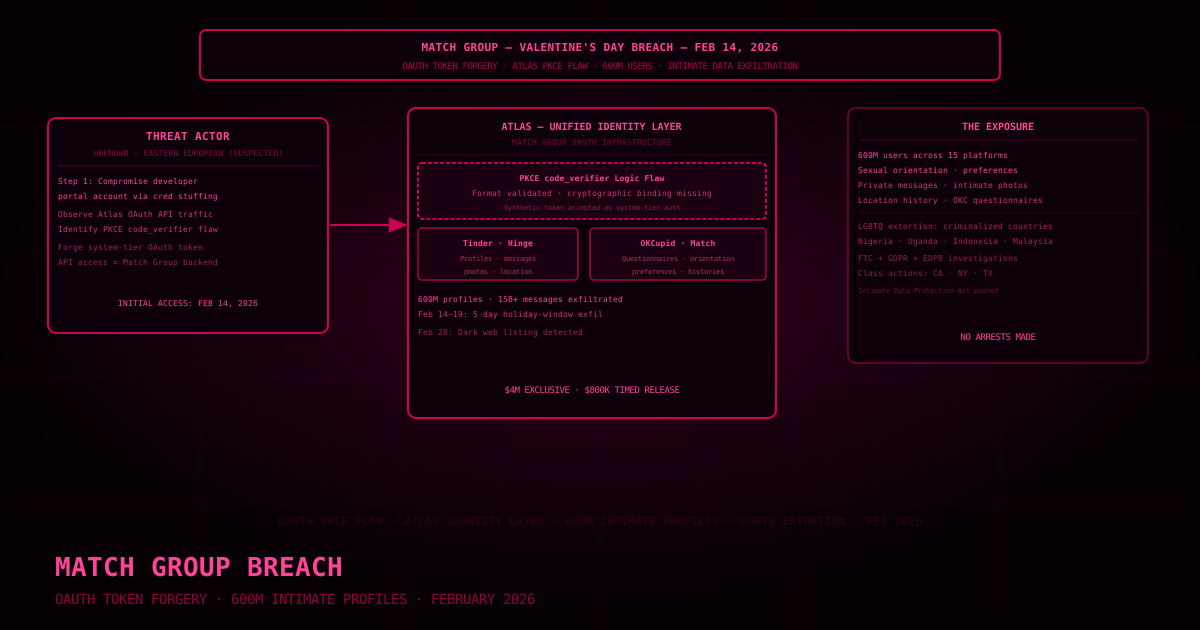
The Valentine's Day Massacre: The Match Group Breach and the Intimate Data of 600 Million
The Valentine’s Day Massacre: The Match Group Breach and the Intimate Data of 600 Million
The alerts began on February 20, 2026 — six days after the data had already left Match Group’s infrastructure.
A threat intelligence firm monitoring dark web forums flagged a listing: a seller offering what they claimed was a complete export of Match Group’s user database, structured by platform. The post included verifiable samples — real user profiles, real message threads, real photographs. The price was $4 million for exclusive access, or $800,000 for a timed release that would make it freely available after thirty days.
Match Group’s security team pulled the incident timeline and found what the logs already knew: starting on February 14, 2026 — Valentine’s Day, which was either coincidence or cruelty — an unknown attacker had used a forged OAuth token to authenticate to Match Group’s internal identity API as a system-level administrator. Over the following five days, across a window timed to the highest-traffic period of the dating industry’s calendar year, the attacker had systematically exported user data from every platform in Match Group’s portfolio.
600 million users. Not financial data. Not credit card numbers. The most intimate information 600 million people had ever entered into a computer — who they were attracted to, what they were looking for in a partner, private messages sent in vulnerability and desire, photographs never intended for any audience other than a potential match, location check-ins mapping where people slept, where they met, how their lives were laid out on the earth.
For most data breaches, the harm is financial. This one was different.
What Match Group Is — And What It Was Holding
Match Group is the largest portfolio company in the history of online dating. Through a sequence of acquisitions beginning in the early 2000s, the company assembled virtual ownership of the entire romantic internet: Tinder, Hinge, OKCupid, Match.com, Plenty of Fish, Meetic, Pairs (Japan), Hakuna (Korea), BLK, Chispa, Archer (LGBTQ+), and six other platforms serving regional markets across four continents.
By 2026, Match Group’s portfolio covered an estimated 40% of all online dating activity globally. Tinder alone had been downloaded 530 million times since its 2012 launch. Hinge had grown from a niche platform to the default app for millions of people seeking serious relationships. OKCupid asked users to answer hundreds of questions about their values, politics, sexuality, and relationship goals — questions whose answers were far more sensitive than any financial credential.
The data Match Group held was not merely personal. It was intimate. It was data people entered not because a company required it but because they wanted someone to know — and that someone was supposed to be a private audience of one.
Match Group’s infrastructure had evolved over two decades of acquisitions into a federated architecture held together by a single unified identity and authentication layer — a system called Atlas that all Match Group applications used to authenticate users and enforce access control. When you logged into any Match Group platform in 2026, Atlas was the system that validated your session, maintained your profile’s linkage across devices, and controlled API-level access to user data tables.
Atlas was also the system that contained the vulnerability.
The OAuth Architecture and the Forged Token
OAuth 2.0 is the industry-standard authorization framework used by virtually every major consumer application. When a user logs in to Match Group’s apps via “Sign in with Google” or “Sign in with Apple,” OAuth is the protocol managing the token exchange. Match Group’s internal Atlas system extended OAuth to manage machine-to-machine communication between its microservices as well — using OAuth client credentials flow for internal API calls between Match Group’s data services.
The vulnerability was a logic flaw in Atlas’s Proof Key for Code Exchange (PKCE) validation — a security extension to OAuth designed to prevent a class of attack called authorization code interception. Atlas’s implementation verified the PKCE code_verifier format but failed to cryptographically bind it to the original code_challenge generated at session initiation for a specific class of internal API clients. In plain terms: if an attacker could observe a legitimate OAuth token in flight and understood the API endpoint structure, they could construct a synthetic token that the Atlas validator would accept as legitimate — elevating the token to the highest permission tier in Match Group’s internal API hierarchy.
The attacker did exactly this. Forensic reconstruction later concluded that the initial access vector was likely a compromised third-party developer account — Match Group ran a large external developer program, and the breach investigators found evidence that a developer portal session had been used to observe authenticated API requests from Match Group’s internal monitoring dashboard. From that session, the attacker extracted enough information about Atlas’s token structure to craft the forge.
On February 14, 2026, the first forged token authenticated against Atlas. It was granted system-tier authorization. The attacker now had API access equivalent to Match Group’s own backend services.
The Data: What Was Taken
The attacker did not take everything randomly. The export followed Match Group’s own data architecture — pulling specific tables from specific services in a sequence that suggested advance knowledge of which databases held which data categories.
What the post-breach forensic analysis confirmed was stolen:
- Core profile data (600M+ accounts): Legal name (for verified profiles), username, birthdate, gender identity, sexual orientation, relationship goals, stated preferences, profile photographs including private/hidden photos, voice notes, and video intros on Hinge
- Private messages (estimated 15B+ messages): Full message threads across Tinder, Hinge, OKCupid, and Match.com, including messages users had previously “deleted” — which in Match Group’s architecture deleted the user-facing record but not the underlying database entry for some categories
- Location history: GPS coordinates logged at session initiation — where users opened the app, time-coded across years for active accounts; on some platforms, aggregated travel history used for “distance” matching
- Preference and behavior data: Who users swiped right or left on, super-liked, unmatched, blocked, or reported — data that revealed patterns of attraction far more precise than stated preference
- OKCupid questionnaire responses: OKCupid’s distinguishing feature was its extensive personality questionnaire. Match Group’s export included complete questionnaire response histories — political views, relationship ethics, sexual practices, substance use, religious beliefs, and hundreds of other categories users had answered in the expectation that only potential matches would see aggregate compatibility scores, not raw individual responses
- Payment and subscription data: Premium subscription histories — including the platform, tier, duration, and renewal pattern — across all properties; transaction references (not full card numbers, which were stored separately with a PCI-compliant payment processor)
- Cross-platform identity linkages: Atlas’s central identity table, which linked users’ accounts across Match Group platforms under a single identifier — revealing, for example, that a user with a hidden Tinder account was also active on Hinge under a different persona
The payment card data was not in the export; Match Group used a third-party PCI DSS processor for transaction handling. Everything else was.
The Harm Architecture: Why This Breach Was Different
In the days following detection, Match Group hired Mandiant and issued notifications to regulatory bodies in the United States, European Union, and twelve other jurisdictions. Legal counsel prepared for the class action litigation that was already in progress by the time the first press reports appeared.
But the breach’s damage was not primarily financial, and it was not primarily legal. It was personal, targeted, and in some cases, life-threatening.
Within two weeks of detection, Match Group’s trust and safety team was documenting a pattern: LGBTQ users whose orientation was revealed by the breach and who lived in countries where homosexuality is criminalized were receiving targeted extortion messages. The messages demonstrated specific knowledge: the sender knew the target’s real name, location, and the contents of their dating profile. The demands were for payment in cryptocurrency. The implicit threat was exposure to family, employer, or — in some jurisdictions — law enforcement.
The list of countries where homosexuality remains illegal included multiple nations where Match Group’s apps were actively used. OKCupid’s questionnaire asked users directly about their sexual orientation. Tinder’s design surfaced preferences through user behavior. The data was now in the hands of parties who appeared to understand precisely how to weaponize it.
LGBTQ-advocacy organizations documented incidents in Nigeria, Uganda, Indonesia, and Malaysia in the weeks following the breach. In at least three cases, individuals who had received extortion threats and not paid subsequently faced public exposure. The link to the Match Group breach data was confirmed forensically in two of those cases.
For heterosexual users in democratic countries, the harm was different in degree but consistent in kind: private messages sent to partners who became ex-partners were now potentially in a database circulating in criminal markets. Location data mapping years of romantic activity was exposed. The photographs — some explicit, some simply intimate — had left the platforms users had shared them on.
A secondary market for the data formed within weeks. Threat intelligence firms documented vendors selling profile subsets organized by geography, age bracket, and — most disturbingly — by orientation flag, demonstrating that the data was being curated for targeted exploitation rather than bulk credential stuffing.
Regulatory Response and the Intimate Data Question
The Federal Trade Commission opened an investigation within seventy-two hours of Match Group’s breach notification. The European Data Protection Board convened an emergency session under GDPR Article 60 coordination procedures. Regulators in the United Kingdom, Australia, and Canada opened parallel proceedings.
The legal frameworks applied were a patchwork:
GDPR (Europe) covered EU residents’ data and provided the clearest framework — Articles 25 (data protection by design), 32 (technical and organizational security measures), and 35 (data protection impact assessment requirements for high-risk processing). Sexual orientation data is special category data under GDPR Article 9, subject to enhanced processing restrictions. The maximum GDPR fine — 4% of global annual revenue — applied to the highest-risk findings. Match Group’s global revenue in 2025 had been approximately $3.7 billion. The potential EU fine alone was $148 million.
US federal law offered a fragmented landscape: no comprehensive federal privacy statute applied to intimate personal data from non-healthcare contexts. The FTC Act Section 5 (unfair or deceptive practices) was the primary enforcement mechanism. Several states — California under CPRA, Washington under MHMD Act, and Virginia under VCDPA — had enacted privacy statutes that applied to sensitive data categories including sexual orientation. Class action litigation under state unfair competition and consumer protection laws was filed within seventy-two hours in California, New York, and Texas.
The breach prompted an immediate push in Congress for the Intimate Data Protection Act — long-stalled legislation that would create a federal framework for the protection of sensitive personal data categories including sexual orientation, health information, financial details, and location data, with enforcement by both the FTC and state attorneys general. Previous versions had died in committee; the Match Group breach gave it new momentum.
The core legislative question the breach surfaced: data collected for one intimate purpose — finding a romantic partner — had been accumulated, centralized, and held without the security architecture that its sensitivity required. The PKCE validation error in Atlas was, in retrospect, an implementation mistake in a codebase that had grown through acquisition and integration over twenty years. But the fundamental architecture — centralizing the most intimate data of 600 million people in a single identity system with a single permission tier — was a design choice, and it was a design choice made without proportionate security investment.
The Attribution Gap
By April 2026, no arrests had been made. The attacker’s identity had not been confirmed.
Forensic analysis identified the developer portal account used in the initial OAuth observation as belonging to an entity registered in Moldova. The cryptocurrency payment address associated with the dark web listing received no confirmed payment before Match Group’s lawyers obtained a court order requiring dark web infrastructure hosts — to the limited extent they could be reached — to remove the listing. The data was already distributed.
Law enforcement cooperation between the United States, European Union, and eastern European jurisdictions proceeded at the pace law enforcement cooperation between those jurisdictions always proceeded: slowly, with jurisdictional gaps, treaty limitations, and the practical difficulty that the persons of interest, if they existed anywhere identifiable, had not left a recoverable paper trail.
The dark web vendor handle associated with the listing disappeared. The data did not.
Legacy: The Price of Intimacy in the Digital Age
The Match Group breach did not expose financial credentials that could be changed with a call to a bank. It exposed years of intimate choices — who people were, who they wanted, what they said, where they went, what they feared, what they hoped.
A credit card number can be reissued. A Social Security number can be monitored for fraud. An orientation cannot be unexposed. A private message cannot be unsent. A photograph cannot be unshared.
For the 600 million people whose data was taken on Valentine’s Day 2026, the exposure was proportional to how honestly they had used the platforms — the more authentically they had engaged, the more of themselves was in the database. The users who had filled out OKCupid questionnaires in full honesty, who had sent vulnerable messages, who had used Tinder to explore an identity not yet visible in their physical lives — these were the users whose exposure was most severe.
The Match Group Breach became the reference event in a policy debate that had been deferred since Ashley Madison in 2015: intimate data — data about who people love, desire, and are — required dedicated legal protection that existing privacy frameworks did not provide. The patchwork of state laws, GDPR’s special category regime, and FTC Section 5 enforcement were all post-hoc mechanisms applied to a problem that design-phase protection should have prevented.
The OAuth token has since been fixed. The Atlas identity system has been redesigned with hardware-bound token signatures and granular permission tiers. Match Group spent $340 million on remediation, settlement reserve, and security architecture overhaul in the twelve months following the breach.
The data is still out there.
Attack Chain: Match Group — OAuth Token Forgery and Intimate Data Exfiltration
graph TD
    A["Reconnaissance\nAttacker surveys Match Group's\ndeveloper portal and Atlas OAuth\nAPI documentation — identifies\nclient credentials flow endpoints"] --> B["Initial Foothold\nCompromise third-party developer\nportal account via credential\nstuffing — observes authenticated\nAtlas API request structure"]
    B --> C["Token Forge\nExploit PKCE code_verifier\nlogic flaw in Atlas: construct\nsynthetic OAuth token with\nsystem-tier authorization"]
    C --> D["First Authentication\nFeb 14, 2026 — Valentine's Day\nForged token accepted by Atlas\nAttacker has API access equiv.\nto Match Group backend services"]
    D --> E["Platform Enumeration\nMap Match Group's internal\nservice topology — identify\ndata tables per platform:\nTinder · Hinge · OKCupid\nMatch.com · OKC questionnaires"]
    E --> F["Staged Exfiltration\nFeb 14–19: systematic table\nexport via Atlas data API\n600M profiles · 15B+ messages\nlocation history · orientation\nprivate photos · questionnaires"]
    F --> G["Detection\nFeb 20: threat intel firm\nflags dark web listing with\nverifiable sample data\nMatch Group pulls incident logs"]
    G --> H["Dark Web Listing\n$4M exclusive or $800K\ntimed release offered\nData confirmed authentic\nby sample verification"]
    H --> I["Targeted Extortion\nLGBTQ users in criminalized\ncountries receive demands\nusing real name + location\nfrom breach data"]
    I --> J["Regulatory Response\nFTC · GDPR · EDPB investigations\nClass actions in CA, NY, TX\nIntimate Data Protection Act\ngains Congressional momentum"]
    J --> K["Legacy\n600M users' intimate data exposed\nNo arrests made · Data circulates\nMatch Group: $340M remediation\nOAuth PKCE logic flaw fixed"]

    style A fill:#1a0a1a,color:#e0e0e0
    style B fill:#3a0a3a,color:#ffaaff
    style C fill:#c0392b,color:#fff
    style D fill:#c0392b,color:#fff
    style F fill:#8e44ad,color:#fff
    style I fill:#8e44ad,color:#fff
    style K fill:#2c3e50,color:#e0e0e0