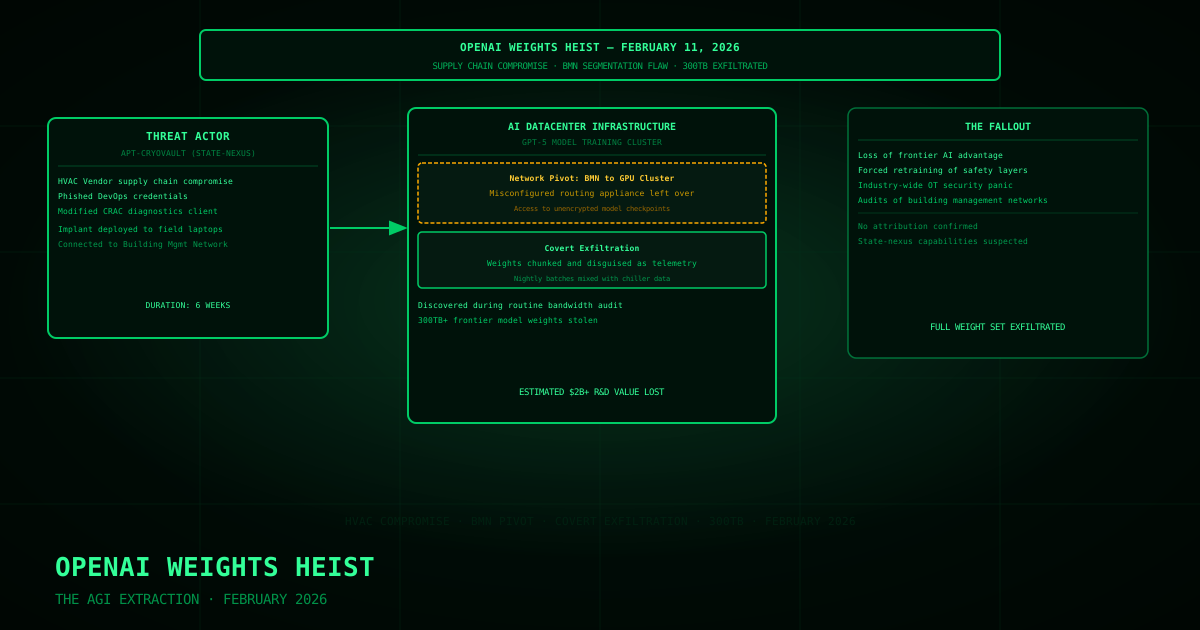
The AGI Extraction: The OpenAI Weights Heist
The AGI Extraction: The OpenAI Weights Heist
The alert that eventually blew the case open had nothing to do with a firewall, an IDS signature, or a SOC analyst staring at a SIEM dashboard. It came from a facilities engineer who noticed that a chiller unit’s remote diagnostics package was uploading roughly four times more data than its baseline — and it was doing it at 3 a.m., every night, for six weeks.
By the time anyone connected that anomaly to what was actually happening two floors below in a restricted colocation suite, the full parameter set of a frontier-class large language model — internally referred to by its codename, but unmistakably a GPT-5-class model — had already left the building. Not over the internet. Not through a VPN tunnel monitored by a security operations center. It left encoded inside what looked, to every monitoring tool in the building, like ordinary precision-cooling telemetry.
The Vendor Nobody Vets
Hyperscale AI datacenters spend enormous sums securing the network perimeter around their GPU clusters: air-gapped model-serving VLANs, hardware security modules for key material, biometric access to the server halls themselves. What they spend comparatively little effort securing is the ecosystem of third-party contractors who service the physical plant — the precision cooling systems, the diesel generators, the fire suppression, the building management systems that keep a datacenter from cooking itself alive.
In this case, the point of entry was a mid-sized precision-cooling and CRAC (computer room air conditioner) maintenance vendor contracted to service liquid-cooling loops across several US datacenter campuses, including a facility housing model-training and model-serving infrastructure for a major AI lab. The vendor’s field technicians used a common remote-diagnostics laptop image to interface with chiller control units on-site — an unremarkable piece of industrial software that had not been meaningfully updated in three years.
Investigators later determined that the vendor’s software supply chain had been compromised roughly four months earlier, when an update to the chiller diagnostics client — pushed from the vendor’s own build server — was silently modified to include a lightweight implant. The compromise of the build server itself was traced to a spear-phished credential belonging to a DevOps contractor who had reused a password across a personal GitHub account and the vendor’s internal CI/CD tooling.
From Cooling Loop to Cluster
Once installed, the implant did nothing for weeks. It sat inside the chiller’s diagnostic subsystem, a piece of embedded Linux running on an industrial PC connected to the facility’s building management network (BMN) — a network segment that, on paper, was supposed to be logically isolated from the datacenter’s compute and storage fabric.
It wasn’t. Investigators found that the BMN and the internal management network for the GPU training cluster shared a single misconfigured routing appliance, installed during a hurried capacity expansion the year before, that had never been fully decommissioned back to its intended isolated state. The chiller implant used this residual route to reach a jump host used by facilities engineers for legitimate purposes — checking rack-level temperature and power draw against workload telemetry.
From that jump host, the operators pivoted using harvested credentials to a storage array hosting checkpoint snapshots of models in active training and fine-tuning. These checkpoints — multi-terabyte tensor files representing the model’s weights at various training stages — were not encrypted at rest within the internal storage fabric, a design decision made for training throughput reasons that nobody had revisited as model value scaled into the billions of dollars.
Exfiltration Disguised as Telemetry
The genuinely novel part of the operation was the exfiltration channel. Rather than attempt a bulk transfer that any anomaly-detection system would flag instantly, the attackers built a staged pipeline: weights were chunked, compressed, and encoded into a format that mimicked the structure of the chiller’s legitimate telemetry payloads — sensor readings, pump cycle logs, refrigerant pressure curves — which were already permitted to leave the facility to the cooling vendor’s cloud-hosted analytics platform as part of the maintenance contract.
Over six weeks, in nightly batches timed to blend with the chiller’s normal reporting cadence, the full weight set moved out. Total exfiltrated volume was later estimated in excess of 300 terabytes, moved in traffic that any single day’s inspection would have judged unremarkable — a slightly larger telemetry packet, easily attributable to a firmware update or a verbose diagnostics mode.
Discovery and Fallout
The facilities engineer who flagged the anomaly wasn’t looking for an intrusion. She was doing a routine cost audit of the datacenter’s outbound bandwidth allocation and noticed the cooling vendor’s allotment had crept upward for no operational reason. It took incident responders another eleven days to trace the anomalous traffic back through the BMN, identify the implant, and confirm that model checkpoint data — not just sensor data — had been embedded in the outbound stream.
By the time containment was complete, attribution pointed toward a state-nexus actor with a documented interest in accelerating domestic frontier-model development, though no government has claimed responsibility and no arrests have been made. The lab in question quietly began retraining critical safety and alignment layers of the model, on the assumption that a full weight set in adversarial hands could be used to reverse-engineer safety mitigations, distill a competing model, or simply hand a rival nation a multi-year AI research shortcut for the cost of a single compromised HVAC vendor.
The incident triggered an industry-wide scramble to audit building management network segmentation across every major AI datacenter campus in the US. Several labs discovered similar residual routing misconfigurations from past capacity expansions. None of them had been actively exploited — yet.
Attack Chain: Cold Aisle Exfil — The GPT-5 Weights Heist (2026)
graph TD
    A["🎯 State-Nexus Actor\nAssessed AI-Acceleration Motive\nTracked as APT-CRYOVAULT"] --> B["Target Selection\nHyperscale AI Datacenter\nFrontier Model Training/Serving Facility"]

    B --> C["Supply Chain Compromise\nPrecision-Cooling Vendor Build Server\nSpear-Phished DevOps Contractor Credential\nReused Password: Personal GitHub → Vendor CI/CD"]

    C --> D["Malicious Update Pushed\nChiller Diagnostics Client Modified\nLightweight Embedded Linux Implant\nDeployed to Field Technician Laptops"]

    D --> E["On-Site Installation\nImplant Lands on CRAC/Chiller Control Unit\nConnected to Building Management Network (BMN)"]

    E --> F["Dormant Phase\nImplant Idle for Several Weeks\nAvoids Triggering Baseline Anomaly Detection"]

    F --> G["Network Pivot\nMisconfigured Routing Appliance\nBMN ↔ GPU Cluster Mgmt Network Bridge\nLeftover From Prior Capacity Expansion"]

    G --> H["Lateral Movement\nHarvested Facilities-Engineer Credentials\nReach Jump Host → Storage Array"]

    H --> I["Model Checkpoint Storage Located\nUnencrypted-at-Rest Tensor Files\nMulti-TB Training Checkpoints"]

    I --> J["Staged Exfiltration Pipeline\nChunk + Compress + Encode Weights\nMimic Legitimate Chiller Telemetry Format"]

    J --> K["Nightly Covert Transfer\n6-Week Duration\nBlended With Cooling Vendor's Cloud Analytics Feed"]

    K --> L["300+ TB Exfiltrated\nFull Frontier Model Weight Set\nDelivered to External Infrastructure"]

    L --> M["Discovery\nFacilities Engineer Flags Bandwidth Anomaly\nRoutine Cost Audit, Not Security Alert"]

    M --> N["Incident Response\n11 Days to Trace BMN Route\nImplant Identified on Chiller Unit"]

    N --> O["Fallout\nModel Safety/Alignment Layers Retrained\nIndustry-Wide BMN Segmentation Audit\nNo Attribution Confirmed, No Arrests"]
// Further Reading & Media
Frontier Model Theft: The Physical Layer Nobody Patches
A technical breakdown of how OT-adjacent supply chains — cooling, power, fire suppression — became the softest target in AI datacenter security, and why the industry's obsession with network perimeter missed the loading dock.
→ View ResourceDarknet Diaries: The Weights Are Gone
An inside account, drawn from incident responders and facilities engineers, of the six weeks between the intrusion and the moment security noticed the anomaly in outbound thermal telemetry traffic.
→ View Resource