When Police Become the Targets: The PNLD Breach
When Police Become the Targets: The PNLD Breach
By the time PNLD confirmed the breach, the people at risk were already in circulation.
Not case files. Not statutes. Not a confidential legal memo. The material reported to have surfaced on dark web marketplaces in the first week of August 2026 was more intimate and, in some ways, more dangerous: the contact details of UK police and justice staff. The people who answer emergency calls. The people who draft charging decisions. The people who process warrants, review custody, advise on procedure, and show up in the aftermath of violent crime. The breach did not just expose information. It exposed a target set.
That distinction mattered immediately. When a retailer loses customer emails, the consequences are fraud, phishing, and cleanup costs. When a health insurer loses patient records, the damage is privacy violation at industrial scale. But when a system used across policing and the criminal justice apparatus leaks staff contact data, the breach exits the digital world almost at once. It becomes a problem of stalking, intimidation, targeted harassment, and the possibility of real-world violence. It becomes, for organized crime groups and lone obsessives alike, an intelligence windfall measured not only in stolen fields but in doorstep distance.
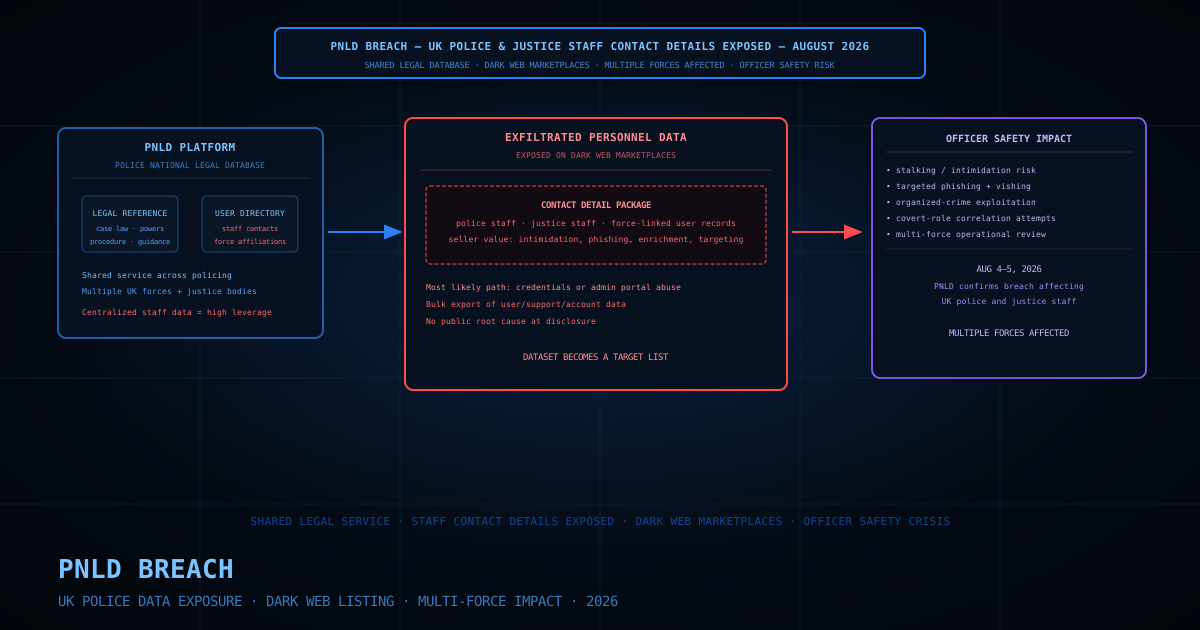
On August 4 and 5, 2026, the Police National Legal Database confirmed a breach affecting UK police and justice staff. Contact details tied to personnel across multiple police forces and justice organizations were reported exposed on dark web marketplaces. The public facts were stark and relatively few. But they were enough.
Because Britain had seen this category of failure before. The Metropolitan Police breach of 2023 exposed the data of officers and staff. The PSNI breach of 2023 published names, ranks, and locations in one of the most operationally sensitive policing environments in Europe. Each time, officials used the language available to them: review, notification, support, mitigation. Each time, the underlying truth was harsher. Once law enforcement personnel become the dataset, the breach is no longer only about privacy. It is about whether the state can protect the people it sends to confront danger on its behalf.
What PNLD Actually Is
The Police National Legal Database is not, despite the ominous ring of the word “database,” a giant vault of criminal evidence or covert case files. It is something more bureaucratic and therefore, in daily practice, more ubiquitous: a legal reference resource used by UK police forces and other criminal justice organizations.
That means PNLD sits in the workflow of ordinary state power. Officers and staff use it to look up statutory authorities, charging guidance, case law summaries, procedural updates, and practical legal references that shape what happens in custody suites, interview rooms, charging decisions, search warrants, and court-facing paperwork. It is not glamorous infrastructure. Most critical systems are not. Like the software that processes insurance claims or school attendance records, its importance lies in how deeply it is embedded in routine operations.
And routine systems accumulate sensitive data almost accidentally.
A legal reference platform does not need to store witness statements to create risk. It only needs to know who its users are, which organizations they belong to, how their accounts are administered, who receives support requests, who manages subscriptions, and how staff can be contacted when access breaks or policy changes. Over time, those support and account-management layers become their own sensitive directory: names, job roles, work contact details, organizational affiliations, perhaps escalation paths and administrative metadata. For an attacker looking to monetize access or construct a target list, that is enough.
This is the modern concentration-point problem. The most consequential breaches are not always the ones that hit the most secret systems. They are often the ones that hit the systems that connect many institutions at once. PNLD served multiple forces and justice bodies. A compromise at the center therefore radiated outward across separate organizations that would otherwise manage their risk independently. One breach became many force-level security problems overnight.
Threat Actor Profile: Unknown, but the Motive Is Legible
Designation: Unknown financially motivated cybercriminals
Attribution: No public attribution as of August 2026; data appearing on dark web marketplaces strongly suggests criminal monetization rather than a purely silent intelligence collection effort
Origin: Publicly unconfirmed
Primary Mission: Sale, extortion, enrichment, and downstream exploitation of law enforcement contact data
Known Tradecraft: Not publicly disclosed in this case; analogous incidents commonly involve credential theft, phishing, supplier compromise, abuse of administrative portals, bulk export of user directories, and resale through dark web brokers
There is an important difference between a breach attributed to a nation-state and one attributed to a financially motivated criminal actor. The state actor often wants the data kept quiet for as long as possible. The criminal actor, by contrast, has every incentive to circulate, sell, sample, and repackage it. Exposure on a dark web marketplace is not merely a disclosure event; it is a distribution model.
That distribution model is what makes the PNLD incident uniquely corrosive. A single buyer does not need to purchase the full dataset for harm to multiply. One broker can sell to many buyers. One buyer can cross-reference the records with older leaks, commercial data brokers, social media traces, public electoral or property records, and previous police-related exposures. What begins as “contact details” can quickly become a richer picture: where someone works, what shift pattern they might keep, which court or station they are associated with, which cases they may have touched, which family members are easiest to reach, which social-engineering pretexts might succeed.
And because the affected population includes police and justice staff, the buyer pool is unusually ugly. Organized crime groups, prison-based coordinators, domestic extremists, fixated individuals, private investigators operating beyond the law, doxxing networks, and opportunistic extortionists all have reasons to want law enforcement contact information. The same record can support very different harms depending on who acquires it.
The Exposure: Why This Data Is Different
The phrase “contact details” can sound mundane to people outside incident response. It should not.
In ordinary corporate breaches, contact data is often treated as second-tier harm — unpleasant, inconvenient, but less severe than financial credentials or national ID numbers. That logic collapses in the law-enforcement context. The value of police and justice contact data lies not in account takeover alone but in proximity. Contact details are how a target is reached, verified, pressured, located, or deceived.
A police constable’s contact record can be weaponized to deliver threats calibrated enough to feel credible. A staff member in a specialist unit can be identified as belonging to a sensitive function without a home address ever appearing in the leak. A prosecutor or court-facing administrator can be subjected to coordinated harassment designed to unsettle a case. A call, text, or spoofed email sent to an exposed staff member can be crafted to appear internal, urgent, and operationally plausible. That is not generic phishing anymore. That is adversarial social engineering against a national policing ecosystem.
Then there are the higher-consequence edge cases.
Undercover policing depends on separation: between real identity and cover identity, between overt contact channels and protected ones, between routine administrative data and operational secrecy. Witness protection and covert-source handling rely on similarly fragile boundaries. A breach of staff contact data does not have to include covert names to create risk. It only has to provide adversaries enough starting points to begin correlation. Which unit uses which contact conventions? Which number suddenly stops working after a disclosure? Which staff member belongs to a force known to run particular operations? Which exposed administrator can be impersonated to elicit internal responses from others? Intelligence work often begins with scraps.
That is why officer-safety concerns surfaced so quickly around the PNLD breach. The danger was not abstract. It was operational.
The Attack Chain We Can Actually Infer
What, technically, happened inside PNLD’s environment has not been fully disclosed publicly. No confirmed intrusion report, root-cause write-up, or named initial access vector had been released when the breach became public in early August 2026. That matters. It means any responsible reconstruction has to separate confirmed facts from assessed likelihoods.
The confirmed facts suggest several things.
First, the exposed material included staff contact details, not merely anonymous usage metrics or public-facing content. That indicates the attackers reached a system or subsystem containing user, support, administrative, or organizational profile data.
Second, the data appeared on dark web marketplaces, which implies some degree of packaging and external monetization. That makes a smash-and-grab export more likely than a purely covert read-only espionage operation.
Third, because multiple UK police forces were affected through a shared service, the compromise likely touched a central directory, customer-management layer, or export-capable administrative environment rather than requiring individual intrusions into each force.
From there, the most plausible attack chains look familiar to anyone who studies modern breaches:
1. Initial Access via Credential Theft or Phishing
The oldest path remains the most common. An attacker obtains valid credentials — through phishing, password reuse, infostealer malware on an employee device, or a third-party supplier compromise — and signs into a legitimate portal. If the exposed records came from a support or administrative layer, a single high-privilege account may have been enough.
2. Administrative Portal or Support-System Abuse
Once inside, the actor does not necessarily need to exploit exotic malware or crash through hardened segmentation. Many high-value systems already contain their own export functions for legitimate support, migration, and account administration. If PNLD or a connected service maintained contact directories, user-management dashboards, or organization-level exports, a valid session could turn a convenience feature into an exfiltration tool.
3. Bulk Enumeration and Quiet Export
Attackers operating for profit tend to move toward the most monetizable data first. In this case, that would mean enumerating user profiles tied to police forces and justice organizations, extracting contact fields and organizational metadata, and packaging them into something sellable. The absence of confirmed wider operational data exposure suggests the actor may have taken the quickest path to marketable personnel information rather than pursuing a longer, noisier intrusion across unrelated police systems.
4. External Staging and Market Listing
Once exfiltrated, the data appears to have surfaced on dark web marketplaces. That usually means the records were staged, sampled, and advertised — either by the intruder directly or by an intermediary broker. At that point the problem changes character. The organization is no longer responding to one adversary. It is responding to a dataset that may now be copied indefinitely.
None of this requires cinematic tradecraft. That is the unnerving part. The technical chain that can produce a police-safety crisis may consist of nothing more exotic than a stolen password, an under-protected admin console, and a bulk export button nobody previously considered life-critical.
The Dark Web Economics of Law Enforcement Data
Why would criminals want this material if it does not contain bank credentials or blackmail-grade personal secrets?
Because law enforcement data has a secondary market value that ordinary corporate data does not.
A list of police and justice contact details can be resold in slices. One buyer wants it for targeted phishing. Another wants it for vishing — impersonating IT support, supervisors, or partner agencies to elicit credentials or case information. Another wants it for doxxing and intimidation. Another wants to enrich a larger package of public and stolen records to build a more precise map of a force’s personnel. Criminal ecosystems specialize. A data broker does not need to know the final use case to profit.
There is also a prestige economy around this kind of breach. Dark web sellers advertise law enforcement-related data because it signals audacity and exclusivity. A breach involving police organizations attracts buyers precisely because it seems harder, riskier, and therefore more valuable. A dataset tied to the justice system is marketed not just as information but as access to protected human infrastructure.
And once the data is in circulation, the danger is cumulative.
An exposed work email can enable a spoofed message that extracts more data. A phone number can support caller-ID impersonation. A role title can help an attacker understand who approves access. A force affiliation can guide region-specific targeting. Even when each field looks harmless in isolation, the assembled record becomes a scaffold for future intrusions.
This is how cybercrime and physical-world coercion begin to overlap. One domain feeds the other.
Discovery: The Moment a Reference System Became a Security Crisis
Breaches often become public through the language of containment: we are investigating an incident; we have taken steps; we are notifying affected parties. Those phrases are necessary. They are also flattening.
What happened around August 4-5, 2026 was not simply that a supplier announced an issue. It was that a legal reference system used across the British policing and justice ecosystem abruptly had to be understood as an officer-safety event.
The internal triage in a case like this is radically different from the triage after a retail breach.
Who exactly was exposed? Which organizations were affected? Were the records tied to overt personnel only, or could some belong to more sensitive units? Were any of the contact points personal rather than strictly institutional? Had the data been merely offered for sale, or already downloaded and redistributed? Could the exposed information be used to identify escalation chains inside forces or justice organizations? Which staff needed immediate warning to change habits, escalate suspicious communications, or review personal security posture?
Multiple police forces were affected, which means the response problem did not belong to one chief information officer or one force headquarters. It became a coordination challenge across separate institutions that nevertheless shared the same breach source. Notification, intelligence-sharing, welfare support, technical remediation, and operational review all had to happen in parallel. Every hour mattered because once a dark web listing exists, the timeline of harm is no longer controlled by the breached organization.
This is where law-enforcement breaches differ from ordinary public-sector incidents. The people exposed are not generic employees of a large bureaucracy. They may be individuals involved in gang investigations, domestic abuse cases, public-order deployments, prison liaison, firearms licensing, child protection, or counter-organized-crime work. Many perform roles that generate resentment even in routine circumstances. Some interact with people who are already violent, fixated, or well-resourced enough to exploit an information leak quickly.
The breach therefore raised precisely the fears it should have raised: officer safety and operational security.
The Thin Boundary Between Contact Data and Physical Risk
Cybersecurity professionals sometimes struggle to explain to non-specialists why certain categories of seemingly low-grade data produce extreme concern. The PNLD breach is a clean example.
Suppose an organized crime network gains a list of staff contacts associated with multiple forces. On its own, the list may not reveal addresses or covert deployments. But organized crime is not solving this as a single-variable puzzle. It is assembling context.
A phone number can be tested against encrypted messaging apps to see whether it is active. An email can be checked against prior breach corpora to discover reused passwords or personal accounts. A role title can be matched to LinkedIn, Facebook, memorial pages, sports clubs, or local press references. A pattern of naming conventions can reveal unit structures. A central support contact can be impersonated to ask officers to “re-authenticate” into a fake portal. A work number can be used to harass an officer’s family if it is already known from other sources who that officer is.
Now scale that across multiple forces.
Even where the initial leak is shallow, the adversary’s ability to enrich it may be deep. That is why breaches involving law enforcement personnel are uniquely dangerous: the exposed dataset is not the end of the attack. It is the start of a targeting cycle.
There is also the problem of deterrence and morale. Police organizations ask people to do difficult, public-facing, and sometimes dangerous work on the understanding that the institution will at least try to keep identifiable risk within acceptable bounds. When contact details spill onto dark web markets, that promise frays. Staff begin thinking about school runs, aging parents, social-media remnants, the old phone number still tied to a bank account, the public-facing role that now feels a little too searchable. Technical compromise becomes psychological exposure.
And in policing, psychological exposure matters. It changes behavior. It makes officers less willing to use personal devices, less trusting of unexpected contact, more cautious about routine paperwork, and more aware that hostile people may know just a little too much.
After PSNI, After the Met
The PNLD breach did not land in a vacuum. It landed in a country that was already painfully educated in what law enforcement data exposure can do.
The PSNI breach in 2023 was catastrophic not only because it exposed personnel information, but because it did so in Northern Ireland, where the stakes of identifying police staff are historically and politically charged. The Metropolitan Police breach in 2023 similarly underscored that administrative and supplier pathways can expose officers without a force’s operational networks ever being directly stormed.
Those incidents should have changed how every connected service supporting policing was classified in the national imagination. They demonstrated that personnel data inside law enforcement-adjacent systems is not back-office clutter. It is a protected asset with direct safety implications.
PNLD became the next reminder.
And there is a structural lesson here that extends beyond one vendor or one week in August. Security programs still tend to prioritize systems according to the sensitivity of their content rather than the sensitivity of their context. A legal reference service can appear lower-risk than an intelligence database because it does not store covert reports. But if it stores the contact details of the people who operate those systems — across many organizations — its breach potential is profound.
The OPM breach of 2015 in the United States made a similar point at a different scale. The disaster was not simply the theft of forms. It was the theft of dossiers about the people entrusted with state power. PNLD is not OPM in size or category. But it rhymes with it in one crucial respect: data about the workforce of government can be strategically or criminally valuable far beyond what the breached system’s bland administrative purpose might suggest.
Response, Recovery, and the Problem of Copies
Once data is exposed on a dark web marketplace, there is no meaningful sense in which it can be recalled.
Listings can be removed. Wallets can be monitored. Platforms can be disrupted. Law enforcement can sometimes seize infrastructure. None of that restores scarcity to a dataset that may already have been copied, mirrored, sampled, or sold privately. This is the irreversibility problem of digital breach response, and it is especially acute when the exposed information belongs to law-enforcement personnel.
So the work shifts from recovery to risk management.
That means identifying affected individuals and organizations as quickly as possible. It means reviewing whether exposed contact points should be retired or segmented. It means warning staff about impersonation attempts and suspicious inbound communications. It means scrutinizing administrative workflows that trust phone numbers or email identities too easily. It means checking whether any exposed records intersect with especially sensitive assignments. It means treating follow-on phishing, vishing, and doxxing attempts not as separate nuisances but as expected second-stage exploitation.
In ordinary enterprise response, that might sound like hygiene. In policing, it is closer to force protection.
There is a cultural challenge embedded here too. Many institutions remain better at handling cyber incidents as IT problems than as human-security problems. But the PNLD breach does not permit that distinction. Its core harm is the conversion of institutional contact data into adversarial targeting material. That requires coordination between cybersecurity teams, protective security, senior command, legal advisors, staff welfare, and — where necessary — specialist units accustomed to evaluating physical threat.
The database may have been digital. The response cannot be.
Legacy: The Day the Reference Library Caught Fire
What will the PNLD breach be remembered for?
Not for spectacular malware. Not for a named ransomware gang with a cartoon leak site mascot. Not for a billion-pound financial loss that can be neatly modeled in quarterly reports. It will be remembered because it illustrated, with unpleasant clarity, a truth modern states keep relearning:
you do not need to breach the most secret system to create a national-security-style personnel crisis.
You only need to compromise a trusted shared service that knows who the people are.
PNLD’s role was administrative, legal, routine. That is exactly why its compromise mattered. Systems that live in the background of state operations tend to inherit trust invisibly. They are used every day. They are rarely dramatized. Their security assumptions harden into routine. And when one of them fails, the breach arrives as a shock not because the system was obscure, but because it was so ordinary that nobody wanted to imagine it as a threat surface.
The legacy of the PNLD breach should therefore be larger than one post-incident review. It should include a change in how policing classifies third-party and shared-service data risk. Any system holding law-enforcement personnel identifiers, contact channels, organizational associations, or administrative hierarchies should be treated as a high-consequence asset even if it contains no evidence files, no covert-source reporting, and no operational plans.
Because criminals understand something bureaucracies sometimes forget: the fastest way to pressure an institution is often to target the humans who make it run.
In the aftermath of the PNLD exposure, multiple forces had to confront the same grim possibility at once — that somewhere, in a marketplace designed for people who traffic in stolen access and sold identities, police and justice staff had been reduced to rows in a catalog. Reachable. Searchable. Enrichable. Potentially targetable.
That is the real story of the breach.
A legal database was compromised. But the damage did not stay in the database. It moved outward — into inboxes, call logs, safeguarding reviews, covert-risk assessments, and the private calculations made by public servants deciding whether the next unknown number is just a nuisance or something worse.
The modern breach is often described as an attack on data. The PNLD incident was a reminder that some data is really about people, and some people, once exposed, carry the risk home with them.
Attack Chain: PNLD Breach — Assessed Law Enforcement Contact Data Exposure
graph TD
    A["Target Selection\nPNLD identified as a shared legal\nreference platform used by UK police\nforces and criminal justice organizations"] --> B["Initial Access\nPublic root cause undisclosed\nMost plausible paths: stolen credentials,\nphishing, or compromise of an\nadministrative/support account"]
    B --> C["Access to User/Admin Layer\nAttacker reaches systems containing\nstaff contact details, organization\naffiliations, or account-management data"]
    C --> D["Enumeration\nPolice and justice staff records\nacross multiple forces and bodies\nare identified and queried in bulk"]
    D --> E["Export and Exfiltration\nContact-detail dataset is packaged\nand removed from PNLD-connected\nenvironment for resale or extortion"]
    E --> F["Dark Web Listing\nStolen law-enforcement personnel\ncontact data appears on criminal\nmarketplaces in early August 2026"]
    F --> G["Discovery and Confirmation\nAug 4–5, 2026: PNLD confirms\nbreach affecting UK police and\njustice staff"]
    G --> H["Multi-Force Response\nNotifications, account review,\nprotective guidance, and operational\nsecurity assessments begin"]
    H --> I["Secondary Exploitation Risk\nPhishing, vishing, stalking,\nintimidation, organized-crime targeting,\nand covert-role correlation attempts"]
    I --> J["Legacy\nOfficer-safety concerns intensify\nacross UK policing; shared-service\npersonnel data reclassified as high risk"]

    style A fill:#1a1a2e,color:#e0e0e0
    style B fill:#4a1a6e,color:#d8b4fe
    style E fill:#c0392b,color:#fff
    style F fill:#c0392b,color:#fff
    style I fill:#8e44ad,color:#fff
    style J fill:#2c3e50,color:#e0e0e0
// Further Reading & Media
Exposed: When Police Become the Targets
An advisory covering the PNLD breach, officer safety implications, and recommended protective measures for exposed law enforcement personnel.
→ View ResourceThe Thin Blue Leak: Police Data on the Dark Web
An investigation into how breached law enforcement data creates physical safety risks and undermines covert operations.
→ View Resource