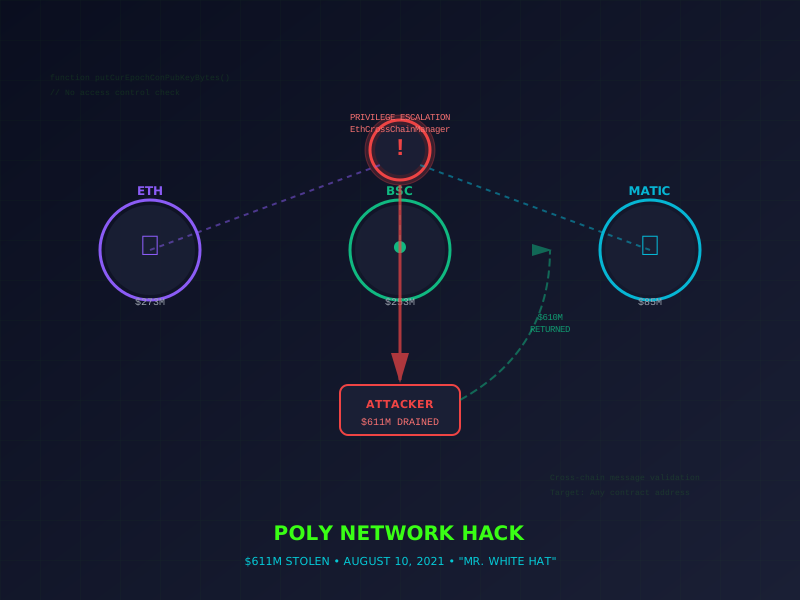
The $611 Million Heist That Wasn't: The Poly Network Hack
The $611 Million Heist That Wasn’t: The Poly Network Hack
On the morning of August 10, 2021, the blockchain analytics firm SlowMist posted an urgent alert on Twitter:
“The cross-chain protocol Poly Network was hacked. Assets on Ethereum, BSC, and Polygon have been transferred by the hacker. The amount is not clear yet but it is already in the hundreds of millions.”
Within hours, the estimate was revised upward. The actual figure: $611 million — the largest cryptocurrency theft in history, exceeding even the notorious Mt. Gox collapse.
Three blockchains had been drained. The attacker had executed a sophisticated exploit targeting a fundamental flaw in Poly Network’s cross-chain bridge architecture. The stolen funds were distributed across Ethereum, Binance Smart Chain, and Polygon. Blockchain forensics firms scrambled to trace the transactions. Law enforcement was notified. The DeFi community braced for contagion.
Then something unprecedented happened.
The attacker began returning the money.
Not some of it. Not after negotiation with law enforcement. Not in exchange for immunity. The attacker — who adopted the pseudonym “Mr. White Hat” and communicated exclusively via embedded messages in Ethereum transactions — returned $610+ million over the next 72 hours, engaged in lengthy on-chain Q&A sessions explaining the exploit and their motivations, and was ultimately offered the position of Chief Security Advisor by the very organization they had just robbed.
This was not a typical cryptocurrency heist. It was something stranger: a demonstration of a critical vulnerability in decentralized finance infrastructure by someone who claimed to have executed it “for fun” and then decided that keeping $611 million was “not very interesting.”
The Platform: Poly Network and Cross-Chain Bridges
Poly Network is a cross-chain interoperability protocol — a category of infrastructure designed to allow digital assets to move between different blockchains. Ethereum, Binance Smart Chain, Polygon, and hundreds of other blockchain networks operate as isolated ledgers with distinct transaction formats, consensus mechanisms, and native tokens. Moving assets from one chain to another is not inherently supported; it requires a bridge protocol.
Cross-chain bridges work by locking assets on the source chain and minting equivalent “wrapped” tokens on the destination chain. When a user wants to move 100 USDC from Ethereum to Binance Smart Chain, for example, the bridge locks 100 USDC in a smart contract on Ethereum and mints 100 bridged-USDC on BSC. When the user wants to return, the bridge burns the BSC tokens and unlocks the original Ethereum tokens.
The critical security challenge is ensuring that only legitimate bridge operations — validated by the bridge’s consensus or governance mechanism — can trigger unlocks. If an attacker can convince the bridge to unlock funds without having legitimately deposited equivalent value on the other side, they can drain the entire bridge’s reserves.
Poly Network’s bridge architecture relied on a set of “keeper” contracts on each supported blockchain. These keepers validated cross-chain transaction messages signed by Poly Network’s off-chain relay nodes. The keeper contracts maintained an internal list of authorized addresses that could execute privileged operations — including updating the keeper’s own configuration.
This was where the vulnerability existed.
The Exploit: A Logic Flaw in Privilege Management
The attacker did not exploit a reentrancy bug, an integer overflow, or a flash loan manipulation — the usual suspects in DeFi hacks. The vulnerability was conceptual: a privilege escalation flaw in the keeper contract’s message validation logic.
Here is what the attacker did, step by step:
Step 1: Craft a Cross-Chain Message The attacker constructed a specially formatted cross-chain transaction message that would be relayed by Poly Network’s nodes from one blockchain (e.g., Ethereum) to another (e.g., Binance Smart Chain). Cross-chain messages included instructions for the destination keeper contract to execute.
Step 2: Exploit the EthCrossChainManager Contract
The destination keeper contract — specifically the EthCrossChainManager — accepted cross-chain messages containing arbitrary function calls to any contract address, including the keeper itself. The keeper validated that the message was signed by authorized relay nodes but did not validate that the target contract of the function call was safe to invoke.
Step 3: Invoke a Privileged Function
The attacker embedded a function call within the cross-chain message targeting the keeper’s own putCurEpochConPubKeyBytes() function — a privileged method used to update the list of authorized public keys that could sign cross-chain messages. Normally, only the contract’s owner or governance process could call this function. But because the function call came from within a validated cross-chain message, the keeper contract executed it.
Step 4: Replace the Authorized Keys with the Attacker’s Own The attacker’s crafted message replaced the keeper’s authorized public key list with a key pair controlled by the attacker. The attacker now had the ability to sign arbitrary cross-chain messages that the keeper would accept as legitimate.
Step 5: Drain the Vaults With control over the keeper’s authorization logic, the attacker issued a series of cross-chain unlock messages instructing the bridge vaults on Ethereum, Binance Smart Chain, and Polygon to transfer their entire reserves to addresses controlled by the attacker.
The exploit executed in minutes. The attacker extracted:
- $273 million in assets on Ethereum
- $253 million on Binance Smart Chain
- $85 million on Polygon
The total: $611 million — at the time, the largest single cryptocurrency theft ever recorded.
The exploit was elegant in its simplicity. The attacker had not brute-forced cryptographic keys, compromised off-chain infrastructure, or exploited a subtle integer arithmetic bug. They had read the contract’s source code, identified that the privilege management function was callable via cross-chain messages without sufficient access control checks, and executed a logical attack that the contract’s designers had not considered.
The Response: A Surreal Negotiation
Within hours of the theft, blockchain forensics firms including SlowMist, PeckShield, and Chainalysis had traced the stolen funds to a set of addresses controlled by the attacker. The assets were not immediately moved to mixers or exchanges — they sat in plain view on the public blockchain, as if the attacker were pausing to consider their next move.
Poly Network issued a public plea:
“Dear Hacker, we want to establish communication with you. The amount of money you hacked is the biggest in DeFi history. Law enforcement in any country will regard this as a major economic crime and you will be pursued. We strongly advise you to return the assets.”
Then something unexpected happened. The attacker began responding — not via email, not via darknet forum, but by embedding messages in Ethereum transactions.
On August 11, the attacker sent a transaction containing the following note in the transaction’s input data field:
“It is always the people who asked me to help them to hack. I have never been interested in it… When spotting the bug, I had a mixed feeling. Ask yourself what to do if you face this situation!”
Additional messages followed over the next 48 hours:
“I did it for fun. When I explored the vulnerability, I had no idea how much I could get. The fact is that I am neither interested in the money nor trying to keep it.”
“I was ready to give back the fund when the network is down. But I asked for some extra time to make the decision. I will return it in a few days when I am ready.”
The messages were bizarre, defensive, and at times philosophical. The attacker explained technical details of the exploit, criticized Poly Network’s security practices, and engaged in Q&A sessions with the blockchain community — all via on-chain transaction metadata.
Then, the attacker began returning the funds.
Starting on August 11 and continuing through August 13, the attacker transferred assets back to addresses controlled by Poly Network:
- $260 million returned on August 11
- $260 million returned on August 12
- $91+ million returned on August 13
By August 13, effectively all of the stolen assets — minus approximately $33 million in USDT that had been frozen by Tether’s centralized control mechanisms before the attacker could move it — had been returned.
The attacker left a final message:
“The plan to return the assets has been made when I decided to hack the Poly Network. I transferred the fund to keep it safe from any investigators / ethical hackers — then to return it in a dramatized fashion.”
The Offer: Chief Security Advisor
On August 13, Poly Network issued a statement thanking “Mr. White Hat” and announcing that the attacker had been offered a $500,000 bug bounty — the maximum payout under Poly’s vulnerability disclosure program — and the position of Chief Security Advisor.
The offer was made publicly. The attacker’s response (via on-chain message) was cryptic:
“I am considering taking the CSA role. But only if Poly is really committed to becoming more secure.”
The DeFi community’s reaction ranged from admiration to outrage. Some argued that the attacker had performed a critical public service by exposing a catastrophic vulnerability in a high-stakes production system before malicious actors could exploit it irreversibly. Others pointed out that the attacker had, in fact, stolen $611 million — regardless of whether they returned it — and that offering them a job normalized theft as a method of vulnerability disclosure.
SlowMist, the blockchain security firm that had traced the attacker’s transactions, concluded its investigation by stating that the attacker’s identity was “not hard to figure out” based on transaction metadata, email addresses leaked in early communications, and on-chain behavioral analysis. However, no arrest or formal identification was made public.
The Vulnerability: Why Bridges Are High-Value Targets
The Poly Network exploit was not an isolated incident. In the years that followed, cross-chain bridge protocols became the highest-value targets in DeFi, with multiple nine-figure thefts executed using similar techniques:
Ronin Network (March 2022): Lazarus Group stole $625 million from the Ethereum sidechain bridge used by the Axie Infinity game by compromising validator keys.
Wormhole Bridge (February 2022): An attacker exploited a signature verification flaw to mint $325 million in unbacked Wrapped ETH on Solana.
Nomad Bridge (August 2022): A logic error in an upgrade allowed anyone to withdraw funds without validation, resulting in $190 million stolen in a “feeding frenzy” where hundreds of users copied the exploit.
Harmony Horizon Bridge (June 2022): Lazarus Group compromised multi-signature wallet keys to steal $100 million.
The pattern is clear: bridges concentrate liquidity (they must hold large reserves to facilitate transfers), bridges trust off-chain components (relays, validators, and multi-sig signers), and bridges implement complex cross-chain logic that is difficult to audit and verify.
The DeFi community has coined the term “bridge risk” to describe the systemic vulnerability posed by these protocols. Every cross-chain asset transfer introduces a trust assumption in the bridge’s security model. If that model fails, the consequences can be catastrophic.
The Aftermath: A Moral Dilemma
The Poly Network hack raised uncomfortable questions that the DeFi industry continues to wrestle with:
Was this a white-hat disclosure or a theft? The attacker’s claim that they “always planned to return the funds” is impossible to verify. Poly Network and affected users incurred zero net financial loss — but they endured 72 hours of uncertainty, reputational damage, and the cost of coordinating recovery operations. The attacker’s methods — executing a full-scale theft before returning funds — inflicted harm regardless of the eventual outcome.
Should vulnerability researchers be rewarded for exploiting systems without permission? Traditional bug bounty programs require responsible disclosure: report the vulnerability to the vendor, allow time for remediation, and receive a reward if the issue is valid. The attacker bypassed this process entirely, executed a public exploit, and then demanded recognition. Some argued this sets a dangerous precedent where researchers can justify unauthorized exploitation as “testing.”
What does “decentralized” mean when assets can be frozen? The $33 million in USDT that was frozen by Tether’s centralized admin keys demonstrated that even blockchain-based assets are not immune to external control. The decision to freeze the funds likely prevented the attacker from liquidating a portion of the theft — but it also highlighted that “decentralized finance” often relies on centralized actors with override authority.
Is code the only law in DeFi? The crypto community’s ethos of “code is law” suggests that smart contracts should be treated as immutable agreements — if the code allows an action, that action is legitimate. The Poly Network exploit was technically permitted by the contract’s logic. But the community overwhelmingly treated it as theft, illustrating a persistent tension between technical permissibility and social norms.
The Legacy: Bridges Under Scrutiny
The Poly Network incident accelerated industry efforts to improve cross-chain bridge security:
Formal Verification: Bridge protocols began adopting formal verification techniques — mathematical proofs that contract logic behaves correctly under all possible inputs — to catch privilege escalation and access control bugs before deployment.
Economic Security Models: Projects like LayerZero and Axelar introduced economic security frameworks where relayers and validators must stake collateral that can be slashed if they relay invalid messages, aligning incentives with correct behavior.
Multi-Signature and Governance Delays: Many bridges implemented multi-signature controls with time-delayed governance mechanisms, ensuring that critical administrative functions (like updating authorized keys) cannot execute instantly.
Security Audits and Bug Bounties: Major bridge protocols allocated millions of dollars to ongoing security audit programs and established bug bounty platforms with payouts reaching into seven figures for critical vulnerability disclosures.
User Education: DeFi platforms began warning users that bridging assets introduces additional risk, encouraging diversification and limiting exposure to any single bridge protocol.
None of these measures eliminate bridge risk entirely. The fundamental challenge remains: cross-chain interoperability requires trust assumptions that contradict the trustless security model of individual blockchains. Every bridge is a compromise.
Attack Chain: Poly Network Hack — August 10, 2021
graph TD
    A["Poly Network\nCross-Chain Bridge Protocol\nConnecting Ethereum / BSC / Polygon"] --> B["Keeper Contract Architecture\nEthCrossChainManager on Each Chain\nValidates Cross-Chain Messages"]

    B --> C["The Vulnerability:\nKeeper Accepts Arbitrary Function Calls\nIncluding Calls to Its Own\nPrivilege Management Functions"]

    C --> D["August 10, 2021\nAttacker Identifies Flaw\nNo Access Control on\nputCurEpochConPubKeyBytes()"]

    D --> E["Step 1: Craft Malicious\nCross-Chain Message\nEmbedded Function Call\nTargeting Keeper Contract Itself"]

    E --> F["Step 2: Message Relayed\nby Poly Network Nodes\nKeeper Validates Relay Signature\n(But Not Target Contract)"]

    F --> G["Step 3: Keeper Executes\nIts Own putCurEpochConPubKeyBytes()\nReplaces Authorized Keys\nwith Attacker's Key"]

    G --> H["Step 4: Attacker Now Controls\nCross-Chain Authorization\nCan Sign Arbitrary Unlock Messages"]

    H --> I["Step 5: Drain the Vaults\nIssue Unlock Commands\nTransfer All Bridge Reserves\nto Attacker Addresses"]

    I --> J["$273M Stolen\nEthereum\n(ETH, USDC, USDT, DAI)"]
    I --> K["$253M Stolen\nBinance Smart Chain\n(BNB, BUSD, BTCB)"]
    I --> L["$85M Stolen\nPolygon\n(MATIC, Wrapped Assets)"]

    J --> M["Total: $611 Million\nLargest DeFi Hack in History\nFunds Visible on Public Blockchain"]
    K --> M
    L --> M

    M --> N["Blockchain Forensics\nSlowMist / PeckShield / Chainalysis\nTrace Attacker Addresses\nNo Immediate Laundering Attempts"]

    N --> O["August 11: Attacker Begins\nOn-Chain Communication\nMessages Embedded in TX Data:\n'I did it for fun'"]

    O --> P["August 11–13:\nFunds Returned Incrementally\n$260M → $260M → $91M\nNearly All Assets Restored"]

    P --> Q["$33M USDT Frozen\nby Tether Admin Keys\nCentralized Override\nAttacker Cannot Move It"]

    P --> R["August 13:\nPoly Network Offers\n$500K Bug Bounty\n+ Chief Security Advisor Role"]

    R --> S["'Mr. White Hat'\nIdentity Remains Pseudonymous\nNo Arrest or Prosecution\nControversy Over Methodology"]

    M --> T["Cross-Chain Bridge Risk\nExposed as Systemic\nSubsequent Hacks Follow:\nRonin $625M, Wormhole $325M"]

    T --> U["Industry Response:\nFormal Verification\nEconomic Security Models\nMulti-Sig + Governance Delays"]
// Further Reading & Media
The Story of the Biggest DeFi Hack in History — And Its Unusual Ending
Ethereum founder Vitalik Buterin's real-time commentary and analysis as the Poly Network hack and subsequent refund unfolded. The thread captures the blockchain community's confusion, technical analysis, and ethical debate during one of the strangest incidents in DeFi history.
→ View Resource