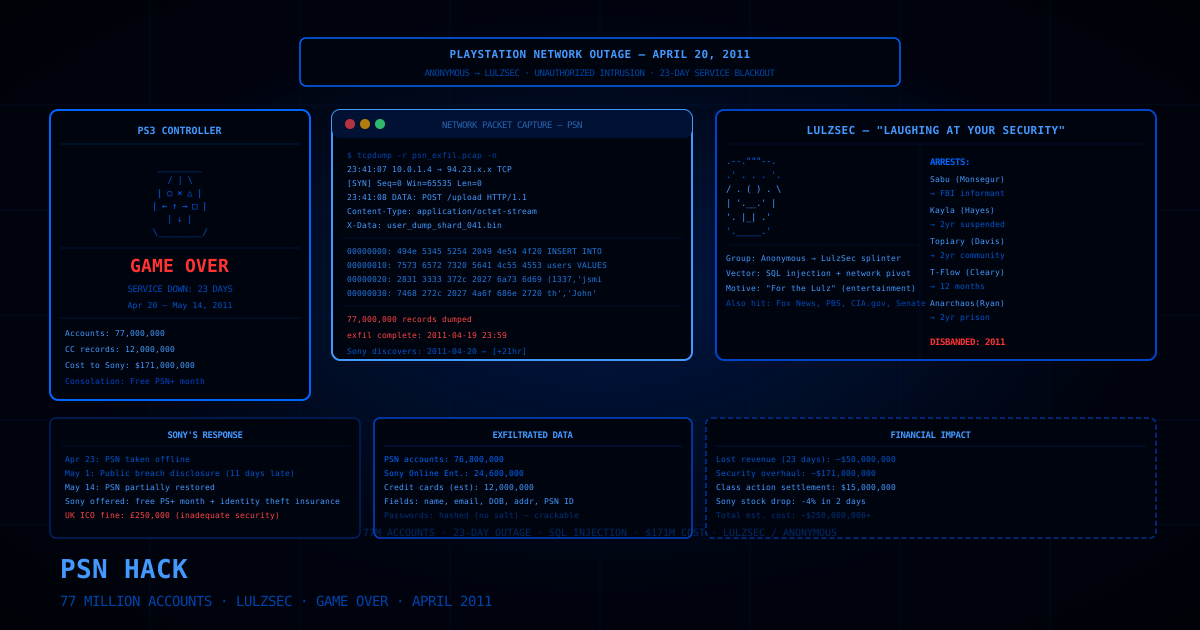
Network Down: The PlayStation Network Hack
Network Down: The PlayStation Network Hack
On the evening of April 20, 2011, millions of PlayStation 3 owners around the world tried to sign in to the PlayStation Network and received the same error message.
The network was down.
This was not, initially, alarming. Networks go down. Servers are patched. Sony would fix it and gamers would get back to their matches by morning. The company posted a brief maintenance notice and said nothing more.
Morning came. The network was still down.
A week passed. The PlayStation Network — the online gaming and media distribution backbone serving 77 million registered accounts across the PS3 and PSP platforms — remained completely offline. Then Sony did something that sent a cold shock through the gaming community and the US Congress simultaneously.
On April 26, six days after the outage began, Sony sent an email to its users. The email was careful, corporate, and devastating in its implications.
Someone had been in the network. Not a brief visit. An intruder — or intruders — had accessed the PlayStation Network servers and copied the personal information of every registered account. Names. Home addresses. Email addresses. Birthdates. Usernames. Passwords. And possibly — Sony was uncertain, which was itself alarming — credit card numbers.
Seventy-seven million accounts. The personal information of tens of millions of people, sitting in someone else’s hands.
The gaming world had just learned what the security industry already knew: Sony was in a war it hadn’t understood it was fighting.
Threat Actor Profile: LulzSec / Anonymous OpSony
Designation: LulzSec (Lulz Security); Anonymous / OpSony collective
Attribution: Partial. LulzSec, a splinter hacking collective with roots in Anonymous, claimed involvement in related Sony breaches. The PlayStation Network intrusion itself was never definitively attributed to a single group, though forensic evidence and the operational timeline are consistent with Anonymous/LulzSec activity. Individual members of LulzSec were later identified and prosecuted for related operations.
Origin: Distributed — United States, United Kingdom, Ireland, Australia
Active (peak): 2010–2012
Primary Mission: Ideological disruption (“lulz” — deriving entertainment from chaos), protest hacking, anti-corporate activism, anti-censorship operations. The PSN attack specifically emerged from protest against Sony’s legal assault on the PS3 jailbreaking community.
Known Tradecraft: SQL injection, web application exploitation, DDoS attacks, credential theft and publication (“doxing”), defacement, social engineering, exploitation of poorly patched web servers
Notorious Operations:
- HBGary Federal Hack (February 2011): Arguably Anonymous’s most sophisticated operation. After HBGary Federal CEO Aaron Barr claimed to have identified Anonymous’s leadership and planned to sell the information to the FBI, Anonymous penetrated HBGary’s email server, exfiltrated 71,000 emails, and published them publicly. The emails revealed HBGary’s plans to produce disinformation campaigns against WikiLeaks and journalists — a revelation that destroyed the company. A demonstration that the hacker collective could conduct targeted, high-sophistication intrusions when motivated.
- Fox.com Breach (May 2011): LulzSec compromised Fox.com, exfiltrating usernames and passwords of over 70,000 registered users and a large cache of contestant data from the show X Factor. Published publicly as a demonstration of capability.
- Senate.gov Attack (June 2011): LulzSec breached the US Senate’s public-facing web server and exfiltrated server configuration files. The attack was more symbolic than damaging, but the political implications — a hacker collective had breached a US government server — generated significant congressional attention.
- CIA Website Takedown (June 2011): LulzSec temporarily took the CIA’s public website (cia.gov) offline via DDoS attack. Announced in real time on Twitter. The brazenness was the point.
The Catalyst: Sony vs. George Hotz
To understand the PlayStation Network breach, you have to understand what Sony did to George Hotz.
George Hotz — known online as “geohot” — was twenty years old in January 2010 when he became the first person publicly known to have fully unlocked the iPhone’s baseband processor. He was the kind of prodigy who moved through the security community like a force of nature: technically brilliant, relentlessly public about his work, and constitutionally unable to resist a challenge.
The PlayStation 3 was, by 2009, the last of the major gaming consoles that had not been thoroughly hacked. Nintendo’s Wii had been cracked. Microsoft’s Xbox 360 had been modded. The PS3 had stood for three years with a reputation for exceptional security — a reputation that, to hackers, was essentially an invitation.
In January 2010, Hotz cracked the PS3. He published a complete jailbreak that, for the first time, allowed PS3 owners to run arbitrary code on the console — including Linux, custom applications, and, theoretically, pirated games. He was careful to note he was motivated by running his own software on his own hardware, a principle he articulated with genuine conviction.
Sony responded in January 2011 by filing a civil lawsuit against Hotz in US federal court, alleging violations of the Digital Millennium Copyright Act and the Computer Fraud and Abuse Act. The lawsuit was not merely about Hotz — it was a sweeping legal action that also subpoenaed YouTube, Twitter, and Google to identify IP addresses of people who had merely watched Hotz’s jailbreak video.
The hacker community watched this with gathering fury. Here was a corporation using the legal system to criminalize watching a video of someone unlocking their own hardware. The chilling effect was obvious. The intent, read from the outside, was to prosecute not just Hotz but anyone who engaged with the PS3 hacking ecosystem.
Anonymous responded by declaring Operation Sony (OpSony) in April 2011. The declaration was posted publicly, with characteristic Anonymous flair: a formal statement of grievances followed by a notice that Sony’s networks would face disruption.
The Opening Salvo: DDoS
In early April 2011, the PlayStation Network began experiencing intermittent outages from DDoS attacks — the opening move of OpSony. Sony’s infrastructure was able to absorb most of this traffic, but the attacks consumed resources and drew attention.
Behind the DDoS noise, something quieter was happening.
The PlayStation Network’s web infrastructure, as would become painfully evident in subsequent forensic analysis and congressional testimony, had significant vulnerabilities. The servers ran web application software that had not been updated with current security patches. The network’s architecture did not enforce adequate segregation between its public-facing services and the database systems that stored user account information. The security practices around the network were, in the words of one congressional witness, consistent with a company that had not taken its internet-facing security posture seriously.
Sometime between April 17 and April 19, 2011, attackers moved past the DDoS noise and conducted a more surgical intrusion. The attack exploited a known vulnerability in Sony’s web application infrastructure — one that security researchers had identified and Sony had not yet patched. Through this vulnerability, the attackers gained unauthorized access to Sony’s PlayStation Network databases.
The personal records of 77 million accounts were exfiltrated.
The Technical Anatomy
Sony’s subsequent disclosure to Congress and regulators, combined with independent security research, painted a picture of a network that had been built for scale and convenience without adequate attention to security fundamentals.
The Initial Breach Vector: The attackers exploited a vulnerability in Sony’s web application layer — the public-facing servers that handled user login, account management, and PlayStation Store transactions. The specific vulnerability has been characterized in technical documentation as consistent with SQL injection combined with known unpatched application server vulnerabilities. Sony’s servers were running software versions that had publicly known security patches which had not been applied.
The Data Layout: PSN’s user database was not adequately segmented from its application servers. Once an attacker had code execution on an application server, the path to the user database was insufficiently protected. Database access controls did not require separate authentication for the level of access the attackers obtained.
Password Storage: Sony stored PSN account passwords in a format that security professionals of 2011 considered inadequate — not bcrypt, not PBKDF2, not any of the memory-hard hashing algorithms that the security community had been recommending for years. The passwords were hashed with less robust algorithms. This meant that the approximately 77 million password hashes extracted from the breach were crackable with the GPU-accelerated dictionary and brute-force attacks that had become standard tools of the era.
Credit Card Data: Sony maintained that the payment data was encrypted, and that there was no evidence of credit card exfiltration — a claim that was received skeptically but was ultimately not definitively contradicted by subsequent evidence. The uncertainty, however, was enough that millions of users and their banks faced months of precautionary card replacements.
The Absence of Detection: Sony did not detect the intrusion in real time. The company became aware that something was wrong when it noticed anomalous traffic patterns — after the exfiltration had already occurred. The company took the network offline on April 20 to investigate what it initially did not fully understand.
The Revelation and the Silence
Sony’s decision to take PSN offline was, from a security standpoint, correct. From a public relations standpoint, the subsequent week of silence was a catastrophe.
For six days, Sony said nothing to its users about why the network was down. The company was conducting an investigation. It was trying to understand the scope of what had occurred. These are legitimate reasons for caution. But 77 million people who might have had their home addresses, email addresses, and possibly credit card numbers stolen were left to wait without information.
When the April 26 email finally arrived, its careful corporate language was read by many users as deliberately minimizing the severity of what had occurred. The use of “may have” to describe the potential credit card exposure — technically accurate but operationally unhelpful — generated significant anger.
The US Senate’s Commerce Committee sent a letter to Sony CEO Howard Stringer demanding answers. The UK’s Information Commissioner’s Office opened an investigation. Class action lawsuits were filed in multiple jurisdictions.
Sony’s testimony before the Senate subcommittee, delivered by a company representative in May 2011, was notable for its frank admission that the company had not maintained adequate security practices for a network of PSN’s scale. The company acknowledged it had not employed an intrusion detection system on PSN’s critical database servers. It acknowledged the application software had not been patched. It acknowledged the security architecture had gaps.
The Second Breach: Sony Online Entertainment
Three days after disclosing the PSN breach, Sony disclosed that its Sony Online Entertainment network — a separate service hosting massively multiplayer online games including EverQuest and Star Wars Galaxies — had also been breached.
Another 24.6 million accounts. Another cache of personal information. Another set of potentially compromised credit card records.
The simultaneous penetration of two entirely separate Sony network infrastructures suggested that the attack had been methodical and sustained rather than opportunistic. Sony was a target, and its attackers had been thorough.
The total exposure across PSN and SOE: over 100 million accounts.
Sony vs. George Hotz: The Settlement
While Sony was managing the catastrophic breach of its gaming networks, its legal battle with George Hotz concluded. In April 2011, Hotz and Sony reached a confidential settlement. Hotz agreed to a permanent injunction prohibiting him from future unauthorized PS3 modifications. Sony agreed to drop the lawsuit.
The outcome satisfied neither side’s supporters. The hacker community saw it as Sony extracting punitive terms from a developer who had done nothing more than exercise what he considered a basic right over his own hardware. Sony supporters saw it as the company allowing Hotz to escape consequences.
Hotz moved to New York, then San Francisco. He eventually joined Google’s security team. Later Tesla. His trajectory — from teenage console jailbreaker to employed security professional at the world’s most valuable technology companies — was exactly what the security community had been arguing all along: that the criminalization of hacking talent was both disproportionate and counterproductive.
The Aftermath: Rebuilding and the Long Shadow
Sony spent $171 million in the immediate aftermath of the breach: on investigation, remediation, network security upgrades, and customer goodwill offerings. The company provided users with free identity theft protection services and compensated them with free PlayStation Plus subscriptions and game downloads.
PSN came back online on May 14–15, 2011 — 23 days after the outage began. When it returned, it returned rebuilt. Sony had engaged multiple external security firms. It had implemented network monitoring, encryption upgrades, and architectural changes that security researchers assessed as substantive.
Members of LulzSec were eventually identified and prosecuted. Hector Monsegur (known as “Sabu”), a key LulzSec organizer, had been arrested by the FBI in June 2011 and flipped — he became a cooperating informant, providing intelligence that led to the arrests of five other LulzSec members in 2012. Ryan Cleary, Jake Davis, Mustafa Al-Bassam, Ryan Ackroyd, and Darren Martyn were among those prosecuted in the UK and US.
The PSN breach remained significant beyond its immediate damage. It demonstrated that a network serving tens of millions of users and processing billions of dollars in transactions could be penetrated through well-known, entirely preventable vulnerabilities. It catalyzed the FTC’s investigation into Sony’s security practices. It contributed to a broader reckoning in the gaming and entertainment industries about security obligations to consumers.
And it cast a long shadow over Sony’s subsequent security posture — a shadow that, three years later in November 2014, the company would discover had not been long enough.
The Sony Pictures hack of 2014 — attributed by the US government to North Korea’s Lazarus Group — was a different attacker with different methods and dramatically different consequences: entire film releases leaked, internal communications exposed, executive emails published, business operations paralyzed. But it happened to the same company, against a security culture that had already demonstrated its weaknesses in 2011.
Some institutions learn from catastrophe. Others require two.
Attack Chain: PlayStation Network Breach — OpSony / LulzSec (2011)
graph TD
    A["⚡ Context: Sony vs. George Hotz\nJanuary 2011 Lawsuit\nDMCA + CFAA Claims\nSubpoenas of YouTube/Twitter Viewers"] --> B["Anonymous Declares OpSony\nApril 2011\n'We Will Make Sony Regret'\nPublic Grievance Statement"]

    B --> C["Phase 1: DDoS Distraction\nPlayStation Network\nTraffic Flooding\nService Disruption + Reconnaissance Cover"]

    C --> D["Phase 2: Web App Reconnaissance\nPSN Internet-Facing Servers\nIdentify Vulnerable Components\nUnpatched Application Server Software"]

    D --> E["Initial Exploitation\nKnown Vulnerability in Web Application Layer\nSQL Injection / Application Server Exploit\nCode Execution on PSN App Server"]

    E --> F["Lateral Movement\nInsufficient Network Segmentation\nApp Server → Database Server Path\nNo Separate Database Authentication Required"]

    F --> G["Access: PSN User Database\n77 Million Account Records"]

    G --> G1["Names + Home Addresses\nEmail Addresses\nBirthdates + Phone Numbers\nPSN Usernames"]
    G --> G2["Password Hashes\n(Inadequate Algorithm — Not bcrypt)\nSecurity Questions + Answers\nTransaction History"]
    G --> G3["Payment Card Data\n(Encrypted — Possibly)\nCVVs + Billing Addresses\nBank Details"]

    G1 --> H["Mass Exfiltration\nApril 17–19, 2011\nNo Real-Time Intrusion Detection\nAnomalous Traffic Not Flagged"]
    G2 --> H
    G3 --> H

    H --> I["Sony Detects Anomaly\nApril 20, 2011\nPSN Taken Offline\n'For Maintenance' — No Disclosure"]

    I --> J["6-Day Silence\nApril 20–26, 2011\nInternal Investigation\n77M Users Unaware of Breach"]

    J --> K["April 26: User Notification Email\n'Personal Information May Have Been Obtained'\nCredit Cards 'May' Be Affected\nSenate Commerce Committee Alarmed"]

    K --> L["Parallel: Sony Online Entertainment\n24.6M Additional Accounts Breached\nEverQuest / Star Wars Galaxies Players\nDisclosed April 29, 2011"]

    L --> M["Congressional Testimony (May 2011)\nNo Intrusion Detection on DB Servers\nApplication Software Not Patched\nArchitecture Gaps Acknowledged"]

    M --> N["23-Day Outage Total\nPSN Returns May 14–15\nRebuilt with New Security Architecture\nFree PlayStation Plus for Affected Users"]

    N --> O["LulzSec Member Identification\nHector Monsegur ('Sabu') Arrested\nFlipped as FBI Informant June 2011\nLed to 5 Additional Arrests 2012"]

    O --> P["🔴 Prosecutions\nRyan Cleary, Jake Davis\nMustafa Al-Bassam, Ryan Ackroyd\nDarren Martyn (UK + US Courts)"]

    P --> Q["$171M Estimated Sony Cost\nClass Actions — Multiple Jurisdictions\nFTC Investigation\nFundamental Security Reforms"]

    Q --> R["Long Shadow\n2014: Sony Pictures Hack\n(Lazarus Group / DPRK)\nSame Company, Different Attacker\nMore Catastrophic Outcome"]