Five Keys to $625 Million: The Ronin Network Hack
Five Keys to $625 Million: The Ronin Network Hack
In March 2022, the Ronin bridge supporting Axie Infinity was drained for roughly $625 million.
The theft was massive, but the mechanism was simple in principle:
The bridge trusted a small validator set. Attackers gained enough validator signatures to approve fraudulent withdrawals.
No smart-contract wizardry was required once trust thresholds were captured.
The Trust Model That Broke
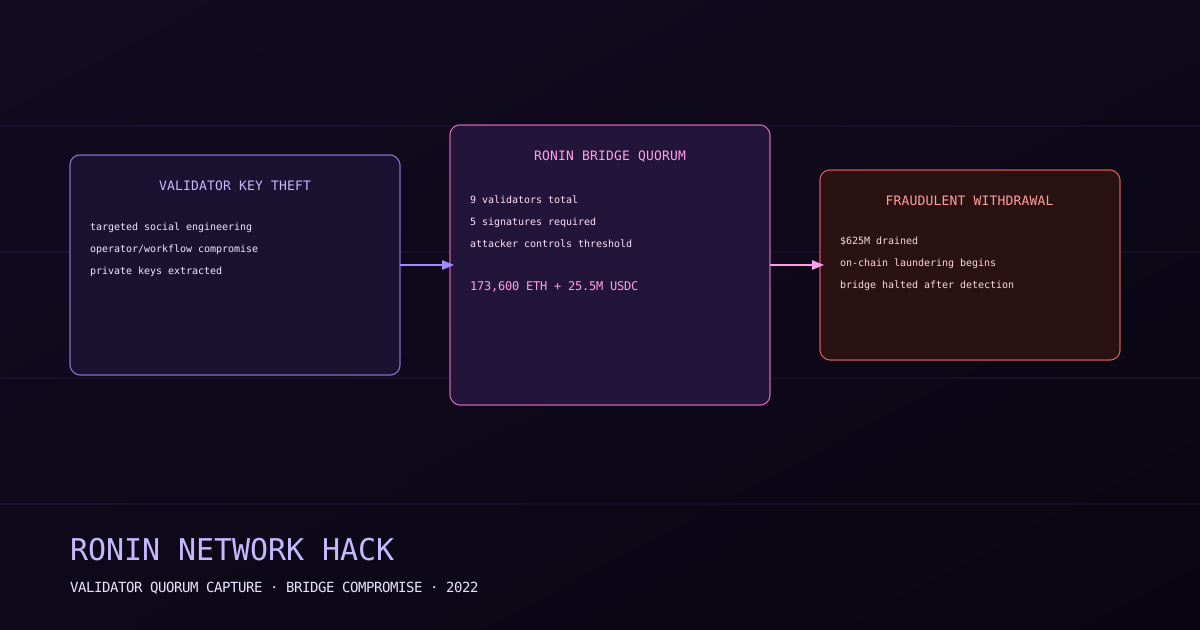
Ronin operated with a 9-validator model and a 5-of-9 signature threshold.
That architecture can be efficient for throughput and governance speed, but it concentrates risk. If attackers control five validators, they control the bridge.
Investigations concluded the actor obtained private keys for the required quorum and authorized fake withdrawals that looked valid to the system.
Initial Access and Key Compromise
Public attributions linked the operation to Lazarus Group tradecraft, including social-engineering and targeted access operations.
The campaign reportedly included compromise paths through organizations and workflows connected to validator operations, not just direct contract exploitation.
This pattern matters:
- Bridges are often treated as pure smart-contract security problems
- In reality, governance, infrastructure, and operational key management are equally critical
The Delay in Discovery
The fraudulent withdrawals occurred before they were widely detected.
The gap between compromise and public discovery amplified loss and complicated response, a recurring issue in crypto incidents where on-chain finality is immediate but operational visibility is fragmented.
By the time broad response mobilized, the funds had begun moving through laundering paths.
Legacy
Ronin changed how the industry talks about bridge security.
The lesson was not only “audits matter.” It was that key custody and validator decentralization are first-order controls.
Post-incident reforms across the ecosystem emphasized:
- Larger and more diverse validator sets
- Hardware-backed key management and stricter operational separation
- Better anomaly detection for large withdrawal patterns
- Faster incident escalation and cross-exchange coordination
Ronin remains a defining case of how quickly financial trust systems fail when quorum control is centralized enough to capture.
Attack Chain: Ronin Bridge Compromise
graph TD
    A["Recon & Targeting\nLazarus-linked operators map\nRonin validator ecosystem"] --> B["Initial Intrusion\nSocial engineering and\ninfrastructure compromise"]
    B --> C["Key Theft\nPrivate keys for multiple\nRonin validators obtained"]
    C --> D["Quorum Capture\nAttacker reaches 5-of-9\nsignature threshold"]
    D --> E["Fraudulent Withdrawals\n173,600 ETH + 25.5M USDC\nauthorized as valid"]
    E --> F["On-Chain Laundering\nFunds moved through mixers\nand exchange pathways"]
    F --> G["Detection & Response\nBridge halted, investigations\nand recovery actions launched"]

    style A fill:#1a1a2e,color:#e0e0e0
    style C fill:#c0392b,color:#fff
    style D fill:#8e44ad,color:#fff
    style E fill:#c0392b,color:#fff
    style G fill:#2c3e50,color:#e0e0e0
// Further Reading & Media
The Ronin Network Hack
How Lazarus compromised validator trust in the Ronin bridge and executed one of the largest crypto thefts ever recorded. Use this reference overview as a jumping-off point for deeper reporting, primary-source disclosures, and historical context.
→ View Resource