The Key That Opened Government Mail: Storm-0558
The Key That Opened Government Mail: Storm-0558
In 2023, investigators uncovered a cloud identity failure with outsized geopolitical impact.
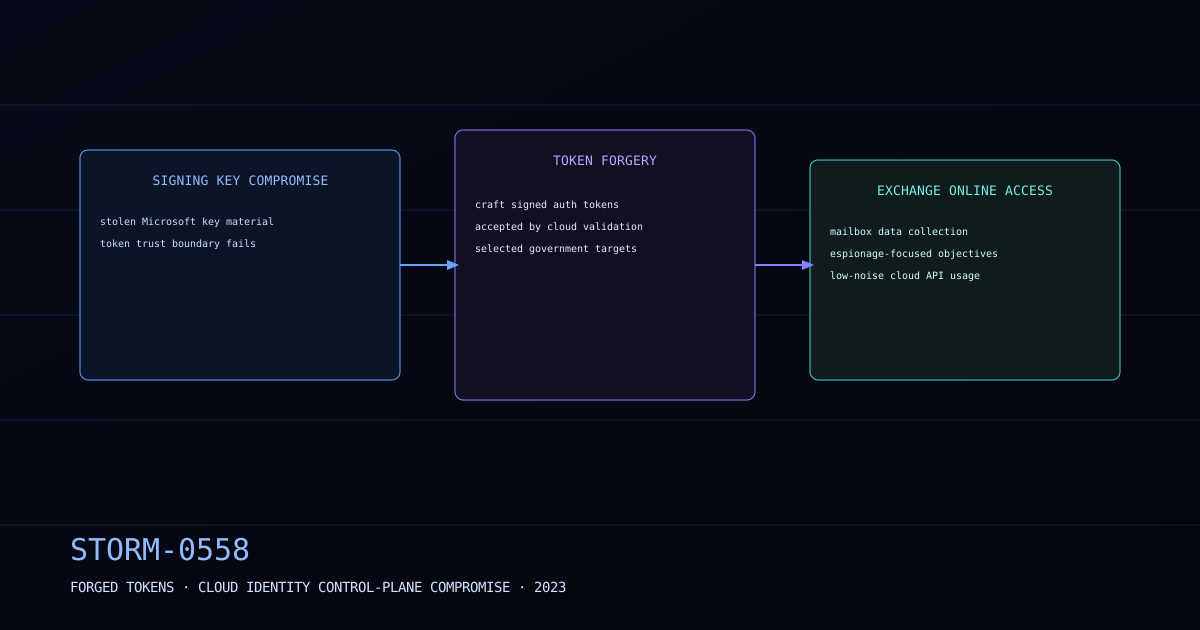
A China-aligned espionage actor, tracked by Microsoft as Storm-0558, obtained a Microsoft signing key and used it to forge authentication tokens that could be accepted by Microsoft cloud services, including Exchange Online.
The result was targeted access to high-value mailboxes, including accounts connected to US government officials.
This was not password spraying and not basic phishing.
It was control-plane compromise: abuse of trust at the identity-token layer.
Why Token-Signing Keys Matter
Cloud identity works because systems trust signed tokens.
If a service accepts a token signature as valid, it assumes identity checks already happened. This is powerful and efficient — and dangerous if signing material is stolen or mis-scoped.
In Storm-0558, a key intended for one token domain was reportedly usable in ways that enabled broader token validation impact than defenders expected.
That design/validation gap turned one stolen secret into cross-tenant risk.
What Attackers Did
Public reporting indicates Storm-0558:
- Acquired a Microsoft-managed signing key
- Crafted forged tokens for selected targets
- Used those tokens to access cloud-hosted mail data
- Focused on espionage collection, not overt disruption
This operation reflected long-horizon intelligence tradecraft: selective targeting, identity-layer abuse, low-noise collection.
Why Detection Was Hard
Traditional controls often look for malware, suspicious binaries, or brute-force login anomalies.
Forged-token operations can evade many of those signals because requests may appear syntactically valid and come through normal cloud API paths.
The defensive challenge is telemetry depth:
- Can defenders distinguish expected token issuance from anomalous acceptance?
- Can they rapidly invalidate trust material and confirm revocation propagation?
- Can they constrain blast radius when cloud control-plane assumptions fail?
Legacy
Storm-0558 forced security teams to revisit assumptions about cloud identity centralization.
If one identity provider serves as root-of-trust for mail, docs, SaaS apps, and admin portals, then a control-plane weakness can become multi-service compromise.
Key lessons:
- Treat signing keys as critical infrastructure, not routine secrets
- Build rapid key-rotation and trust-invalidation playbooks
- Improve token telemetry and anomaly detection at validation boundaries
- Plan for provider-side failure modes, not only customer-side misconfiguration
The operation was a reminder that in cloud systems, the most important perimeter is often invisible.
Attack Chain: Storm-0558 Token Forgery Campaign
graph TD
    A["Threat Actor\nStorm-0558 selects diplomatic\nand policy targets"] --> B["Signing Key Compromise\nMicrosoft-managed key obtained"]
    B --> C["Token Forgery\nActor crafts signed tokens\nfor targeted identities"]
    C --> D["Token Acceptance\nCloud validation path accepts\nforged token as legitimate"]
    D --> E["Mailbox Access\nExchange Online data accessed\nfor selected accounts"]
    E --> F["Espionage Collection\nEmail intelligence gathered\nwith low operational noise"]
    F --> G["Discovery & Disclosure\nInvestigation, attribution,\nkey invalidation, customer guidance"]

    style A fill:#1a1a2e,color:#e0e0e0
    style B fill:#c0392b,color:#fff
    style C fill:#8e44ad,color:#fff
    style E fill:#0d3b66,color:#a9d6ff
    style G fill:#2c3e50,color:#e0e0e0
// Further Reading & Media
Storm-0558
How a stolen Microsoft signing key enabled forged tokens against Exchange Online and exposed senior government email accounts. Use this reference overview as a jumping-off point for deeper reporting, primary-source disclosures, and historical context.
→ View Resource