Phishing the Identity Layer: The 0ktapus Campaign Against Twilio
Phishing the Identity Layer: The 0ktapus Campaign Against Twilio
The 0ktapus campaign in 2022 was not notable for a new vulnerability class.
It was notable for scale and execution discipline.
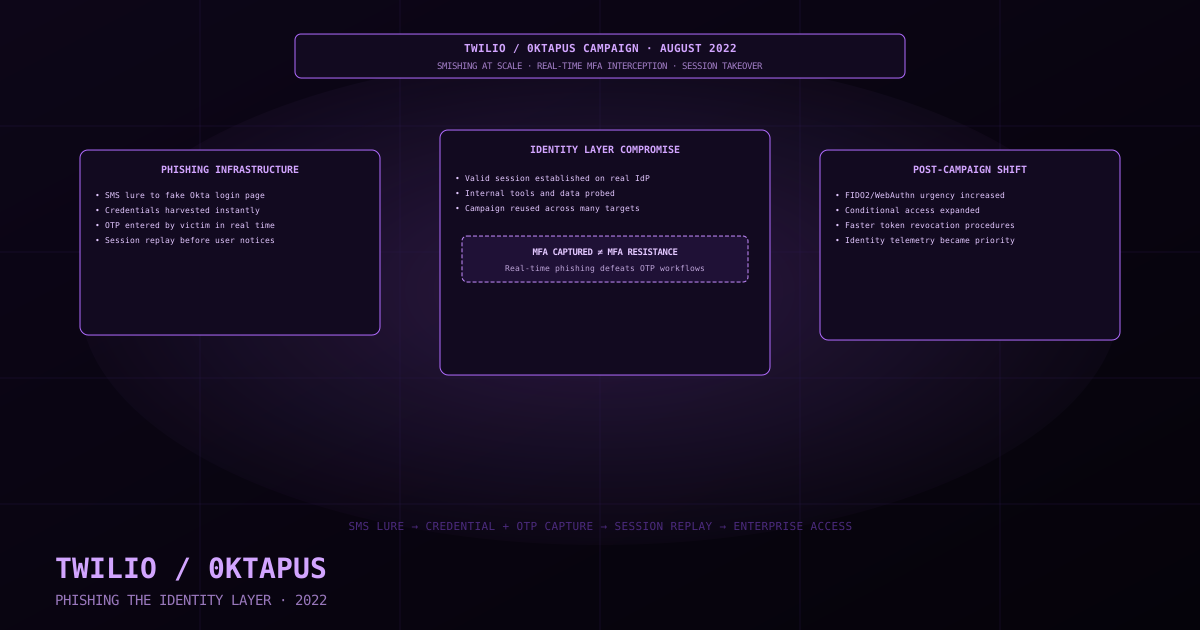
Attackers used SMS phishing pages that mimicked enterprise Okta sign-in portals, then harvested credentials and one-time passcodes in real time.
Why This Worked
The campaign targeted a common defensive assumption: that MFA alone stops credential theft.
In real-time phishing, the attacker can proxy the entire login flow:
- Victim enters username and password
- Victim enters OTP
- Attacker immediately reuses both
- Session is established before user notices
When speed and workflow are attacker-controlled, MFA becomes a speed bump instead of a wall.
Why Twilio Mattered
Twilio’s disclosure made clear that identity compromise at one organization can become an access path to customer communications environments and internal tooling.
The incident also helped expose the broader pattern: this was a campaign, not a one-off.
Many organizations using similar identity flows saw related phishing pressure in the same period.
Structural Lessons
0ktapus helped normalize stronger controls now considered baseline for high-risk users:
- Phishing-resistant MFA (FIDO2/WebAuthn)
- Device and context-based conditional access
- Better detection of impossible session transitions
- Faster session revocation on suspected credential theft
Legacy
0ktapus became the bridge between earlier phishing eras and modern identity-centric intrusion.
It demonstrated that attackers do not need to break the identity provider.
They can simply trick users into granting a valid session.
Attack Chain: 0ktapus / Twilio 2022
graph TD
    A["Target List Building\nEmployee phone numbers and\norg details collected"] --> B["SMS Phishing Wave\nSmishing messages send users\nto fake Okta portals"]
    B --> C["Credential Harvest\nUsername/password captured\nin attacker kit"]
    C --> D["MFA Interception\nOne-time passcodes captured\nin real time"]
    D --> E["Session Establishment\nValid login replayed into\nreal identity platform"]
    E --> F["Internal Access\nSelected systems, data, or\ncustomer-facing tooling reached"]
    F --> G["Campaign Scaling\nSame kit and workflow\nreused across many orgs"]
    G --> H["Enterprise Response\nToken resets, user advisories,\nphishing-resistant MFA rollout"]

    style A fill:#1a1a2e,color:#e0e0e0
    style B fill:#c0392b,color:#fff
    style D fill:#8e44ad,color:#fff
    style E fill:#0d3b66,color:#a9d6ff
    style H fill:#2c3e50,color:#e0e0e0
// Further Reading & Media
The 0ktapus Campaign Against Twilio
How a large-scale SMS phishing campaign harvested Okta credentials and one-time codes across major companies, showing that MFA can fail when adversaries capture the session in real time. Use this reference overview as a jumping-off point for deeper reporting, primary-source disclosures, and historical context.
→ View Resource