When Hospitals Go Dark: The UMMC Ransomware Shutdown
When Hospitals Go Dark: The UMMC Ransomware Shutdown
By the morning of February 20, 2026, the screens were still glowing at the University of Mississippi Medical Center. That was the unnerving part. The hospital had not gone black in the cinematic sense. The monitors were on. The terminals booted. The buildings were lit. Elevators still ran. Clinicians still clipped on badges and walked into patient rooms.
What had vanished was harder to see and more dangerous to lose: the hospital’s memory.
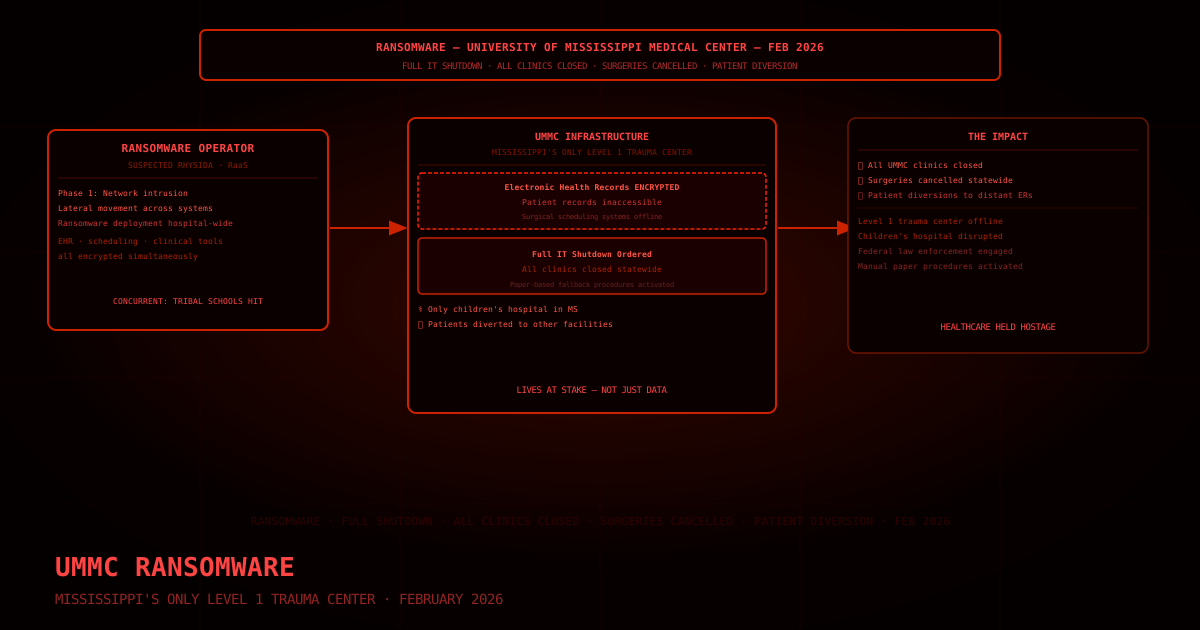
The electronic health record was unavailable. Scheduling systems were down. Clinical tools that modern medicine treats as background infrastructure — the software layer that tells a nurse what was given on the last shift, tells a surgeon which case is next, tells a clinic which patient is arriving at 10:40 and what happened at their last visit — had been encrypted in a ransomware attack severe enough to trigger a full IT shutdown. Across Mississippi, all UMMC clinics were closed. Surgeries were cancelled. Patients were diverted. The state’s only Level 1 trauma center and only academic medical center was suddenly trying to function with one hand tied behind its back.
That would have been a serious incident anywhere. In Mississippi, it was something more consequential.
UMMC is not just another regional hospital system. It is the institution the state leans on when cases become too complex, too urgent, too pediatric, too specialized, too fragile for anywhere else. UMMC operates Mississippi’s only children’s hospital. It is the place community hospitals call when the injury is too severe, the transfer too delicate, the complication too strange, or the patient too young. When ransomware hit UMMC around February 19-20, 2026, the crisis was not merely digital. It was geographic. It was clinical. It was statewide.
And because hospital ransomware is never really about computers, not in the end, it became immediately a story about time: how long clinicians could safely work on paper, how long ambulances could be diverted, how long surgeries could wait, how long a healthcare system could endure the loss of trust in its own machines.
What UMMC Actually Is
The University of Mississippi Medical Center, based in Jackson, is the apex institution in Mississippi healthcare. It is the state’s only academic medical center, meaning it is not simply a hospital but the center of Mississippi’s physician training, specialty care, research, and tertiary referral network. It is also the state’s only Level 1 trauma center — the designation reserved for institutions equipped and staffed to provide the highest level of surgical trauma care at all hours, with specialist coverage, operating capacity, critical care support, and the teaching and research infrastructure that designation requires.
That alone would make UMMC disproportionately important. But UMMC also operates the only children’s hospital in Mississippi, which gives it an additional role few organizations can absorb on its behalf. Pediatric critical care is not a service that can be improvised at scale. Neonatal care cannot simply be redirected to the next building over if the next building over does not exist. A cyber incident that hits UMMC therefore lands differently than one that hits a typical regional provider network. It strikes not just capacity, but exclusivity.
UMMC’s clinical footprint extends beyond Jackson through clinics across Mississippi. That detail mattered enormously once the ransomware detonated. A hospital outage can be severe but localized. A health-system outage shuts doors far from the main campus. It strands appointments in towns far from the SOC, far from the data center, far from the executives making containment decisions. When UMMC closed clinics statewide, the blast radius of a single cyber event expanded into missed oncology visits, rescheduled specialty consults, deferred follow-ups, and hours of extra driving for patients who, in many cases, had few realistic alternatives even before the incident.
Healthcare systems often describe themselves in abstractions: networks, service lines, patient volumes, bed counts. In a ransomware event, those abstractions become operational truths. A network fails as a network. A referral hub fails as a hub. And an institution that sits at the center of a medically underserved state does not absorb downtime the way a market with abundant redundancy might. It exports the shock outward.
Threat Actor Profile: Suspected Rhysida
Designation: Rhysida (suspected); ransomware-as-a-service / extortion operation
Attribution: No public federal attribution had been formally announced at the time of the incident, but multiple reporting threads and responder assessments treated the intrusion as consistent with Rhysida tradecraft, particularly amid a concurrent ransomware campaign affecting schools operated by the Cheyenne and Arapaho Tribes that was publicly attributed to Rhysida
Origin: Financially motivated cybercriminal enterprise; first emerged publicly in 2023; widely assessed as operating through an affiliate model
Primary Mission: Data theft, extortion, and ransomware deployment against organizations with low tolerance for downtime, including healthcare, education, local government, and enterprise targets
Known Tradecraft: Phishing, credential theft, abuse of valid accounts, use of remote administration tooling, pre-encryption data exfiltration, and pressure through public leak-site extortion
Notable Operations Associated with Rhysida or Its Publicly Reported Activity:
- British Library (2023): A devastating extortion and service disruption incident that crippled public-facing services, catalog access, and internal operations for months.
- Insomniac Games (2023): Theft and public release of sensitive internal data, including development material, after extortion demands were not met.
- Cheyenne and Arapaho Tribes school campaign (February 2026): A concurrent education-sector attack wave that sharpened industry suspicion around Rhysida’s involvement in other February 2026 incidents.
What made Rhysida relevant to the UMMC story was not just a name on a threat board. It was the group’s fit. Rhysida had become associated with targets that could not tolerate prolonged operational interruption and with campaigns that combined encryption with public pressure. Hospitals are unusually vulnerable to that model. They are data-rich, operationally brittle, full of legacy technology, dependent on availability, and ethically constrained in ways a manufacturer or retailer is not. A factory can idle a line. A hospital cannot idle a trauma bay and call it a business decision.
Still, the important word in UMMC’s case was suspected. The public record around the intrusion was incomplete. No public indictment, no takedown notice, and no full federal technical advisory had yet placed the UMMC attack inside a named prosecution narrative. What responders and analysts could do was compare observed effects, timing, victimology, and tradecraft. The match was close enough to matter, but not so definitive that caution could be discarded.
The Most Likely Technical Chain
The precise initial intrusion path into UMMC was not publicly confirmed in the first wave of reporting. That absence is normal. Hospitals do not disclose forensic detail in real time, and incident responders are often still trying to determine whether the first suspicious login was the first foothold or simply the first evidence they retained. But the confirmed consequences at UMMC — encryption of the EHR, scheduling systems, and clinical tools, followed by a defensive full IT shutdown — fit a familiar hospital ransomware pattern closely enough to reconstruct the most likely sequence.
It probably did not begin with a dramatic zero-day.
Healthcare ransomware rarely does. More often the attack starts with a compromised credential, a phishing email that lands on an overworked employee’s laptop, or an internet-facing access path that was convenient for the business and insufficiently hardened for the adversary. Hospitals have thousands of employees, rotating clinical staff, contractors, vendors, temporary accounts, remote billing workflows, managed devices, unmanaged devices, legacy medical platforms, and a constant need to balance security with speed. That complexity creates edges. Ransomware operators live at the edges.
In a UMMC-like environment, the most plausible opening moves were the ones seen over and over in healthcare intrusions:
- Credential compromise or phishing-based access into an employee, contractor, or vendor account
- Foothold establishment on a workstation or remote access platform
- Privilege escalation toward identity infrastructure, administrative consoles, or virtualization layers
- Reconnaissance to identify what matters most operationally: EHR dependencies, scheduling systems, file servers, interface engines, authentication systems, and backup paths
- Pre-encryption staging, which in modern ransomware frequently includes data exfiltration, backup disruption, and scripted deployment preparation
- Encryption and detonation at a moment chosen for maximum confusion and maximum leverage
Hospitals are particularly fragile in the reconnaissance phase because the critical systems are not isolated to one application. The EHR is the visible center, but clinical care rides on a web of connected services around it: authentication, database servers, interface engines that move data between applications, scheduling modules, departmental tools, messaging layers, imaging integrations, and the countless quiet middleware components that clinicians never see but depend on every minute. If an attacker maps that terrain well enough, they do not need to destroy everything. They only need to encrypt enough of the right systems to collapse trust.
That is the part the public often misses about hospital ransomware. The goal is not always raw destruction. It is operational illegibility. If clinicians cannot trust the medication record, the surgery schedule, the patient identity workflow, or the status of an order, care does not simply become slower. It becomes riskier. The more safety-critical the workflow, the more likely the institution is to shut the system down rather than operate in uncertainty.
At UMMC, responders determined the safest course was a full IT shutdown. That strongly suggests the incident was not confined to a single workstation or a peripheral business system. It suggests risk to core network services, uncertainty about lateral movement, or visible encryption on systems sufficiently central that leaving broad swaths of the environment online would have invited more damage. In healthcare, once responders lose confidence in the containment boundary, the containment boundary tends to move outward fast.
The timing of the event — around February 19-20, 2026 — also fits the operational logic of ransomware crews. Attacks often detonate during overnight or early-morning windows, when staffing is thinner, executive decision-makers are not yet in the building, and a hospital’s clinical day is only beginning to build momentum. A ransomware crew is not trying to make a point about symbolism. It is trying to maximize dislocation between the moment of encryption and the moment the target fully understands what has happened.
By the time a hospital realizes its EHR and scheduling stack are encrypted, the important adversary work is usually already done. Access was obtained earlier. Privileges were raised earlier. Systems were mapped earlier. The criminals may have spent days or weeks deciding what to hit and what to leave intact. The visible outage is the final act. The attack itself started long before the first clinician discovered that a chart would not open.
That is why full restoration in healthcare is so slow even when backups exist. Backups answer only one question: can we restore data? A hospital facing ransomware has to answer a harder one first: what can we trust? If identity infrastructure was touched, if administrative accounts were abused, if update mechanisms were altered, if scheduled tasks or domain policies were weaponized, then every restored system has to be treated as a possible reinfection path until proven otherwise. Medicine can tolerate inconvenience. It cannot tolerate uncertainty at scale.
The Shutdown: February 19-20
Around February 19-20, 2026, UMMC crossed from cybersecurity incident to clinical emergency.
The ransomware attack triggered a full IT shutdown. That phrase sounds administrative until you unpack what it means inside a hospital. It means not simply that office workers lose email, but that the infrastructure connecting registration to charts, charts to orders, orders to departments, departments to results, and results back to the bedside has become untrustworthy. It means the health system has decided that leaving digital systems live poses too much risk — either because encryption is spreading, because attacker presence is uncertain, or because responders can no longer assert which parts of the network are clean.
At UMMC, the effect was immediate and visible across the state.
All UMMC clinics across Mississippi were closed. The decision was brutal but rational. Outpatient clinics live and die by scheduling integrity, chart availability, registration workflows, documentation access, and the ability to move patients through a tightly timed sequence of administrative and clinical tasks. Remove the EHR and scheduling layer, and most ambulatory care becomes difficult. Remove them statewide, and clinic operations stop being an inconvenience problem and become a safety problem.
Surgeries were cancelled. That, too, was not just about the operating room. Surgical care depends on a chain of digital confidence extending backward through pre-op documentation, consent management, lab review, case sequencing, intraoperative support, and postoperative coordination. If the systems binding that chain together are encrypted or offline, the clinically safer choice is often cancellation, however painful.
Patients were diverted. In many cyber incidents, “diversion” sounds abstract — a routing word, a logistics term. At a Level 1 trauma center, it is a measure of stress placed on an entire regional system. Diversions move patients, yes, but they also move time, complexity, and risk. Mississippi has only one Level 1 trauma center. There is no second UMMC waiting in reserve. Every diversion decision therefore carried disproportionate weight, not because the institution had no fallback at all, but because its fallback options were narrower than those of states with deeper redundancy.
And behind those institutional decisions sat a more intimate one: clinicians had to continue caring for patients already in the building.
Hospitals do not evacuate because a network fails. Intensive care units do not empty. Infants in a children’s hospital do not stop needing medication because a chart server is encrypted. The practical question is not whether care continues. It is how badly care degrades when the invisible coordination layer disappears.
Paper Medicine
UMMC activated paper-based clinical fallback procedures — the set of emergency workflows every hospital keeps somewhere in binders, on downtime carts, in filing cabinets, or in institutional memory, hoping not to use them for long.
Paper medicine is real medicine. It can save lives. Hospitals drill for it because they must. But paper is not a peer alternative to digital care; it is an emergency substitute. It is slower, more fragile, harder to audit, harder to scale, and easier to get wrong under pressure.
In a paper fallback environment, simple things become elaborate. Registration takes longer. Patient identification requires more manual cross-checking. Orders may need to be handwritten, physically carried, verbally confirmed, and transcribed later. Unit clerks become traffic controllers. Nurses document by hand and then hand off by hand. Departments that usually exchange structured digital records fall back to phone calls, runners, fax-like workarounds, whiteboards, and improvised logs. Every transaction that software normally performs invisibly must be performed by a person who is already busy.
This matters because hospital care is not only about expertise. It is about synchronization.
A trauma center functions because dozens of people can act on the same information quickly: identity, allergies, lab results, imaging status, operating room readiness, consult placement, bed assignment, prior history, active medications, and the timestamped record of what just happened. When those channels become manual, care does not stop, but it thickens. Time accumulates in new places. Transcription risk rises. Handoffs grow less certain. And the staff absorbing that burden are the same people expected to preserve calm for patients who can see the disruption even if they cannot name it.
The burden on UMMC was magnified by its role as Mississippi’s only children’s hospital. Pediatric and neonatal care generate exactly the kinds of high-dependency workflows that punish uncertainty. Weight-based medication dosing, specialty consult coordination, transfer pathways, and complex inpatient management all rely on reliable information flow. Even when clinicians can and do work safely on paper, the margin for delay narrows.
Ransomware responders often describe healthcare downtime in business language: outage windows, service degradation, restoration priorities. Clinicians understand it differently. They understand it as the return of friction to tasks that had been engineered, over decades, to remove friction. If a nurse has to write what used to auto-populate, if a physician has to call where they used to click, if a clinic has to close because the schedule itself cannot be trusted, then the hospital has not merely lost convenience. It has lost throughput, certainty, and some portion of its safety buffer.
That is what ransomware buys the attacker in healthcare: leverage through the reintroduction of chaos.
Why Rhysida Fit the Moment
The suspicion around Rhysida was sharpened by timing.
At roughly the same moment UMMC was fighting to contain its own crisis, a concurrent ransomware campaign hit schools operated by the Cheyenne and Arapaho Tribes, and that campaign was publicly attributed to Rhysida. Incident responders do not attribute based on coincidence alone, but clustering matters. Ransomware groups often run multiple affiliate operations inside the same broad time window, using similar note formats, extortion workflows, and operational tooling. When two public-sector or quasi-public-sector targets in different states are hit in close succession with similar contours, defenders start asking whether they are looking at isolated opportunism or a campaign.
Rhysida’s public pattern made the hypothesis plausible. The group had shown interest in institutions whose pain threshold for downtime is low and whose public visibility is high. Healthcare and education fit that profile almost perfectly. Both sectors are operationally fragile, ethically constrained, budget-stretched, and reputationally exposed. Both depend heavily on users who cannot simply wait out a multiweek outage. A library can be shamed with leaked files. A school can be pressured by disrupted classes. A hospital can be pressured by cancelled procedures and diverted patients.
None of that proves Rhysida hit UMMC. But it helps explain why responders, journalists, and sector analysts treated Rhysida as more than a generic placeholder. In ransomware, fit matters. Victimology matters. Concurrent activity matters. And the difference between “confirmed” and “consistent with” is often the difference between what responders privately believe and what the public record can yet support.
The Response: Containment Before Convenience
Once UMMC shut systems down, the recovery challenge was no longer simply technical. It became triage.
A healthcare incident response team has to restore systems in the order that clinical risk demands, not in the order that a normal enterprise IT department might prefer. Identity services, network segmentation, and core infrastructure have to be understood first. Then come the systems whose return most directly improves safe patient care. But every restoration step has to be weighed against reinfection risk. Bringing a server back online quickly is easy. Bringing it back online with enough confidence to reconnect it to live patient workflows is hard.
Federal law enforcement was engaged. In ransomware cases, that matters for several reasons even when it does not produce instant relief. Law enforcement can correlate campaigns across victims, identify overlap with known infrastructure, preserve evidence for later prosecutions, coordinate intelligence, and sometimes help determine whether the target is dealing with a known decryptor path or a known extortion brand. But there is rarely a miracle in these cases. Federal involvement does not put the chart back up by noon. It does not reopen clinics the same morning. It does not erase the hours clinicians have already spent improvising around the outage.
The institution still has to do the exhausting work of recovery: isolate segments, inventory affected systems, validate backups, rebuild trust in identity, rotate credentials, check persistence, restore applications, test interfaces, and communicate constantly with staff who need practical answers rather than cybersecurity vocabulary. If a hospital’s digital nervous system was severed on Thursday night, someone has to reconnect each nerve by hand.
The public often asks why these recoveries take so long. The answer is that hospitals cannot restore on hope. A retailer can bring back a point-of-sale cluster and deal with defects in a less consequential context. A hospital restoring EHR access, clinical documentation, or scheduling systems is restoring infrastructure that will immediately shape treatment decisions. A maybe-clean system is not clean enough. A maybe-accurate patient record is not accurate enough. In healthcare, speed loses to trust every time.
Aftermath: What the UMMC Attack Revealed
The UMMC ransomware attack was a story about cybersecurity, but it was also a story about single points of clinical failure.
American healthcare likes to describe redundancy as if it were natural. In reality, redundancy is distributed unevenly. Large metropolitan markets may have multiple academic systems, multiple trauma centers, multiple pediatric referral options, and multiple backup paths when one institution stumbles. Mississippi does not have that luxury at the same scale. Because UMMC is the state’s only academic medical center, only Level 1 trauma center, and only children’s hospital, a ransomware event there is not merely an institutional outage. It is a statewide stress test.
That is what made the closure of all UMMC clinics across Mississippi so significant. It showed how a cyberattack on one health system can convert immediately into access problems far beyond the attacked campus. It also showed that “downtime procedures” are not enough by themselves if the outage is broad, prolonged, and system-wide. Paper works best as a bridge, not as a substitute for an entire digital care ecosystem spread across clinics, specialty services, referral pathways, and inpatient units.
The UMMC incident also reinforced a lesson healthcare has been trying not to learn for years: ransomware in medicine is not primarily a data privacy problem. It is a care continuity problem.
The public conversation after healthcare breaches often focuses on records stolen, notifications mailed, and credit monitoring offered. Those things matter. But in acute-care ransomware, confidentiality is only half the story and sometimes not the most urgent half. The first-order question is whether the hospital can still function. Can clinicians see what they need to see? Can patients be scheduled? Can surgeries proceed? Can a trauma system operate without introducing unacceptable uncertainty? Can the children’s hospital continue at full safety margin? UMMC forced those questions into the foreground.
It also underscored the growing convergence between sectors long treated separately in risk discussions. The same week saw a Rhysida-attributed campaign against the Cheyenne and Arapaho Tribes schools and a suspected Rhysida-style event at UMMC. Education and healthcare are structurally different, but from the attacker’s perspective they share a trait that matters more: both are institutions society depends on, institutions that cannot simply go offline without moral and political consequences. Ransomware crews understand that dependency. They monetize it.
Legacy: The Cost of Digital Dependence
What lingers after a hospital ransomware event is not just the outage. It is the altered understanding of what a hospital is.
For years, healthcare cybersecurity was often framed as a compliance issue, a privacy issue, or a procurement issue. The UMMC attack belongs to the class of incidents that makes those framings feel inadequate. A modern hospital is not a building full of clinicians plus some IT. It is a clinical organism woven tightly into software. The chart is software. The schedule is software. The referral logic is software. The alerting path is software. The routing of information between human beings is software. When ransomware encrypts enough of that fabric, the institution can remain physically open while functionally impaired.
That does not mean digital medicine was a mistake. It means digital medicine created a new category of clinical dependency without creating equal resilience everywhere.
The practical lessons are familiar and still too often neglected: aggressively reduce internet-facing attack surface; harden remote access; require multi-factor authentication everywhere it can possibly be required; segment corporate and clinical domains; protect identity infrastructure as critical care infrastructure; maintain offline and immutable backups; rehearse paper downtime beyond the tabletop level; pre-stage downtime kits; know how to close clinics and communicate with patients fast; design recovery plans that prioritize safe care, not just system uptime.
But UMMC points to a larger strategic lesson as well. States with highly centralized specialty care need to think about cyber resilience the way they think about trauma coverage, storm response, and public health surge capacity: as a matter of continuity for the population, not just the institution. If one hospital carries unique statewide responsibilities, then its cyber failure is partly a state resilience problem whether lawmakers call it that or not.
The ransomware operators who hit UMMC — whether they were Rhysida or a crew using strikingly similar methods — almost certainly did not need to understand Mississippi healthcare in any meaningful civic sense. They only needed to understand leverage. They encrypted the systems that let the institution coordinate itself, and the institution had to choose between unsafe certainty and safe disruption. It chose disruption.
That was the right choice. It was also the attacker’s business model.
The final lesson of UMMC is the one healthcare keeps relearning in public: hospitals do not become resilient because they own downtime binders. They become resilient when the loss of software does not immediately become the loss of coordinated care. On February 20, 2026, Mississippi discovered how much of that coordination lived inside systems it could no longer trust.
The buildings stayed open. The network did not. For the hours that mattered most, one of the most important medical institutions in the state had to practice medicine from memory.
Attack Chain: UMMC Ransomware Shutdown (Assessed)
graph TD
    A["Suspected Rhysida-Style Operation<br/>Financially motivated ransomware affiliate<br/>targets low-downtime institutions"] --> B["Initial Access<br/>Likely phishing, stolen credentials,<br/>or abuse of a valid remote access path<br/>(publicly unconfirmed)"]
    B --> C["Foothold in UMMC IT Environment<br/>Attacker establishes persistence<br/>and begins internal reconnaissance"]
    C --> D["Privilege Escalation<br/>Administrative access expanded toward<br/>identity, servers, or virtualization layers"]
    D --> E["Target Identification<br/>EHR dependencies, scheduling systems,<br/>clinical tools, and core infrastructure mapped"]
    E --> F["Pre-Encryption Staging<br/>Scripts prepared; backups and recovery paths<br/>likely assessed or disrupted"]
    F --> G["Ransomware Detonation<br/>Around Feb 19-20, 2026<br/>EHR, scheduling, and clinical systems encrypted"]
    G --> H["Full IT Shutdown<br/>UMMC disconnects systems to contain spread<br/>and prevent further compromise"]
    H --> I["Clinical Fallback Activated<br/>Paper-based procedures, manual coordination,<br/>downtime operations across care settings"]
    I --> J["Operational Impact<br/>All UMMC clinics closed statewide<br/>Surgeries cancelled<br/>Patients diverted"]
    J --> K["Escalation to Statewide Care Crisis<br/>Only academic medical center,<br/>only Level 1 trauma center,<br/>only children's hospital under strain"]
    K --> L["Federal Law Enforcement Engaged<br/>Incident response, forensic investigation,<br/>restoration, and recovery begin"]
    L --> M["Legacy<br/>Healthcare cyber resilience reframed as<br/>patient-safety and continuity-of-care issue"]

    style A fill:#1a1a2e,color:#e0e0e0
    style G fill:#c0392b,color:#fff
    style H fill:#c0392b,color:#fff
    style J fill:#c0392b,color:#fff
    style M fill:#2c3e50,color:#e0e0e0
// Further Reading & Media
When Hospitals Go Dark: The UMMC Ransomware and the Cost of Healthcare Cyber Insecurity
A post-incident advisory on the UMMC ransomware attack, covering the clinical impact, emergency fallback procedures, and recommended defenses for healthcare organizations.
→ View ResourceCode Blue: Ransomware in the ER
An interview-driven episode exploring how ransomware is reshaping hospital emergency preparedness and the ethical dilemmas of paying ransoms when patient lives are at stake.
→ View Resource