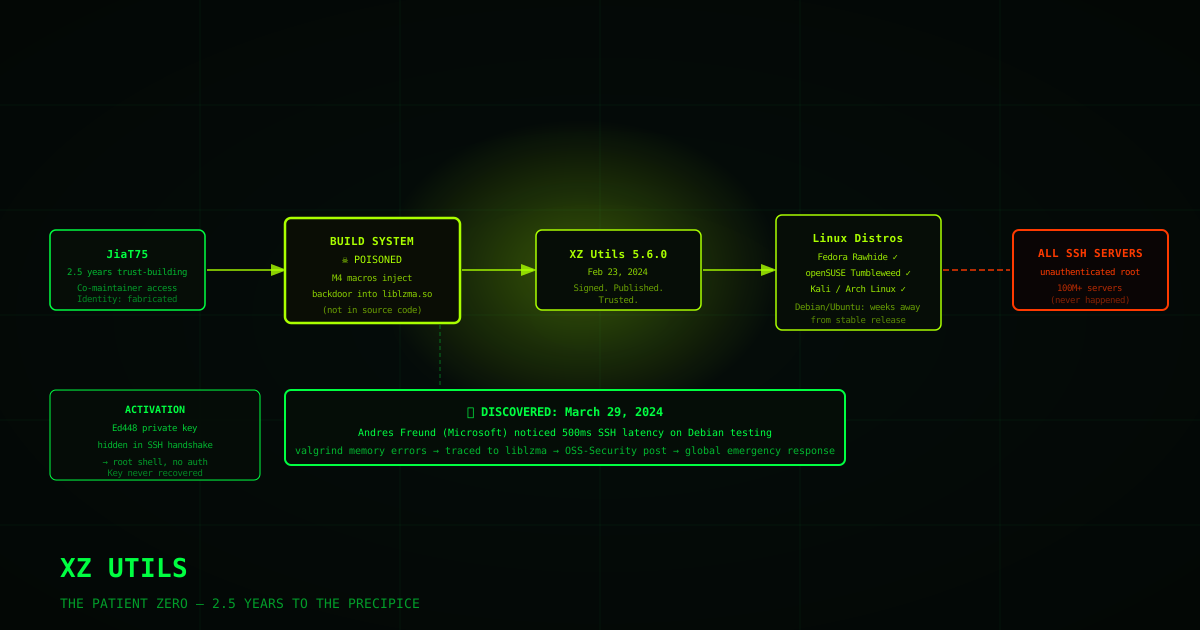
The Patient Zero: XZ Utils Backdoor
XZ Utils: The Patient Zero
On Friday, March 29, 2024, Andres Freund — a software engineer at Microsoft working on PostgreSQL database performance — posted a message to the Open Source Security mailing list that began with quiet precision:
“I’ve been investigating the xz-utils backdoor, and I believe I have a pretty good understanding of what it does.”
The response from the security community was immediate and global. Within hours, major Linux distributions — Fedora, Debian, openSUSE, Kali Linux, Arch Linux — issued emergency advisories. The US Cybersecurity and Infrastructure Security Agency (CISA) published a public alert. Security researchers across the world began analyzing what Freund had found.
What had been planted inside XZ Utils — a compression library present in virtually every Linux distribution on the planet — was not a crude backdoor. It was a work of exceptional technical sophistication: a multi-stage, conditional implant hidden inside the build system itself rather than the source code, targeting a specific configuration of OpenSSH running on systemd-based Linux systems, activating only on x86-64 architectures, designed to be invisible to standard code review, and capable of granting its operator unauthenticated root-level command execution on any affected server in the world.
It had been weeks away from appearing in the stable release of every major Linux distribution on earth.
The person who put it there had been patiently building toward that moment for two and a half years.
Threat Actor Profile: JiaT75 / Jia Tan
Designation: JiaT75 (GitHub handle); Jia Tan (stated identity); associated sock puppet accounts: Jigar Kumar, Dennis Ens, HansHansen
Attribution: Unknown; assessed with high confidence to be a nation-state operation; behavioral indicators suggest East Asian origin (UTC+8 commit patterns), with characteristics consistent with Chinese intelligence operations — though no conclusive public attribution has been made
Origin: Unknown; commit timestamps suggest UTC+8 timezone activity, though deliberate timezone shifting was observed
Primary Mission: Long-term infiltration of critical open-source software infrastructure; insertion of undetectable supply chain backdoor targeting global SSH authentication
Known Tradecraft: Identity fabrication, multi-year trust-building, sock puppet pressure campaigns, build-system-level code injection, cryptographic backdoor design, counter-forensic operational security
Notorious Operations:
- XZ Utils Backdoor (2021–2024): The most sophisticated open-source software supply chain attack ever publicly documented. A fabricated identity spent 2.5 years becoming a trusted co-maintainer of a critical Linux utility before inserting a conditional SSH backdoor that, had it reached widespread deployment, would have provided unauthenticated root access to a significant fraction of the world’s internet-facing servers.
Note: The true identity and organizational affiliation of JiaT75 / Jia Tan remains officially unattributed as of this writing. No government has publicly named a suspect. The GitHub account was suspended. The sock puppet accounts were deleted. The attacker has not been identified.
The Setup: Becoming Trusted
XZ Utils is a compression library so ubiquitous in the Linux ecosystem that it is essentially invisible to most administrators. It compresses and decompresses the .xz and .lzma formats used across Linux for package distribution, log compression, and data archival. It is the kind of software that is installed by default, updated automatically, and never thought about.
Its maintainer was Lasse Collin, a Finnish developer who had been working on the project since 2009 — quietly, alone, and unpaid, as most critical open-source infrastructure is maintained. Collin was the sole person reviewing contributions and cutting releases. He had dealt with burnout and personal mental health challenges over the years. He was, like most maintainers of this kind, carrying an invisible load.
In October 2021, a GitHub account named JiaT75 submitted its first commit to XZ Utils. The contribution was modest — a patch to the test infrastructure. Collin reviewed it, found it reasonable, and merged it.
JiaT75 continued contributing. Through 2021 and into 2022, the patches were consistently well-written, the review feedback responsive, the engagement professional. Nothing about the account was suspicious. It had no prior GitHub history of note; this was not unusual for a new contributor to a relatively obscure utility library. Collin appreciated the help.
Then, beginning in early 2022, something interesting started happening in the XZ Utils issue tracker. A series of GitHub accounts — primarily Jigar Kumar and Dennis Ens — began posting pointed comments complaining about the project’s development pace and criticizing Collin’s responsiveness. The comments argued that other contributors should be given more commit rights, and that the project needed more active maintenance. The accounts had thin histories and no other notable activity across GitHub.
These accounts exist to apply social pressure. They appear, make noise, and disappear.
The pressure had an effect. Collin, dealing with personal circumstances and stretched thin on an unpaid project, began deferring more to JiaT75. By late 2022, JiaT75 had been granted co-maintainer access to the XZ Utils repository. By 2023, he had become the effective primary maintainer — handling releases, responding to issues, managing the project’s build infrastructure. The sock puppet accounts ceased activity.
JiaT75 had invested more than a year in building toward a single outcome: legitimate, trusted write access to a library installed on hundreds of millions of systems.
The Weapon: What Was Inside XZ Utils 5.6.0
On February 23, 2024, JiaT75 released XZ Utils version 5.6.0, followed by version 5.6.1 on March 9. These releases contained the backdoor. But they contained it in a way that would defeat nearly any code reviewer in the world.
The payload was not in the source code. It was embedded in the build system — specifically in a set of binary test data files and M4 autoconf macros that were processed during compilation. A security engineer examining xz.c, liblzma.c, or any of the human-readable source files would find nothing wrong. The malicious logic executed only during the build process and only under precisely specified conditions.
Here is what the backdoor actually did:
Target: Systems running a systemd-based Linux distribution where liblzma was linked into the OpenSSH server daemon (sshd) as a transitive dependency through libsystemd. This was the default configuration on many major distributions.
Mechanism: The injected build code produced a modified liblzma.so shared library. This library included a hook that intercepted the RSA_public_decrypt() function within OpenSSH. This function is called during the RSA authentication phase of every SSH connection.
Activation: The backdoor checked every incoming SSH connection for a specifically structured payload embedded in the RSA N value of the public key presented during the connection handshake. If this field contained a valid cryptographic signature produced by a specific Ed448 private key held exclusively by the attacker, the backdoor would extract and execute a command embedded in the payload — before SSH authentication completed.
Effect: Unauthenticated root command execution. No username. No password. No SSH key on file. An attacker possessing the Ed448 private key could send a single crafted SSH connection to any affected server anywhere on the internet and receive an authenticated root shell in return. The connection would appear normal to any observer without knowledge of the backdoor’s activation protocol.
The technical design was careful in ways that reveal sophisticated tradecraft. The malicious binary files were disguised as test data using realistic filenames and structurally plausible content. The M4 macro injection chain was deliberately obfuscated. The cryptographic activation mechanism — using a private Ed448 key held only by the attacker — meant that even a researcher who discovered and analyzed the binary modification could not demonstrate its effect without that key. The backdoor’s payload channel was invisible to any form of passive monitoring or intrusion detection that lacked knowledge of the protocol.
It was not the work of an opportunist. It was engineered.
The Discovery: 500 Milliseconds and Curiosity
Andres Freund was running a Debian Sid (testing) system as part of his regular PostgreSQL development work. While benchmarking SSH connections for an unrelated reason, he noticed that SSH logins were taking approximately 500 milliseconds longer than expected. He was also observing unexpectedly high CPU utilization from the sshd process during idle periods.
Both anomalies were subtle. Many engineers — perhaps most — would have attributed them to routine system variability and moved on.
Freund ran valgrind — a memory analysis tool — against the SSH process and found memory errors he could not immediately explain. He traced the anomalous resource usage upstream through the dependency chain. It correlated with the version of liblzma installed from the XZ Utils package. He looked more carefully at the XZ Utils package.
On March 28, 2024, he posted initial findings to the OSS-Security mailing list. The next day, his comprehensive analysis landed: a detailed breakdown of the build-system injection, the backdoor mechanism, and the activation protocol. It was immediately recognized as a critical discovery.
The affected versions — 5.6.0 and 5.6.1 — had reached:
- Fedora Rawhide (Fedora’s rolling-release development track) ✓
- openSUSE Tumbleweed (rolling release) ✓
- Kali Linux ✓
- Arch Linux ✓
They had not yet reached the stable release tracks of Debian, Ubuntu, Fedora stable, or Red Hat Enterprise Linux. These distributions had the versions in testing pipelines and were scheduled for inclusion in upcoming stable releases — potentially weeks away.
The window between rolling-release exposure and stable-release mass deployment had closed to days.
What Would Have Happened
Security researchers spent weeks reconstructing the potential deployment trajectory.
Had Freund not noticed the 500-millisecond slowdown, XZ Utils 5.6.x would have entered the stable release tracks of all major Linux distributions within weeks. Automatic package updates — the mechanism that keeps hundreds of millions of servers current — would have distributed the backdoored liblzma.so to a significant fraction of the world’s internet-facing servers within days of stable-release publication.
Every cloud provider running systemd-based Linux. Every corporate server room. Every university computing cluster. Every managed hosting provider. Every government system administrator who had configured automatic security updates. All would have received, trusted, and deployed a library that gave a single private key holder unauthenticated root access to their systems.
The attacker would have held an Ed448 private key that functioned as a skeleton key for the internet’s infrastructure. Not an exploit. Not a vulnerability. A mathematical secret and a TCP connection to port 22.
The scale of what was nearly achieved is genuinely difficult to frame. SolarWinds compromised approximately 18,000 organizations and was considered the most significant supply chain intrusion in history. The XZ Utils deployment, if completed, would have reached orders of magnitude more systems, with a simpler and more reliable exploitation mechanism, and with no indicator of compromise detectable by any standard security tooling.
It was discovered by one engineer noticing an anomaly that had nothing to do with security.
Attribution: The Ghost in the Repository
The identity of JiaT75 / Jia Tan remains officially unattributed.
Commit timestamp analysis showed a consistent pattern suggesting UTC+8 working hours — consistent with China, much of Southeast Asia, and parts of Russia’s Far East — though deliberate timezone manipulation was observed in some commit periods. Comments in certain test binary files contained Chinese-language strings. Several behavioral patterns in the social engineering campaign — the slow trust-building, the sock puppet pressure mechanism, the patience, the target selection — are consistent with tradecraft attributed to Chinese intelligence operations.
The technical sophistication of the backdoor is assessed by every major security research team that has analyzed it to indicate state-level resources and planning. The operation ran for 2.5 years with no operational security failure. The target — global SSH authentication infrastructure — is strategically significant in ways that align with nation-state intelligence collection rather than criminal financial motivation.
No government has formally attributed the campaign. No individual has been identified. The GitHub account is suspended. The sock puppets are deleted. The Ed448 private key has never been published or used in any known incident.
Whoever spent two and a half years building toward this moment has not been found.
The Legacy: The Open Source Problem
XZ Utils crystallized a structural tension that the security community had been aware of but unable to resolve: critical internet infrastructure is maintained by individuals who are largely unpaid, often isolated, and sometimes exhausted — and this creates an attack surface that patient, well-resourced adversaries can exploit over years.
Lasse Collin maintained a compression library installed on hundreds of millions of systems. He had no security team. No incident response budget. No mechanism to verify the real identity of contributors who appeared helpful. When pressure accumulated and a reliable collaborator offered to take more responsibility, the path of least resistance led to co-maintainer access. The structural conditions for this attack exist across thousands of open-source projects.
For the open-source ecosystem, XZ Utils drove immediate, concrete change. The OpenSSF (Open Source Security Foundation) accelerated work on supply chain security standards and contributor identity verification. Multiple Linux distributions adopted more conservative policies for promoting contributors to maintainer status. Projects began reviewing build systems — not just source code — as part of security audits. The industry recognized that “trust the code, not the person” is insufficient when a trusted person controls the build pipeline that compiles the code.
For enterprise security teams, XZ Utils extended the supply chain threat model to its deepest logical conclusion. The question is no longer “was this vendor’s build server compromised?” The question is “who contributed this library, over what period, with what oversight?” — a question that most organizations have no tooling to answer.
For intelligence services globally, the operation — whatever its provenance — represented a qualitative shift in supply chain attack strategy: not compromising an existing vendor’s infrastructure, but constructing a fake identity, investing years in building community trust, and becoming a trusted contributor in an environment with no formal security review process and no organizational accountability.
For Andres Freund, the discovery was accidental in the most precise sense: he was benchmarking something else. The anomaly was half a second of extra latency and slightly elevated CPU consumption. These are signals most engineers dismiss without investigation.
The attacker built an impeccable ghost. The ghost was almost invisible.
It was not.
Attack Chain: XZ Utils Backdoor — JiaT75
graph TD
    A["🔮 JiaT75 / Jia Tan\n(Unknown — Nation-State Assessed)\nEst. UTC+8 timezone\nIdentity fabricated"]

    A --> B["Phase 1: Target Selection\n2021\nXZ Utils: ubiquitous compression\nlibrary in all Linux distributions\nMaintained by single volunteer developer"]

    B --> C["Initial Legitimate Contribution\nOct 2021\nSmall patch to test infrastructure\nBuilding commit history and trust"]

    C --> D["18 Months of Trust-Building\n2021–2022\nConsistent, high-quality commits\nPass code review without issue\nMaintainer relationship develops"]

    D --> E["Sock Puppet Pressure Campaign\n2022\n'Jigar Kumar' and 'Dennis Ens'\nGitHub accounts pressure Lasse Collin:\n'Project needs more active maintenance'\n'Other contributors deserve commit rights'"]

    E --> F["Maintainer Complies\nLasse Collin (overworked,\npersonal challenges)\nGrants JiaT75 co-maintainer status\nLate 2022"]

    F --> G["JiaT75 Becomes\nEffective Primary Maintainer\n2023\nControls releases, CI infrastructure,\nbuild system, issue triage\nSock puppets disappear"]

    G --> H["Backdoor Development\nBuild-System Injection\nvia M4 Autoconf Macros\n+ Malicious Binary Test Files\n(NOT in human-readable source code)"]

    H --> H1["Target Configuration:\nsystemd-based Linux\nwhere liblzma linked\ninto OpenSSH via libsystemd"]
    H --> H2["Mechanism:\nIntercept RSA_public_decrypt()\nin OpenSSH at runtime\nvia modified liblzma.so"]
    H --> H3["Activation:\nIncoming SSH connection contains\nEd448-signed magic payload\nin RSA public key N field"]

    H3 --> I{"Valid Ed448 Signature?"}
    I -->|"Yes — attacker holds key"| I1["Execute attacker's command\nas root, pre-authentication\nNo username, no password, no key"]
    I -->|"No"| I2["SSH proceeds normally\nNo trace, no anomaly\nBackdoor invisible"]

    G --> J["Release: XZ Utils 5.6.0\nFeb 23, 2024\nBackdoor armed and deployed"]

    J --> K["Release: XZ Utils 5.6.1\nMarch 9, 2024\n(Minor patch — crash fix)"]

    K --> L["Distribution Pipeline"]
    L --> L1["✅ Fedora Rawhide — AFFECTED"]
    L --> L2["✅ openSUSE Tumbleweed — AFFECTED"]
    L --> L3["✅ Kali Linux — AFFECTED"]
    L --> L4["✅ Arch Linux — AFFECTED"]
    L --> L5["⏳ Debian / Ubuntu / RHEL\nIn testing pipeline\nWeeks from stable release"]

    K --> M["🔍 Discovery\nAndres Freund (Microsoft)\nMarch 28–29, 2024"]
    M --> M1["Noticed 500ms SSH latency\non Debian testing system\n+ elevated CPU from sshd\nwhile benchmarking PostgreSQL"]
    M1 --> M2["Ran valgrind → memory errors\nTraced to liblzma / xz-utils 5.6.x\nFiled comprehensive OSS-Security post"]

    M --> N["Emergency Response\nMarch 29, 2024"]
    N --> N1["All major distributions\nrevert to xz-utils 5.4.x"]
    N --> N2["CISA Advisory Published"]
    N --> N3["Global researcher analysis\nbuild full technical picture\nof backdoor mechanism"]

    L5 --> O["💀 Near Miss Assessment\nStable deployment was weeks away\nWould have reached hundreds\nof millions of servers globally\nSkeleton key for the internet"]

    O --> P["JiaT75 Account Suspended\nSock puppets deleted\nAttacker identity unknown\nEd448 private key never recovered"]

    P --> Q["🏛️ Industry Consequences"]
    Q --> Q1["OpenSSF Supply Chain\nSecurity Standards Accelerated\nContributor Vetting Programs"]
    Q --> Q2["Linux Distro Maintainer\nPromotion Policies Tightened\nBuild System Security Audits"]
    Q --> Q3["Enterprise Dependency\nAudit Tools Proliferate:\nWho contributed this library?"]
    Q --> Q4["Open Source Sustainability\nDebate Intensifies:\nCritical infra needs\npaid, vetted maintainers"]
// Further Reading & Media
XZ Utils Backdoor
A ghost identity named Jia Tan spent two years earning the trust of an open-source community, inserted an almost undetectable backdoor into one of Linux's core compression libraries, and came within weeks of obtaining an unauthenticated root shell on every major Linux server on the internet — before a Microsoft engineer noticed a 500-millisecond slowdown. Use this reference overview as a jumping-off point for deeper reporting, primary-source disclosures, and historical context.
→ View Resource